875 posters, 25 topics, 3,440 authors, 1,061 institutions
ePostersLive by SciGen Technologies S.A. All rights reserved.
SAGES 2026 Annual Meeting Emerging Technology Session
March 25-28, 2026 | Tampa, FL, USA

P058
Emergent Robotic Hernia Repairs Among Patients with Elevated BMI: Insights from the ACS-NSQIP Database
Part of Topic
Abdominal Wall Hernias
EMERGENT ROBOTIC HERNIA REPAIRS AMONG PATIENTS WITH ELEVATED BMI: INSIGHTS FROM THE ACS-NSQIP DATABASE
•Obesity has been a prominent risk factor for adverse outcomes after hernia repair
•Robotic hernia repairs have been increasingly performed, with obese patients experiencing positive outcomes, like low recurrence
•However, the outcomes of emergent robotic hernia repair are less well understood
•Objective: Evaluate the effects of obesity on outcomes after emergent robotic hernia repair
•Retrospective analysis of the 2022-2023 ACS-NSQIP database was performed (n=135,800 hernia repairs identified by CPT code)
•Inclusion Criteria: patients who underwent emergent robotic-assisted hernia repair (n=261) and subgroup analysis of ventral/epigastric hernia repairs (n=236)
•Descriptive analyses and univariate regression models for short-term perioperative outcomes comparing patients with BMI>=30 vs. <30
•Most patients were 50-69 years (51.3% vs. 49.5%), female (57.4% vs. 58.4%), and White (69.4% vs. 68.8%)
•Approximately 1/3 per cohort had diabetes, 10% current smokers, and most had hypertension (61.7% vs. 61.8%)
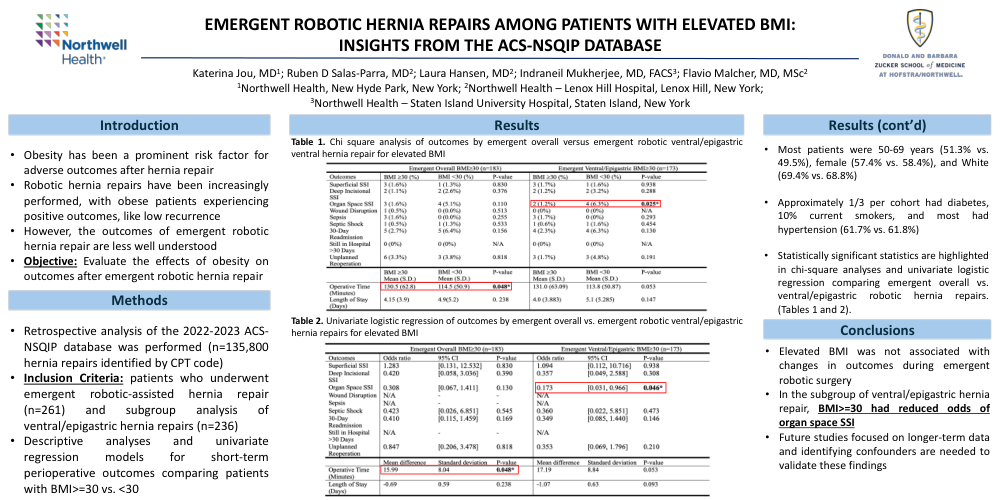
•Statistically significant statistics are highlighted in chi-square analyses and univariate logistic regression comparing emergent overall vs. ventral/epigastric robotic hernia repairs. (Tables 1 and 2).
•Elevated BMI was not associated with changes in outcomes during emergent robotic surgery
•In the subgroup of ventral/epigastric hernia repair, BMI>=30 had reduced odds of organ space SSI
•Future studies focused on longer-term data and identifying confounders are needed to validate these findings