875 posters, 25 topics, 3,440 authors, 1,061 institutions
ePostersLive by SciGen Technologies S.A. All rights reserved.
SAGES 2026 Annual Meeting Emerging Technology Session
March 25-28, 2026 | Tampa, FL, USA

P591
COMPREHENSIVE REPORT ON THE FIRST 20 ESOPHAGEAL ATRESIA PATIENTS TREATED WITH MAGNETIC COMPRESSION ANASTOMOSIS USING THE CONNECT EA(TM) SYSTEM
Part of Topic
Foregut
COMPREHENSIVE REPORT ON THE FIRST 20 ESOPHAGEAL ATRESIA PATIENTS TREATED WITH MAGNETIC COMPRESSION ANASTOMOSIS USING THE CONNECT EATM SYSTEM
Oliver Muensterer, Anne-Sophie Holler, Dan Laser, Michael Harrison
Objective
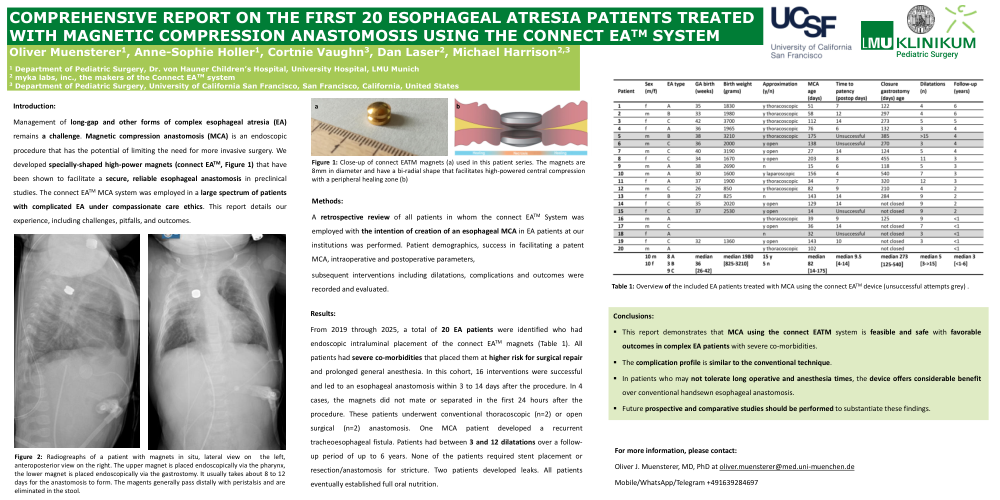
Management of long-gap and other forms of complex esophageal atresia (EA) remains a challenge. Magnetic compression anastomosis (MCA) is an endoscopic procedure that has the potential of limiting the need for more invasive surgery. We developed specially-shaped high-power magnets (connect EATM) that have been shown to facilitate a secure, reliable esophageal anastomosis in preclinical studies. The connect EATM MCA system was employed in a large spectrum of patients with complicated EA under compassionate care ethics. This report details our experience, including challenges, pitfalls, and outcomes.
Methods
A retrospective review of all patients in whom the connect EATM System was employed with the intention of creation of an esophageal MCA in EA patients at our institutions was performed. Patient demographics, success in facilitating a patent MCA, intraoperative and postoperative parameters, subsequent interventions including dilatations, complications and outcomes were recorded and evaluated.
Results
From 2019 through 2025, a total of 20 EA patients were identified who had endoscopic intraluminal placement of the connect EATM magnets (Table). All patients had severe co-morbidities that placed them at higher risk for surgical repair and prolonged general anesthesia. In this cohort, 16 interventions were successful and led to an esophageal anastomosis within 3 to 14 days after the procedure. In 4 cases, the magnets did not mate or separated in the first 24 hours after the procedure. These patients underwent conventional thoracoscopic (n=2) or open surgical (n=2) anastomosis. One MCA patient developed a recurrent tracheoesophageal fistula. Patients had between 3 and 12 dilatations over a follow-up period of up to 6 years. None of the patients required stent placement or resection/anastomosis for stricture. Two patients developed leaks. All patients eventually established full oral nutrition.
Conclusions
This report demonstrates that MCA using the connect EATM system is feasible and safe with favorable outcomes in complex EA patients with severe co-morbidities. The complication profile is similar to the conventional technique. In patients who may not tolerate long operative and anesthesia times, the device offers considerable benefit over conventional handsewn esophageal anastomosis. Future prospective and comparative studies should be performed to substantiate these findings.