875 posters, 25 topics, 3,440 authors, 1,061 institutions
ePostersLive by SciGen Technologies S.A. All rights reserved.
SAGES 2026 Annual Meeting Emerging Technology Session
March 25-28, 2026 | Tampa, FL, USA

P558
Endoluminal Vacuum Therapy for the Management of Esophageal Leaks and Perforations
Part of Topic
Flexible Endoscopy
ENDOLUMINAL VACUUM THERAPY FOR THE MANAGEMENT OF ESOPHAGEAL LEAKS AND PERFORATIONS
Saamia Shaikh, DO JD1, Kristen R. Kent, MD MPhil1, McKell Quattrone, MD1, Eric D. Moyer, MD1, Skylar Korek, MD1, Vamsi V. Alli, MD2, Elizabeth M. Sodomin, MD1, Eric M. Pauli, MD1, Joshua S. Winder, MD1
1.Division of Minimally Invasive and Bariatric Surgery, Department of Surgery, Penn State Health Milton S. Hershey Medical Center, Hershey, PA
2. Department of Surgery, Endeavor Health, Evanston, IL
BACKGROUND
Esophageal leaks and perforations can be life-threatening and were traditionally managed surgically with either primary repair, esophageal diversion, or complex delayed conduit reconstruction and are associated with high morbidity and mortality.
Endoluminal vacuum therapy (eVAC) is a minimally invasive endoscopic approach that has revolutionized the management of leaks throughout the gastrointestinal tract.
METHODS
Single institution retrospective review of patients with esophageal injuries undergoing eVAC therapy by a surgical endoscopist
Clinical success defined as endoscopic findings revealing a closure of the esophageal defect or a healing abscess cavity with granulation tissue.
RESULTS
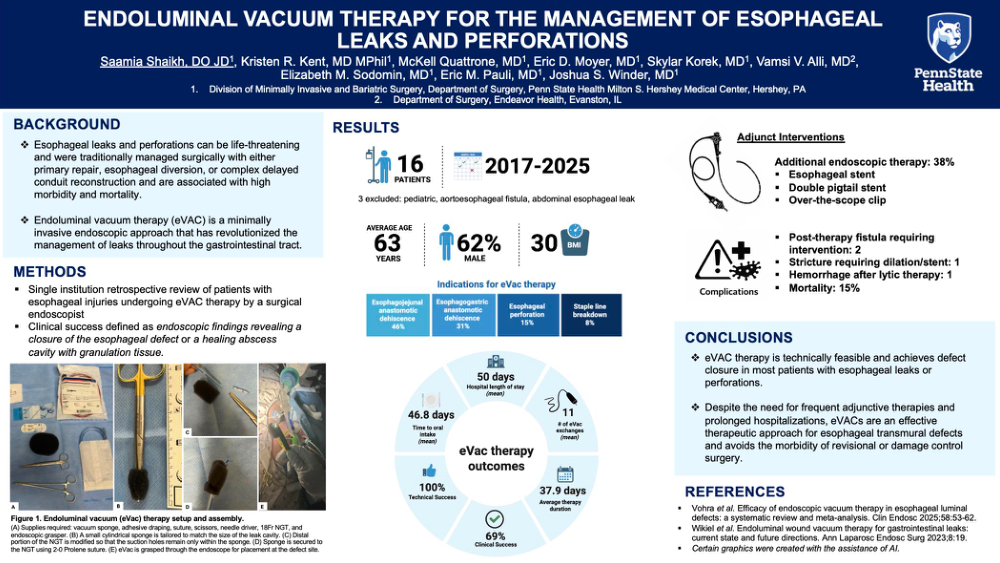
16 patients identified (2017–2025)
3 excluded: pediatric (n=1), aortoesophageal fistula (n=1), abdominal esophageal leak (n=1)
Final cohort: 13 patients
Indications for eVAC:
Esophagojejunal anastomotic dehiscence – 46% (n=6)
Esophagogastric anastomotic dehiscence – 31% (n=4)
Esophageal perforation – 15% (n=2)
Staple-line breakdown – 8% (n=1)
Patient Characteristics:
Median age: 63 years
Male: 62%
White: 86%
Mean BMI: 30.5 kg/m²
eVAC Therapy Outcomes:
Mean therapy duration: 37.9 days (4–137)
Mean exchanges: 11 (2–41)
Mean hospital LOS: 50 days
Mean time to oral intake: 46.8 days
Technical success: 100%
Clinical success: 69%
Adjunct Interventions
Additional endoscopic therapy: 38
Esophageal stent
Double pigtail stent
Over-the-scope clip
Complications:
Post-therapy fistula requiring intervention: 2 patients
Stricture requiring dilation/stent: 1
Hemorrhage after lytic therapy: 1
Mortality: 15%
CONCLUSIONS
eVAC therapy is technically feasible and achieves defect closure in most patients with esophageal leaks or perforations.
Despite the need for frequent adjunctive therapies and prolonged hospitalizations, eVACs are an effective therapeutic approach for esophageal transmural defects and avoids the morbidity of revisional or damage control surgery.