875 posters, 25 topics, 3,440 authors, 1,061 institutions
ePostersLive by SciGen Technologies S.A. All rights reserved.
SAGES 2026 Annual Meeting Emerging Technology Session
March 25-28, 2026 | Tampa, FL, USA

P513
Preliminary Satisfaction Evaluation of a Gamification-Based Tabletop Laparoscopic Skill Trainer
Poster Presenter
Authors
James C Rosser, Owen Burns, Muavé Sanders, Dylan Wong, Krishay Sridalla, Sri Sai Akkineni, Ramy Freeman, Lara Hams
Affiliations
Jacobs School of Medicine and Biomedical Sciences, Medical College of Georgia, Washington and Lee University, Baylor College of Medicine, Northwestern University Feinberg School of Medicine, University of Maryland, College Park, Friends School of Baltimore
Part of Topic
Education / Simulation
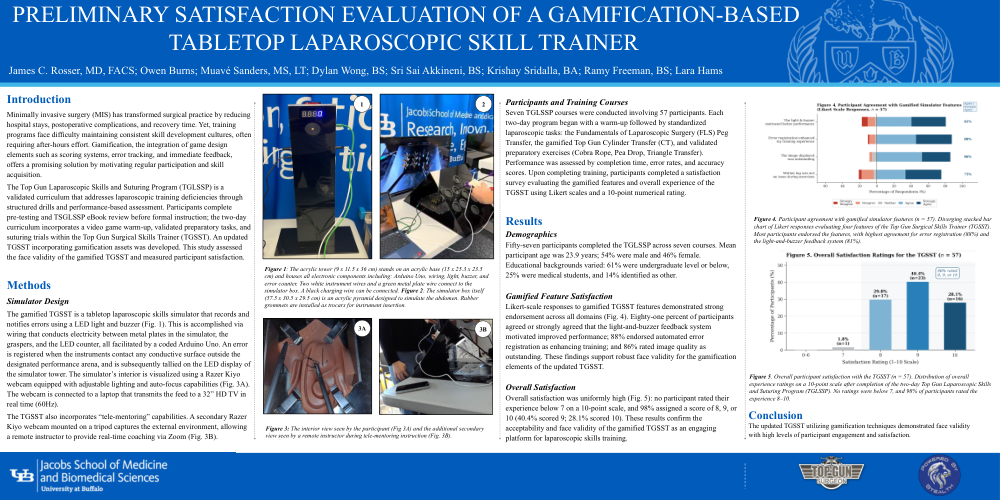
PRELIMINARY SATISFACTION EVALUATION OF A GAMIFICATION-BASED TABLETOP LAPAROSCOPIC SKILL TRAINER
James C. Rosser, MD, FACS; Owen Burns; Muavé Sanders, MS, LT; Dylan Wong, BS; Sri Sai Akkineni, BS; Krishay Sridalla, BA; Ramy Freeman, BS; Lara Hams
Introduction
Minimally invasive surgery (MIS) has transformed surgical practice by reducing hospital stays, postoperative complications, and recovery time. Yet, training programs face difficulty maintaining consistent skill development cultures, often requiring after-hours effort. Gamification, the integration of game design elements such as scoring systems, error tracking, and immediate feedback, offers a promising solution by motivating regular participation and skill acquisition.
The Top Gun Laparoscopic Skills and Suturing Program (TGLSSP) is a validated curriculum that addresses laparoscopic training deficiencies through structured drills and performance-based assessment. Participants complete pre-testing and TSGLSSP eBook review before formal instruction; the two-day curriculum incorporates a video game warm-up, validated preparatory tasks, and suturing trials within the Top Gun Surgical Skills Trainer (TGSST). An updated TGSST incorporating gamification assets was developed.This study assessed the face validity of the gamified TGSST and measured participant satisfaction.
Methods
Simulator Design
The gamified TGSST is a tabletop laparoscopic skills simulator that records and notifies errors using a LED light and buzzer (Fig. 1). This is accomplished via wiring that conducts electricity between metal plates in the simulator, the graspers, and the LED counter, all facilitated by a coded Arduino Uno. An error is registered when the instruments contact any conductive surface outside the designated performance arena, and is subsequently tallied on the LED display of the simulator tower. The simulator’s interior is visualized using a Razer Kiyo webcam equipped with adjustable lighting and auto-focus capabilities (Fig. 3A). The webcam is connected to a laptop that transmits the feed to a 32” HD TV in real time (60Hz).
The TGSST also incorporates “tele-mentoring” capabilities. A secondary Razer Kiyo webcam mounted on a tripod captures the external environment, allowing a remote instructor to provide real-time coaching via Zoom (Fig. 3B).
Figure 1: The acrylic tower (9 x 11.5 x 36 cm) stands on an acrylic base (15 x 25.3 x 23.5 cm) and houses all electronic components including: Arduino Uno, wiring, light, buzzer, and error counter. Two white instrument wires and a green metal plate wire connect to the simulator box. A black charging wire can be connected. Figure 2: The simulator box itself (57.5 x 30.5 x 29.5 cm) is an acrylic pyramid designed to simulate the abdomen. Rubber grommets are installed as trocars for instrument insertion.
Figure 3: The interior view seen by the participant (Fig 3A) and the additional secondary view seen by a remote instructor during tele-mentoring instruction (Fig. 3B).
Participants and Training Courses
Seven TGLSSP courses were conducted involving 57 participants. Each two-day program began with a warm-up followed by standardized laparoscopic tasks: the Fundamentals of Laparoscopic Surgery (FLS) Peg Transfer, the gamified Top Gun Cylinder Transfer (CT), and validated preparatory exercises (Cobra Rope, Pea Drop, Triangle Transfer). Performance was assessed by completion time, error rates, and accuracy scores.Upon completing training, participants completed a satisfaction survey evaluating the gamified features and overall experience of the TGSST using Likert scales and a 10-point numerical rating.
Results
Demographics
Fifty-seven participants completed the TGLSSP across seven courses. Mean participant age was 23.9 years; 54% were male and 46% female. Educational backgrounds varied: 61% were undergraduate level or below, 25% were medical students, and 14% identified as other.
Gamified Feature Satisfaction
Likert-scale responses to gamified TGSST features demonstrated strong endorsement across all domains (Fig. 4). Eighty-one percent of participants agreed or strongly agreed that the light-and-buzzer feedback system motivated improved performance; 88% endorsed automated error registration as enhancing training; and 86% rated image quality as outstanding. These findings support robust face validity for the gamification elements of the updated TGSST.
Overall Satisfaction
Overall satisfaction was uniformly high (Fig. 5): no participant rated their experience below 7 on a 10-point scale, and 98% assigned a score of 8, 9, or 10 (40.4% scored 9; 28.1% scored 10). These results confirm the acceptability and face validity of the gamified TGSST as an engaging platform for laparoscopic skills training.
Figure 4. Participant agreement with gamified simulator features (n = 57). Diverging stacked bar chart of Likert responses evaluating four features of the Top Gun Surgical Skills Trainer (TGSST). Most participants endorsed the features, with highest agreement for error registration (88%) and the light-and-buzzer feedback system (81%).
Figure 5. Overall participant satisfaction with the TGSST (n = 57). Distribution of overall experience ratings on a 10-point scale after completion of the two-day Top Gun Laparoscopic Skills and Suturing Program (TGLSSP). No ratings were below 7, and 98% of participants rated the experience 8–10.
Conclusion
The updated TGSST utilizing gamification techniques demonstrated face validity with high levels of participant engagement and satisfaction.