875 posters, 25 topics, 3,440 authors, 1,061 institutions
ePostersLive by SciGen Technologies S.A. All rights reserved.
SAGES 2026 Annual Meeting Emerging Technology Session
March 25-28, 2026 | Tampa, FL, USA

P473
Same-Admission Colectomy After Sigmoid Volvulus Detorsion: Current Evidence for Optimal Timing
Poster Presenter
Part of Topic
Colorectal
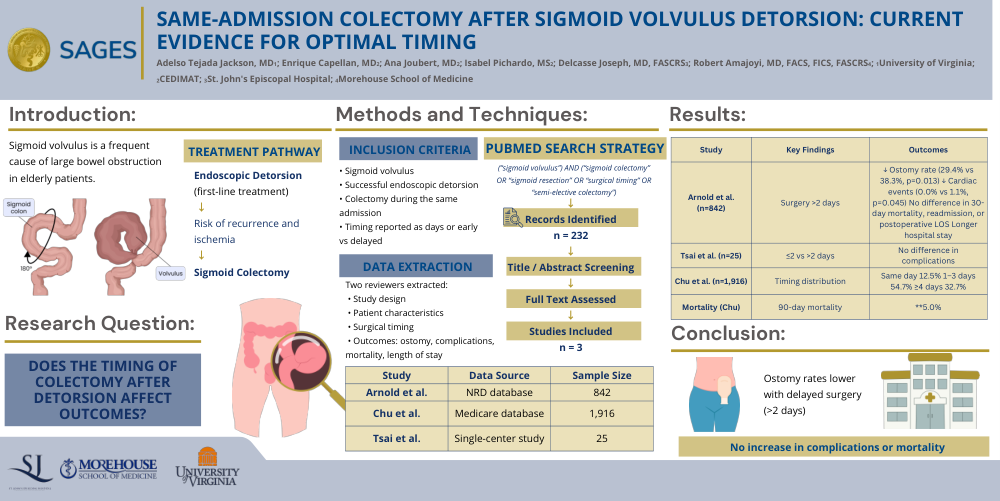
SAME-ADMISSION COLECTOMY AFTER SIGMOID VOLVULUS DETORSION: CURRENT EVIDENCE FOR OPTIMAL TIMING Adelso Tejada Jackson, MD1; Enrique Capellan, MD2; Ana Joubert, MD2; Isabel Pichardo, MS2; Delcasse Joseph, MD, FASCRS3; Robert Amajoyi, MD, FACS, FICS, FASCRS4; 1University of Virginia; 2CEDIMAT; 3St. John's Episcopal Hospital; 4Morehouse School of Medicine
Introduction: Sigmoid volvulus is a frequent cause of large bowel obstruction in elderly patients. The usual first step is endoscopic detorsion, followed by surgery during the same admission to prevent recurrence and ischemia. Whether the timing of surgery after detorsion matters is less clear. Surgeons often wait to allow stabilization and bowel edema resolution, but this must be weighed against risks of delay and longer hospitalization. We reviewed the literature for evidence on whether timing affects mortality, complications, ostomy rates, or length of stay.
Methods and Techniques: We asked whether the timing of surgery after successful endoscopic detorsion changes outcomes in sigmoid volvulus. PubMed was searched from inception using (“sigmoid volvulus”) AND (“sigmoid colectomy” OR “sigmoid resection” OR “surgical timing” OR “semi-elective colectomy”), limited to English-language human studies. The search returned 232 articles, of which three met criteria: Arnold et al. (NRD, n=842), Chu et al. (Medicare, same-admission subgroup n=1,916), and Tsai et al. (single-center, n=25). Studies were included if they reported colectomy during the same admission with timing expressed as days or grouped early vs delayed. Two reviewers extracted study design, patient details, timing, operative approach, ostomy, complications, mortality, and length of stay. Results were summarized narratively, prioritizing adjusted database studies.
Results: Three studies with 2,783 patients reported on timing of colectomy after detorsion during the same admission. Arnold found waiting >2 days lowered ostomy rates (29.4% vs 38.3%, p=0.013) and cardiac events (0.0% vs 1.1%, p=0.045) with no difference in 30-day mortality, readmission, or postoperative stay, though hospital stay was longer. Tsai found no difference in complications between ≤2 days and >2 days. Chu reported 12.5% same-day, 54.7% at 1–3 days, 32.7% ≥4 days, with similar 90-day mortality (5.0%, 4.8%, 4.6%; p=0.92).
Conclusion: Briefly delaying colectomy after detorsion is safe, does not increase mortality or complications, and may reduce ostomy rates. Surgery should still be done during the same admission, and further studies are needed to define the optimal timing.