875 posters, 25 topics, 3,440 authors, 1,061 institutions
ePostersLive by SciGen Technologies S.A. All rights reserved.
SAGES 2026 Annual Meeting Emerging Technology Session
March 25-28, 2026 | Tampa, FL, USA

P466
Trends in treatment recommendations for proximal rectal cancer from four NAPRC hospitals in a single healthcare system
Part of Topic
Colorectal
Introduction: Trends in the treatment of rectal cancer (RC) have changed significantly over recent decades with a shift toward total neoadjuvant therapy (TNT) for organ preservation and the reduction of local recurrence1. In addition, the introduction of Watch and Wait protocols has led to increased rates of organ preservation when patients achieve a complete clinical response to neoadjuvant therapy2. Despite these changes, treatment of proximal rectal cancer remains controversial regarding neoadjuvant therapy versus upfront surgery. To evaluate recent trends in proximal rectal cancer treatment, we analyzed data from four NAPRC approved hospitals within a single healthcare system.
Objectives:
•Determine distribution of rectal cancer locations within our NAPRC population
•Stratify treatment recommendations by rectal cancer location
•Identify post-neoadjuvant effects on tumor and nodal stages
Methods: Data from 4 hospitals’ NAPRC accredited tumor boards (TB) from 2020-2025 was entered into a system-wide REDCap database. Recommendations from the initial TB presentation were analyzed, along with subsequent post-neoadjuvant TB recommendations and surgical outcomes data. Information including diagnostic imaging results, clinical staging, neoadjuvant therapy regimens, and surgical pathology were analyzed.
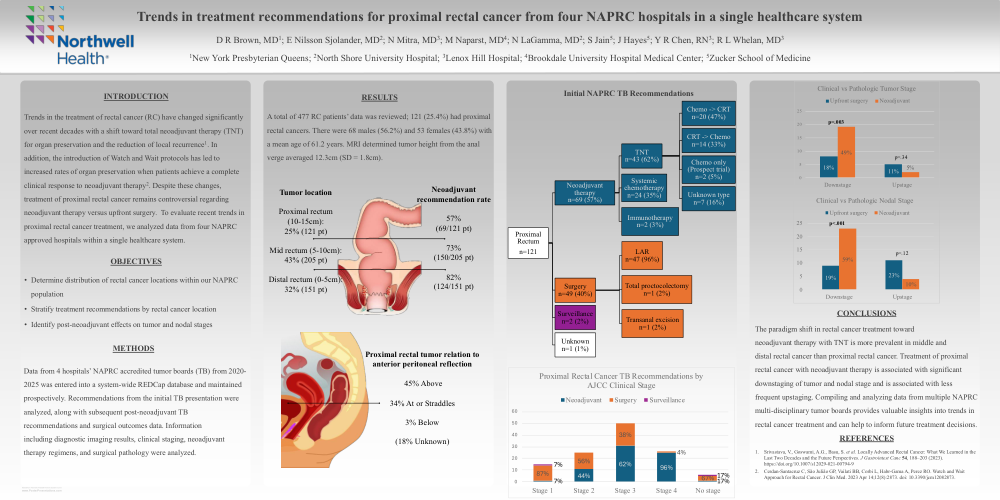
Results: A total of 477 RC patients’ data was reviewed; 121 (25.4%) had proximal rectal cancers. There were 68 males (56.2%) and 53 females (43.8%) with a mean age of 61.2 years. MRI determined tumor height from the anal verge averaged 12.3cm (SD=1.8cm). Per MRI, 44.6% were above the anterior peritoneal reflection (APR), 33.9% straddled the APR, 3.3% were below, and 18.2% unknown. Neoadjuvant treatment was recommended for 68/121 patients (56.2%), surgery for 49 patients (40.5%), and observation for 2 (1.6%). Neoadjuvant was less likely to be recommended for proximal-RC (56.2%) than mid-RC (73.2%), or distal-RC (82.1%). TNT was the predominant neoadjuvant recommendation (43 pts, 62.3%) followed by systemic chemotherapy (SC, 24 pts, 34.8%) and immunotherapy (2 pts, 2.9%). TNT sequence was SC followed by radiation (RT) in 46.5% (20 pts), RT followed by SC in 32.6% (14 pts), SC alone (Prospect trial) (2 pts, 4.7%); and unknown in 16.3%. In patients undergoing neoadjuvant treatment, significant pathologic downstaging of T stage was noted in 48.7% and, as regards N stage, 59.0% were downstaged. Upstaging was noted in 26.7 % of surgery alone patients but in no neoadjuvant therapy patients.
Conclusions: The paradigm shift in rectal cancer treatment toward neoadjuvant therapy with TNT is more prevalent in middle and distal rectal cancer than proximal rectal cancer. Treatment of proximal rectal cancer with neoadjuvant therapy is associated with significant downstaging of tumor and nodal stage and is associated with less frequent upstaging. Compiling and analyzing data from multiple NAPRC multi-disciplinary tumor boards provides valuable insights into trends in rectal cancer treatment and can help to inform future treatment decisions.