875 posters, 25 topics, 3,440 authors, 1,061 institutions
ePostersLive by SciGen Technologies S.A. All rights reserved.
SAGES 2026 Annual Meeting Emerging Technology Session
March 25-28, 2026 | Tampa, FL, USA

P464
Beyond the Usual Complications: A Rare Case of Ischemic Colitis Following Loop Ileostomy Reversal
Poster Presenter
Authors
Affiliations
Part of Topic
Colorectal
Beyond The Usual Complications: A Rare Case of Ischemic Colitis Following Loop Ileostomy Reversal
Aja Harding, DO; Angelo Federico, DO; Chadi Faraj, DO
Department of Surgery, Corewell Health, Dearborn, MI
Given the extreme rarity of ischemic colitis following loop ileostomy reversal, available literature regarding the underlying pathology is non-existent. Following retrospective review of the case, we suspect the possibility that the patient had an unidentified coloanal anastomotic stricture from his previous LAR. For this specific case, flexible endoscopy was not part of the preoperative planning and instead, a WSCE was performed. It is important to note that endoscopy has both the greatest sensitivity and specificity in identifying anastomotic complications when compared to retrograde contrast studies and digital rectal exam.2 Also, the utility of WSCE for preoperative planning and detecting clinically relevant anastomotic strictures has been debated given mixed data, such as the inability to identify strictures in up to 8.3-11% of patients in certain cohorts.3Given this, the use of routine endoscopy as part of preoperative planning in loop ileostomy reversal should be considered.
Potential postoperative complications following loop ileostomy reversal include small bowel obstruction, anastomotic leak, postoperative ileus, wound infections, and more.1 While ischemic colitis is a well-documented cause of gastrointestinal morbidity, the available literature supporting ischemic colitis as a potential complication following ileostomy reversal is extremely limited. Despite extensive research on the restoration of bowel continuity and associated complications, there is a absence if literature on this topic suggesting ischemic colitis following loop ileostomy reversal is extremely rare.
,
This case describes a 65-year-old male with a history of perforated sigmoid diverticulitis requiring low anterior resection (LAR) and loop ileostomy formation. He eventually underwent reversal of the ileostomy and subsequently developed ischemia of the right colon.
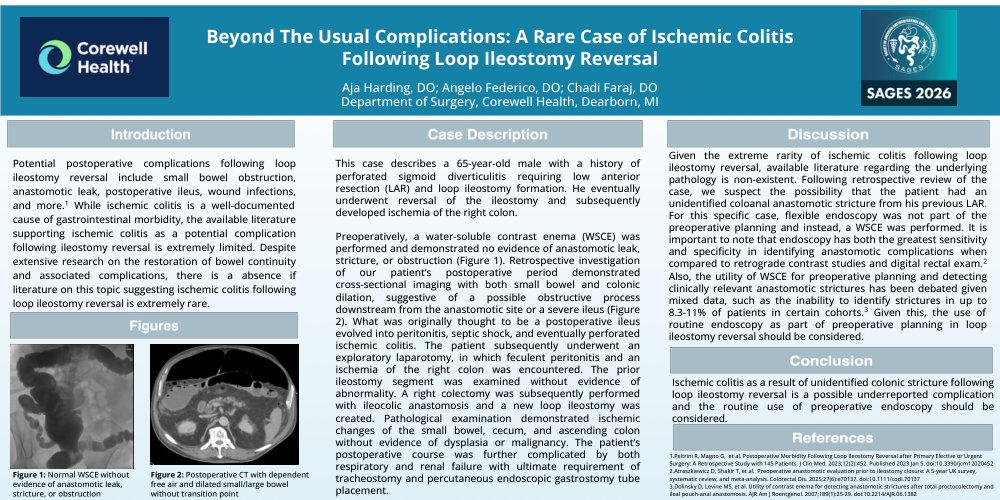
Preoperatively, a water-soluble contrast enema (WSCE) was performed and demonstrated no evidence of anastomotic leak, stricture, or obstruction (Figure 1). Retrospective investigation of our patient’s postoperative period demonstrated cross-sectional imaging with both small bowel and colonic dilation, suggestive of a possible obstructive process downstream from the anastomotic site or a severe ileus (Figure 2). What was originally thought to be a postoperative ileus evolved into peritonitis, septic shock, and eventually perforated ischemic colitis. The patient subsequently underwent an exploratory laparotomy, in which feculent peritonitis and an ischemia of the right colon was encountered. The prior ileostomy segment was examined without evidence of abnormality. A right colectomy was subsequently performed with ileocolic anastomosis and a new loop ileostomy was created. Pathological examination demonstrated ischemic changes of the small bowel, cecum, and ascending colon without evidence of dysplasia or malignancy. The patient’s postoperative course was further complicated by both respiratory and renal failure with ultimate requirement of tracheostomy and percutaneous endoscopic gastrostomy tube placement.
Ischemic colitis as a result of unidentified colonic stricture following loop ileostomy reversal is a possible underreported complication and the routine use of preoperative endoscopy should be considered.
1.Peltrini R, Magno G, et al. Postoperative Morbidity Following Loop Ileostomy Reversal after Primary Elective or Urgent Surgery: A Retrospective Study with 145 Patients. J Clin Med. 2023;12(2):452. Published 2023 Jan 5. doi:10.3390/jcm12020452
2.Atraszkiewicz D, Shakir T, et al. Preoperative anastomotic evaluation prior to ileostomy closure: A 5-year UK survey, systematic review, and meta-analysis. Colorectal Dis. 2025;27(6):e70137. doi:10.1111/codi.70137
3.Dolinsky D, Levine MS, et al. Utility of contrast enema for detecting anastomotic strictures after total proctocolectomy and ileal pouch-anal anastomosis. AJR Am J Roentgenol. 2007;189(1):25-29. doi:10.2214/AJR.06.1382
Figure 1: Normal WSCE without evidence of anastomotic leak, stricture, or obstruction
Figure 2: Postoperative CT with dependent free air and dilated small/large bowel without transition point