875 posters, 25 topics, 3,440 authors, 1,061 institutions
ePostersLive by SciGen Technologies S.A. All rights reserved.
SAGES 2026 Annual Meeting Emerging Technology Session
March 25-28, 2026 | Tampa, FL, USA

P459
Fuzheng YiLiu Decoction Promote Colorectal Cancer Apoptosis and Reduce Its Proliferation via IGF2/IGF1R/PI3K/AKT Pathway based on Network Pharmacology, Serum Metabolomics, PCR Array, Molecular Docking and Dynamics, and Molecular Experiments
Poster Presenter
Authors
Yu Wei, Zhangyu Jiang, Chang Song, Yuan Qiao, Xianz Wang, Wenhui Ma, Tao Wang, Yuting Xu, Fei Wang, Wenjun Xiong, Wei Wang
Affiliations
The First Affiliated Hospital of Guangzhou University of Chinese Medicine, Zhongshan Hospital of Traditional Chinese Medicine, Zhongshan 528400, China, Traditional Chinese Medicine Hospital of Changshan, Zhejiang 310000, China
Part of Topic
Colorectal
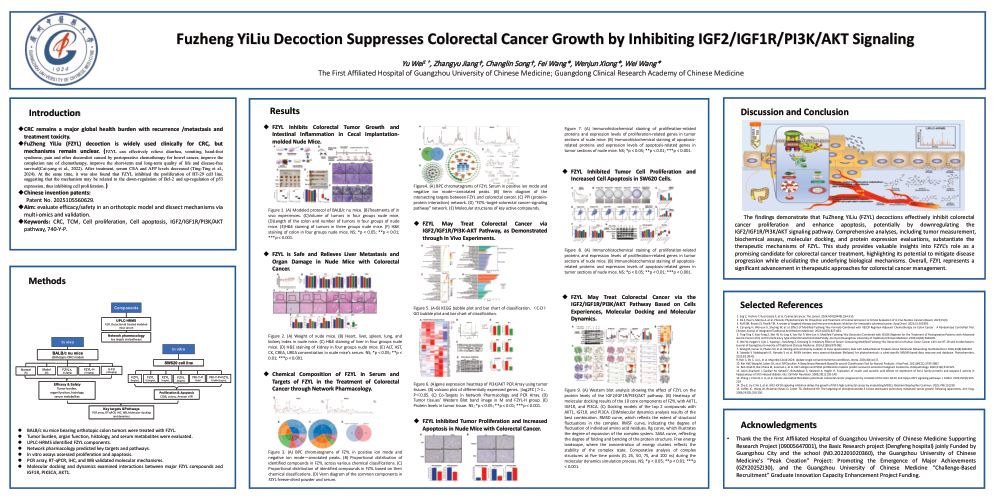
Background: Colorectal cancer (CRC) is one of the most common cancers, with high incidence and mortality rates. This Traditional Chinese Medicine (TCM) FuZheng YiLiu (FZYL) decoction is widely used in the treatment of CRCat the First Affiliated Hospital of Guangzhou University of Chinese Medicine. However, its mechanism of action remains unclear.
Aim: To investigate the therapeutic effects and mechanisms of FZYL against CRC.
Methods: BALB/c nu mice bearing orthotopic colon tumors were treated with FZYL. Tumor burden, organ function, histology, and serum metabolites were evaluated. UPLC–HRMS identified FZYL components, and network pharmacology predicted key targets and pathways. In vitro assays assessed proliferation and apoptosis. PCR array, RT-qPCR, IHC, and WB validated molecular mechanisms. Molecular docking and dynamics examined interactions between major FZYL compounds and IGF1R, PIK3CA, and AKT1.
Results: FZYL reduced tumor growth and angiogenesis, alleviated colitis, and showed no liver or kidney toxicity. Metabolomics and network pharmacology highlighted PI3K/AKT signaling, with IGF2/IGF1R and RAS identified as key nodes. FZYL downregulated IGF2, IGF1R, p-PI3K, p-AKT, Ki67, and PCNA, while upregulating Caspase3, BCL2 and Bax. In vitro, FZYL inhibited SW620 cell proliferation and induced apoptosis via the IGF2/IGF1R/PI3K/AKT pathway. Docking and dynamics confirmed strong binding between FZYL compounds and IGF1R/PIK3CA/AKT1.
Conclusion: FZYL may inhibit CRC proliferation and promote apoptosis by suppressing the IGF2/IGF1R/PI3K/AKT pathway, potentially slowing down the progression of colorectal cancer.