875 posters, 25 topics, 3,440 authors, 1,061 institutions
ePostersLive by SciGen Technologies S.A. All rights reserved.
SAGES 2026 Annual Meeting Emerging Technology Session
March 25-28, 2026 | Tampa, FL, USA

P440
Early Feeding Versus Standard of Care in Colorectal Surgery: A Systematic Review and Meta-Analysis of Randomized Clinical Trials
Poster Presenter
Authors
Dante Souza, Paula Pauperio, Ivonne Zuniga, Maria Clara Faveri, Túlio Pimentel, Thomaz Passos Sampaio, Matheus Vanzin Fernandes, Valery Vilchez
Affiliations
TriHealth Good Samaritan Hospital, Cincinnati, OH, USA, Escola Bahiana de Medicina e Saude Publica (EBMSP), Brazil, Universidad Nacional Autónoma de Nicaragua, Faculdade de Medicina de Marília (FAMEMA), Brazil, Universidade Federal de Pernambuco (UFPE), Brazil, Universidade Federal de Ciencias da Saude de Porto Alegre (UFCSPA), Brazil,
Part of Topic
Colorectal
EARLY FEEDING VERSUS STANDARD OF CARE IN COLORECTAL SURGERY: A SYSTEMATIC REVIEW AND META-ANALYSIS OF RANDOMIZED CLINICAL TRIALS Dante Souza, MD1; Paula Pauperio2; Ivonne Zuniga, MD3; Maria Clara Faveri4; Túlio Pimentel5; Thomaz Passos Sampaio, MD2; Matheus Vanzin Fernandes, MD6; Valery Vilchez, MD7;
1TriHealth Good Samaritan Hospital, Cincinnati, OH, USA; 2Escola Bahiana de Medicina e Saude Publica (EBMSP), Brazil; 3Universidad Nacional Autónoma de Nicaragua; 4Faculdade de Medicina de Marília (FAMEMA), Brazil; 5Universidade Federal de Pernambuco (UFPE), Brazil; 6Universidade Federal de Ciencias da Saude de Porto Alegre (UFCSPA), Brazil; 7University of California Irvine (UCI), CA, USA
Introduction: Colorectal surgery can range from minimally invasive outpatient procedures to emergent laparotomies, presenting different degrees of postoperative complications and length of hospital stay (LOS). Early feeding (EF) initiation within the first 24 hours postoperatively may provide essential nutritional support to reduce complication rates and LOS.
Methods: PubMed, EMBASE, and Cochrane Central databases were searched for randomized clinical trials comparing EF versus standard of care (SC) in colorectal surgery. The endpoints of interest were postoperative LOS, nausea, vomiting, time to first stool and flatus, postoperative ileus duration, abdominal distention, need for nasogastric tube, reoperation, wound infection, anastomotic leak, 30-day mortality, and complications measured by a Clavien-Dindo ≥3.
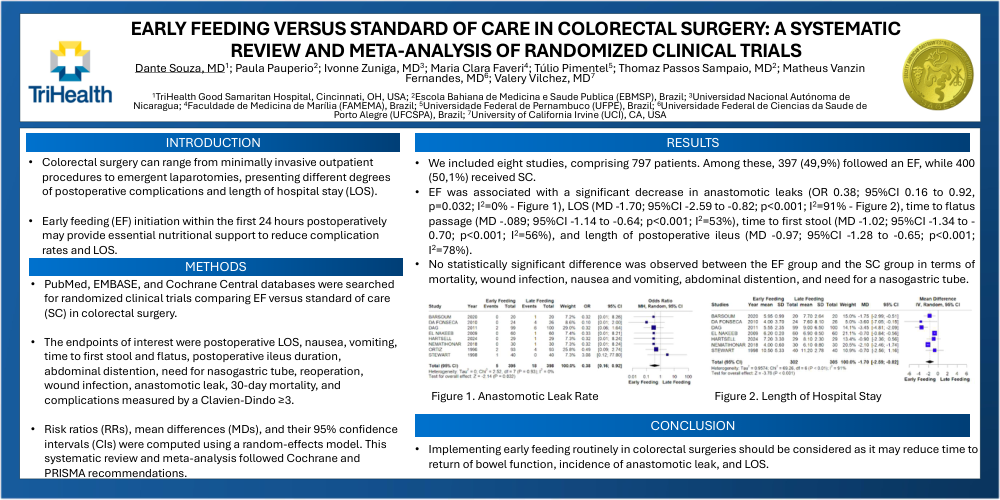
Results: We included eight studies, comprising 797 patients. Among these, 397 (49,9%) followed an EF, while 400 (50,1%) received SC. Overall, EF was associated with a significant decrease in anastomotic leaks (OR 0.38; 95%CI 0.16 to 0.92, p=0.032; I2=0% - Figure 1), LOS (MD -1.70; 95%CI -2.59 to -0.82; p<0.001; I2=91% - Figure 2), time to flatus passage (MD -.089; 95%CI -1.14 to -0.64; p<0.001; I2=53%), time to first stool (MD -1.02; 95%CI -1.34 to -0.70; p<0.001; I2=56%), and length of postoperative ileus (MD -0.97; 95%CI -1.28 to -0.65; p<0.001; I2=78%). No statistically significant difference was observed between the EF group and the SC group in terms of mortality, wound infection, nausea and vomiting, abdominal distention, and need for a nasogastric tube.
Conclusion: Implementing early feeding routinely in colorectal surgeries should be considered as it may reduce time to return of bowel function, incidence of anastomotic leak, and LOS