875 posters, 25 topics, 3,440 authors, 1,061 institutions
ePostersLive by SciGen Technologies S.A. All rights reserved.
SAGES 2026 Annual Meeting Emerging Technology Session
March 25-28, 2026 | Tampa, FL, USA

P042
SURGEON-RADIOLOGIST CONCORDANCE IN IMAGING INTERPRETATION OF COMPLEX VENTRAL HERNIAS: IMPLICATIONS FOR SURGICAL PLANNING
Poster Presenter
Part of Topic
Abdominal Wall Hernias
SURGEON–RADIOLOGIST CONCORDANCE IN IMAGING INTERPRETATION OF COMPLEX VENTRAL HERNIAS: IMPLICATIONS FOR SURGICAL PLANNING
Introduction
Preoperative planning for complex ventral hernia relies heavily on imaging interpretation. However, surgeons and radiologists often use different descriptive frameworks, potentially leading to discrepancies in diagnosis, surgical approach selection, and risk stratification. The extent of this disagreement has not been systematically evaluated. This study aimed to assess the concordance between surgical and radiological interpretations.
Methods and Procedures
We conducted a cross-sectional analytical study at a tertiary referral center including patients with complex ventral hernias operated between 2017 and 2023, all with preoperative CT scans. Variables assessed included hernia size, anatomical location, number of defects, and presence of rectus diastasis. Agreement was analyzed using Cohen’s kappa and the intraclass correlation coefficient (ICC).
Results
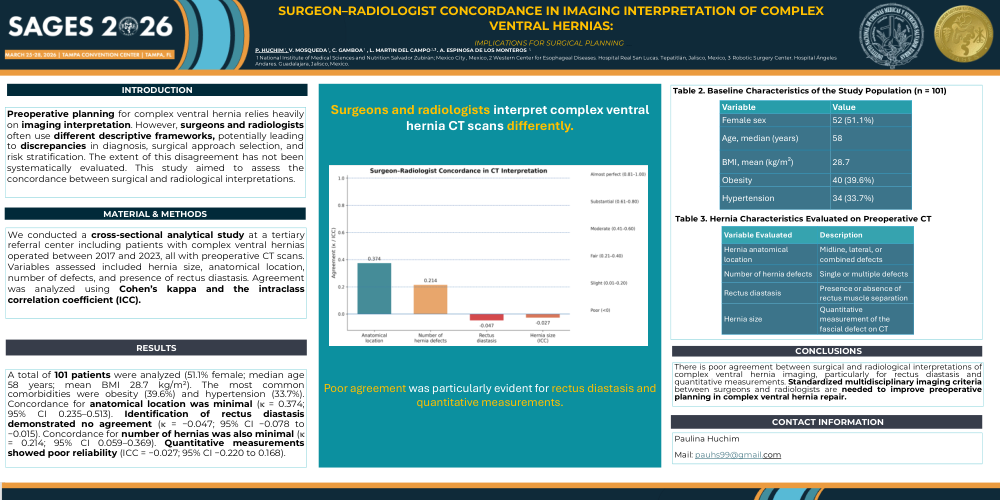
A total of 101 patients were analyzed (51.1% female; median age 58 years; mean BMI 28.7 kg/m²). The most common comorbidities were obesity (39.6%) and hypertension (33.7%). Concordance for anatomical location was minimal (κ = 0.374; 95% CI 0.235–0.513). Identification of rectus diastasis demonstrated no agreement (κ = −0.047; 95% CI −0.078 to −0.015). Concordance for number of hernias was also minimal (κ = 0.214; 95% CI 0.059–0.369). Quantitative measurements showed poor reliability (ICC = −0.027; 95% CI −0.220 to 0.168).
Conclusions
There is poor agreement between surgical and radiological interpretations of complex ventral hernia imaging, particularly for rectus diastasis and quantitative measurements. These findings highlight the urgent need for standardized, multidisciplinary imaging criteria to enhance preoperative assessment and improve surgical decision-making.