875 posters, 25 topics, 3,440 authors, 1,061 institutions
ePostersLive by SciGen Technologies S.A. All rights reserved.
SAGES 2026 Annual Meeting Emerging Technology Session
March 25-28, 2026 | Tampa, FL, USA

P431
Impact of Preoperative Weight Loss on Postoperative Outcomes in Patients with Obesity Undergoing Colorectal Cancer Resection: A Systematic Review and Meta-analysis
Poster Presenter
Authors
Katherine Lam, Laura Vidotto, Mariana Kachan, Lina Chaves, Patricia Sylla
Affiliations
Part of Topic
Colorectal
Background:
In non-obese patients who underwent surgery for colorectal cancer, preoperative weight loss and malnutrition are associated with increased postoperative complications. However, whether preoperative weight loss specifically in patients with obesity (BMI ≥ 30 kg/m²) affects surgical outcomes after colorectal cancer resection remains unclear. The aim of the study is to evaluate whether preoperative weight loss affects postoperative outcomes in obese patients undergoing colorectal cancer resection.
Methods:
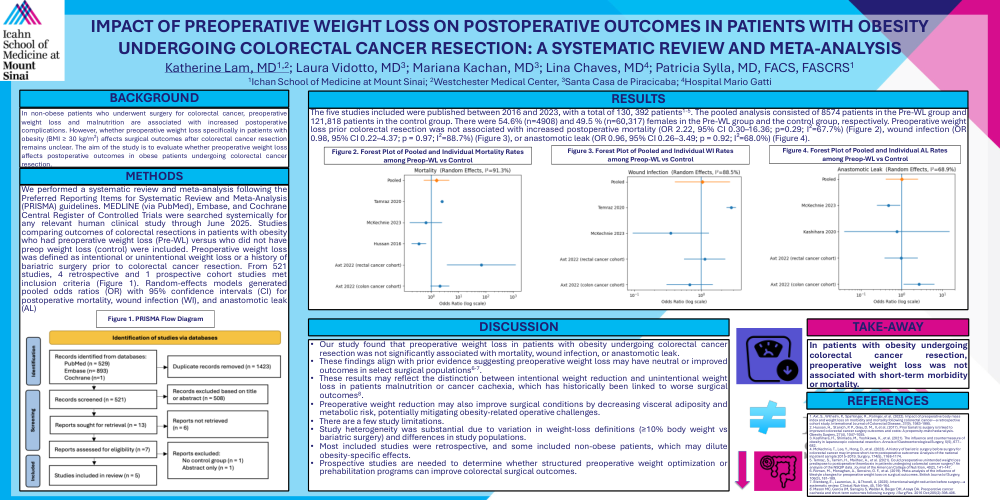
We performed a systematic review and meta-analysis following the Preferred Reporting Items for Systematic Review and Meta-Analysis (PRISMA) guidelines. MEDLINE (via PubMed), Embase, and Cochrane Central Register of Controlled Trials were searched systemically for any relevant human clinical study through June 2025. Studies comparing outcomes of colorectal resections in patients with obesity who had preoperative weight loss (Pre-WL) versus who did not have preop weight loss (control) were included. Preoperative weight loss was defined as intentional or unintentional weight loss or a history of bariatric surgery prior to colorectal cancer resection. From 521 studies, 4 retrospective and 1 prospective cohort studies met inclusion criteria (Figure 1). Random-effects models generated pooled odds ratios (OR) with 95% confidence intervals (CI) for postoperative mortality, wound infection (WI), and anastomotic leak (AL).
Results:
The five studies included were published between 2016 and 2023, with a total of 130, 392 patients1-5. The pooled analysis consisted of 8574 patients in the Pre-WL group and 121,818 patients in the control group. There were 54.6% (n=4908) and 49.5 % (n=60,317) females in the Pre-WL group and the control group, respectively. Preoperative weight loss prior colorectal resection was not associated with increased postoperative mortality (OR 2.22, 95% CI 0.30–16.36; p=0.29; I²=67.7%) (Figure 2), wound infection (OR 0.98, 95% CI 0.22–4.37; p = 0.97; I²=88.7%) (Figure 3), or anastomotic leak (OR 0.96, 95% CI 0.26–3.49; p = 0.92; I²=68.0%) (Figure 4).
Discussion:
Our study found that preoperative weight loss in patients with obesity undergoing colorectal cancer resection was not significantly associated with mortality, wound infection, or anastomotic leak. These findings align with prior evidence suggesting preoperative weight loss may have neutral or improved outcomes in select surgical populations6-7. These results may reflect the distinction between intentional weight reduction and unintentional weight loss in patients malnutrition or cancer cachexia, which has historically been linked to worse surgical outcomes8. Preoperative weight reduction may also improve surgical conditions by decreasing visceral adiposity and metabolic risk, potentially mitigating obesity-related operative challenges. There are a few study limitations. Study heterogeneity was substantial due to variation in weight-loss definitions (≥10% body weight vs bariatric surgery) and differences in study populations. Most included studies were retrospective, and some included non-obese patients, which may dilute obesity-specific effects. Prospective studies are needed to determine whether structured preoperative weight optimization or prehabilitation programs can improve colorectal surgical outcomes.
Conclusion/Take-away:
In patients with obesity undergoing colorectal cancer resection, preoperative weight loss was not associated with short-term morbidity or mortality.