875 posters, 25 topics, 3,440 authors, 1,061 institutions
ePostersLive by SciGen Technologies S.A. All rights reserved.
SAGES 2026 Annual Meeting Emerging Technology Session
March 25-28, 2026 | Tampa, FL, USA

P412
Years in the Making: Late-Presenting Ischemic Colitis Successfully Treated with Conservative Management
Poster Presenter
Authors
Affiliations
Part of Topic
Colorectal
Years in the Making: Late-Presenting Ischemic Colitis Successfully Treated with Conservative Management
Valerie Fiore, DO, Gagandeep Samra, MD, Delcasse Joseph, MD
Department of General Surgery, Episcopal Health Services
Introduction
Ischemic colitis ranges from mild self-limiting mucosal injury to full-thickness necrosis requiring surgical intervention with high mortality.1 Early diagnosis is often challenging due to its non-specific symptoms, including abdominal pain, bloody diarrhea, and leukocytosis.2 Colonic collaterals provide arcading blood flow to bowel segments.3 However, in patients with previous abdominal surgeries, particularly segmental colectomies, the collateral circulation may be compromised increasing the risk of ischemic events. While most cases of ischemic colitis resolve with conservative management, approximately 20% of patients require surgical intervention.4 Treatment ranges from supportive conservative management to surgical resection.
Case Report
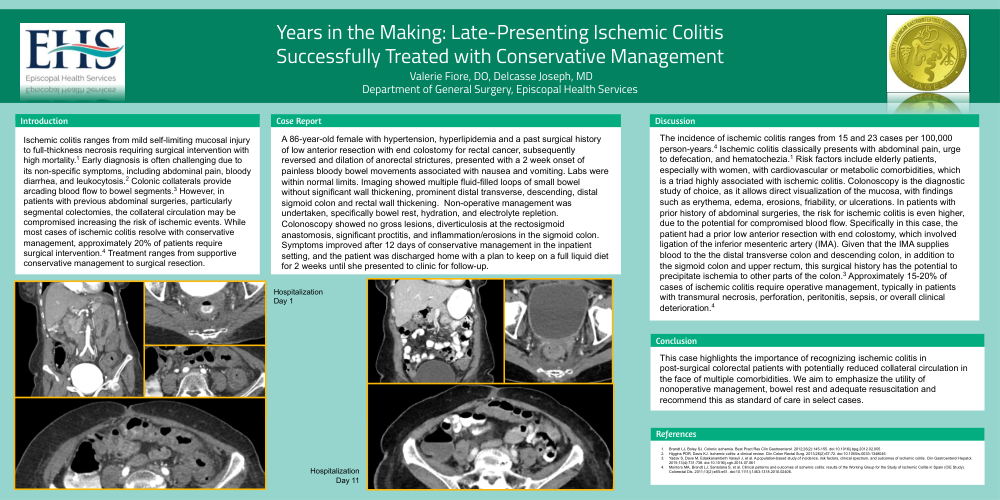
A 86-year-old female with hypertension, hyperlipidemia and a past surgical history of low anterior resection with end colostomy for rectal cancer, subsequently reversed and dilation of anorectal strictures, presented with a 2 week onset of painless bloody bowel movements associated with nausea and vomiting. Labs were within normal limits. Imaging showed multiple fluid-filled loops of small bowel without significant wall thickening, prominent distal transverse, descending, distal sigmoid colon and rectal wall thickening. Non-operative management was undertaken, specifically bowel rest, hydration, and electrolyte repletion. Colonoscopy showed no gross lesions, diverticulosis at the rectosigmoid anastomosis, significant proctitis, and inflammation/erosions in the sigmoid colon. Symptoms improved after 12 days of conservative management in the inpatient setting, and the patient was discharged home with a plan to keep on a full liquid diet for 2 weeks until she presented to clinic for follow-up.
Discussion
The incidence of ischemic colitis ranges from 15 and 23 cases per 100,000 person-years.4 Ischemic colitis classically presents with abdominal pain, urge to defecation, and hematochezia.1 Risk factors include elderly patients, especially with women, with cardiovascular or metabolic comorbidities, which is a triad highly associated with ischemic colitis. Colonoscopy is the diagnostic study of choice, as it allows direct visualization of the mucosa, with findings such as erythema, edema, erosions, friability, or ulcerations. In patients with prior history of abdominal surgeries, the risk for ischemic colitis is even higher, due to the potential for compromised blood flow. Specifically in this case, the patient had a prior low anterior resection with end colostomy, which involved ligation of the inferior mesenteric artery (IMA). Given that the IMA supplies blood to the the distal transverse colon and descending colon, in addition to the sigmoid colon and upper rectum, this surgical history has the potential to precipitate ischemia to other parts of the colon.3 Approximately 15-20% of cases of ischemic colitis require operative management, typically in patients with transmural necrosis, perforation, peritonitis, sepsis, or overall clinical deterioration.4
Conclusion
This case highlights the importance of recognizing ischemic colitis in post-surgical colorectal patients with potentially reduced collateral circulation in the face of multiple comorbidities. We aim to emphasize the utility of nonoperative management, bowel rest and adequate resuscitation and recommend this as standard of care in select cases.
References
-
Brandt LJ, Boley SJ. Colonic ischemia. Best Pract Res Clin Gastroenterol. 2012;26(2):145-155. doi:10.1016/j.bpg.2012.02.005
-
Higgins PDR, Davis KJ. Ischemic colitis: a clinical review. Clin Colon Rectal Surg. 2013;26(2):67-72. doi:10.1055/s-0033-1348045
-
Yadav S, Dave M, Edakkanambeth Varayil J, et al. A population-based study of incidence, risk factors, clinical spectrum, and outcomes of ischemic colitis. Clin Gastroenterol Hepatol. 2015;13(4):731-738. doi:10.1016/j.cgh.2014.07.061
-
Montoro MA, Brandt LJ, Santolaria S, et al. Clinical patterns and outcomes of ischemic colitis: results of the Working Group for the Study of Ischemic Colitis in Spain (CIE Study). Colorectal Dis. 2011;13(2):e55-e61. doi:10.1111/j.1463-1318.2010.02406.