875 posters, 25 topics, 3,440 authors, 1,061 institutions
ePostersLive by SciGen Technologies S.A. All rights reserved.
SAGES 2026 Annual Meeting Emerging Technology Session
March 25-28, 2026 | Tampa, FL, USA

P393
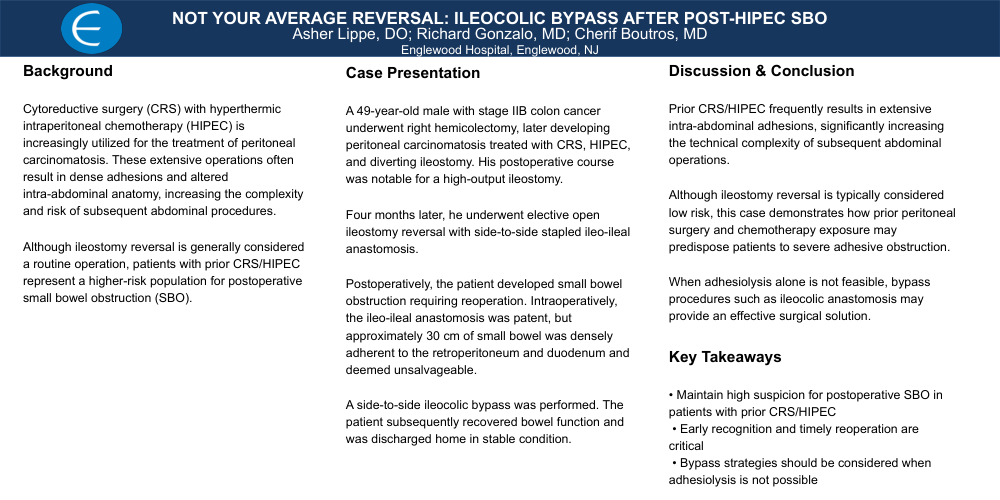
NOT YOUR AVERAGE REVERSAL: ILEOCOLIC BYPASS AFTER POST-HIPEC SBO
Poster Presenter
Authors
Affiliations
Part of Topic
Colorectal
NOT YOUR AVERAGE REVERSAL: ILEOCOLIC BYPASS AFTER POST-HIPEC SBO
Background
Cytoreductive surgery (CRS) with hyperthermic intraperitoneal chemotherapy (HIPEC) is increasingly utilized for the treatment of peritoneal carcinomatosis. These extensive operations often result in dense adhesions and altered intra-abdominal anatomy, increasing the complexity and risk of subsequent abdominal procedures.
Although ileostomy reversal is generally considered a routine operation, patients with prior CRS/HIPEC represent a higher-risk population for postoperative small bowel obstruction (SBO).
Case Presentation
A 49-year-old male with stage IIB colon cancer underwent right hemicolectomy, later developing peritoneal carcinomatosis treated with CRS, HIPEC, and diverting ileostomy. His postoperative course was notable for a high-output ileostomy.
Four months later, he underwent elective open ileostomy reversal with side-to-side stapled ileo-ileal anastomosis.
Postoperatively, the patient developed small bowel obstruction requiring reoperation. Intraoperatively, the ileo-ileal anastomosis was patent, but approximately 30 cm of small bowel was densely adherent to the retroperitoneum and duodenum and deemed unsalvageable.
A side-to-side ileocolic bypass was performed. The patient subsequently recovered bowel function and was discharged home in stable condition.
Discussion & Conclusion
Prior CRS/HIPEC frequently results in extensive intra-abdominal adhesions, significantly increasing the technical complexity of subsequent abdominal operations.
Although ileostomy reversal is typically considered low risk, this case demonstrates how prior peritoneal surgery and chemotherapy exposure may predispose patients to severe adhesive obstruction.
When adhesiolysis alone is not feasible, bypass procedures such as ileocolic anastomosis may provide an effective surgical solution.
Key Takeaways
• Maintain high suspicion for postoperative SBO in patients with prior CRS/HIPEC
• Early recognition and timely reoperation are critical
• Bypass strategies should be considered when adhesiolysis is not possible