875 posters, 25 topics, 3,440 authors, 1,061 institutions
ePostersLive by SciGen Technologies S.A. All rights reserved.
SAGES 2026 Annual Meeting Emerging Technology Session
March 25-28, 2026 | Tampa, FL, USA

P317
Comparative Analysis of Bias Presentation: Examining Bariatric Surgery and Weight Loss Medication Videos on YouTube
Poster Presenter
Part of Topic
Bariatric
Background:
Weight loss surgery (WLS) is the most effective long-term treatment for clinically severe obesity, while weight loss medications (WLM), particularly GLP-1 agonists, have gained rapid popularity.
YouTube is a major source of patient health information;understanding differences in the quality and tone of videos discussing these treatment modalities is essential.
Methods:
Design:Observational cross sectional study
Setting:Publicly accessible YouTube platform
Population:English-language YouTube videos related to weight loss surgery (WLS) and weight loss medications (WLM; GLP-1 agonists)
Comparison:WLS videos vs WLM videos
Primary Outcome:Informational quality assessed using the DISCERN instrument and video tone (positive, neutral, negative)
Secondary Outcomes:Uploader source, content type, view ratio, and engagement metrics
Analysis:Descriptive statistics and nonparametric tests, including Mann-Whitney U and χ² tests (p < 0.05).
Results:
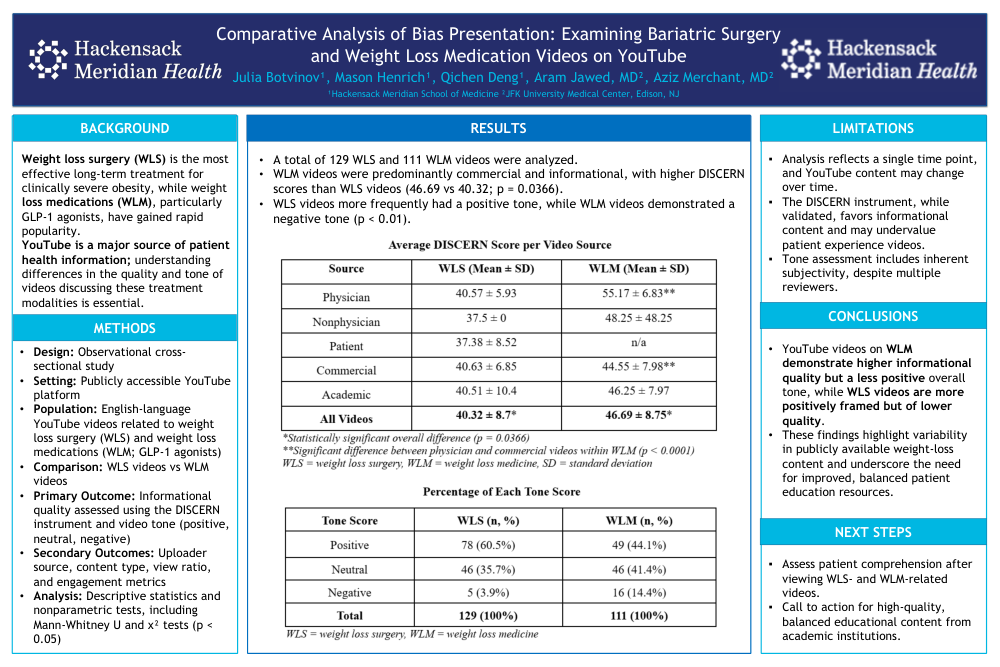
A total of 129 WLS and 111 WLM videos were analyzed.
WLM videos were predominantly commercial and informational, with higher DISCERN scores than WLS videos (46.69 vs 40.32; p = 0.0366).
WLS videos more frequently had a positive tone, while WLM videos demonstrated a negative tone (p < 0.01).
Limitations:
Analysis reflects a single time point, and YouTube content may change over time.
The DISCERN instrument, while validated, favors informational content and may undervalue patient experience videos.
Tone assessment includes inherent subjectivity, despite multiple reviewers.
Conclusions:
YouTube videos on WLM demonstrate higher informational quality but a less positiveoverall tone, while WLS videos are more positively framed but of lower quality.
These findings highlight variability in publicly available weight-loss content and underscore the need for improved, balanced patient education resources.
Next steps:
Assess patient comprehension after viewing WLS-and WLM-related videos.
Call to action for high-quality, balanced educational content from academic institutions.