875 posters, 25 topics, 3,440 authors, 1,061 institutions
ePostersLive by SciGen Technologies S.A. All rights reserved.
SAGES 2026 Annual Meeting Emerging Technology Session
March 25-28, 2026 | Tampa, FL, USA

P292
Management of Retained Stomach after Gastro-Gastric Fistula Perforation: A Multidisciplinary Surgical Approach
Poster Presenter
Part of Topic
Bariatric
Introduction:
•Gastro-gastric fistulas (GGF) in patients with Roux- en-Y gastric bypass (RNYGB) is a rare but challenging surgical problem1
•Clinical presentation
•poor oral intake
•weight regain
•overall emotional and clinical decline.
•Surgical management can involve revision of the gastrojejunostomy anastomosis or remnant gastrectomy2
•We present a complex case of a perforated GGF
Pre-operative course:
•A 51-year-old female with a history of RNYGB underwent a revision for weight regain, due to GGF.
•The patient subsequently presented to our tertiary care institution with persistent reflux and poor oral intake.
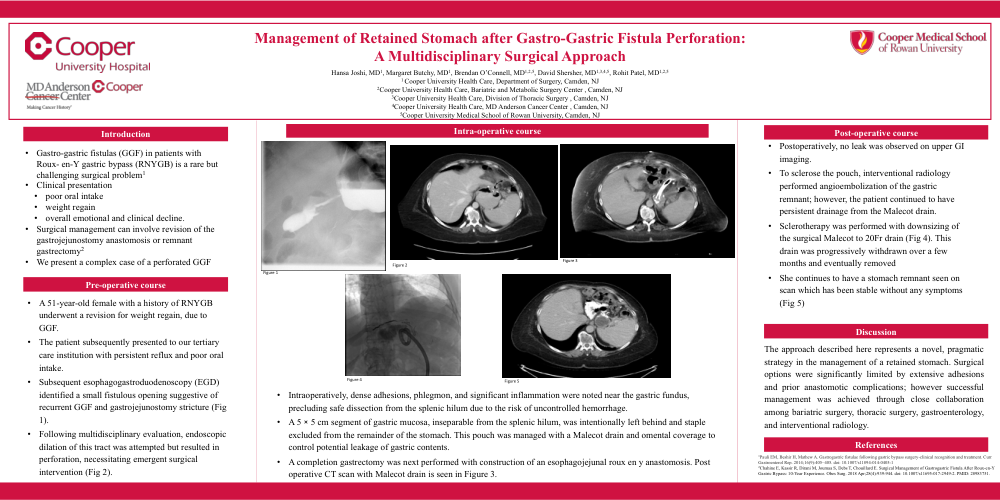
•Subsequent esophagogastroduodenoscopy (EGD) identified a small fistulous opening suggestive of recurrent GGF and gastrojejunostomy stricture (Fig 1).
•Following multidisciplinary evaluation, endoscopic dilation of this tract was attempted but resulted in perforation, necessitating emergent surgical intervention (Fig 2).
Intra-operative course:
•Intraoperatively, dense adhesions, phlegmon, and significant inflammation were noted near the gastric fundus, precluding safe dissection from the splenic hilum due to the risk of uncontrolled hemorrhage.
•A 5 × 5 cm segment of gastric mucosa, inseparable from the splenic hilum, was intentionally left behind and staple excluded from the remainder of the stomach. This pouch was managed with a Malecot drain and omental coverage to control potential leakage of gastric contents.
•A completion gastrectomy was next performed with construction of an esophagojejunal roux en y anastomosis. Post operative CT scan with Malecot drain is seen in Figure 3.
Post-operative course:
•Postoperatively, no leak was observed on upper GI imaging.
•To sclerose the pouch, interventional radiology performed angioembolization of the gastric remnant; however, the patient continued to have persistent drainage from the Malecot drain.
•Sclerotherapy was performed with downsizing of the surgical Malecot to 20Fr drain (Fig 4). This drain was progressively withdrawn over a few months and eventually removed
•She continues to have a stomach remnant seen on scan which has been stable without any symptoms (Fig 5)
Discussion:
The approach described here represents a novel, pragmatic strategy in the management of a retained stomach. Surgical options were significantly limited by extensive adhesions and prior anastomotic complications; however successful management was achieved through close collaboration among bariatric surgery, thoracic surgery, gastroenterology, and interventional radiology.