875 posters, 25 topics, 3,440 authors, 1,061 institutions
ePostersLive by SciGen Technologies S.A. All rights reserved.
SAGES 2026 Annual Meeting Emerging Technology Session
March 25-28, 2026 | Tampa, FL, USA

P286
Comparison of Robotic Versus Laparoscopic Bariatric Surgery with Concurrent Cholecystectomy: An MBSAQIP Database Analysis (2015-2023)
Poster Presenter
Part of Topic
Bariatric
COMPARISON OF ROBOTIC VERSUS LAPAROSCOPIC BARIATRIC SURGERY WITH CONCURRENT CHOLECYSTECTOMY: AN MBSAQIP DATABASE ANALYSIS (2015-2023) Jason Silvers, MD1; Oscar Tuesta, MD1; Adrian Riva, MD1; Hien Nguyen, MD2; Gina Andrales, MD2; Michael Schweitzer, MD2; Christina Li, MD1; Raul Sebastian, MD2; 1Northwest Hospital; 2Johns Hopkins Hospital
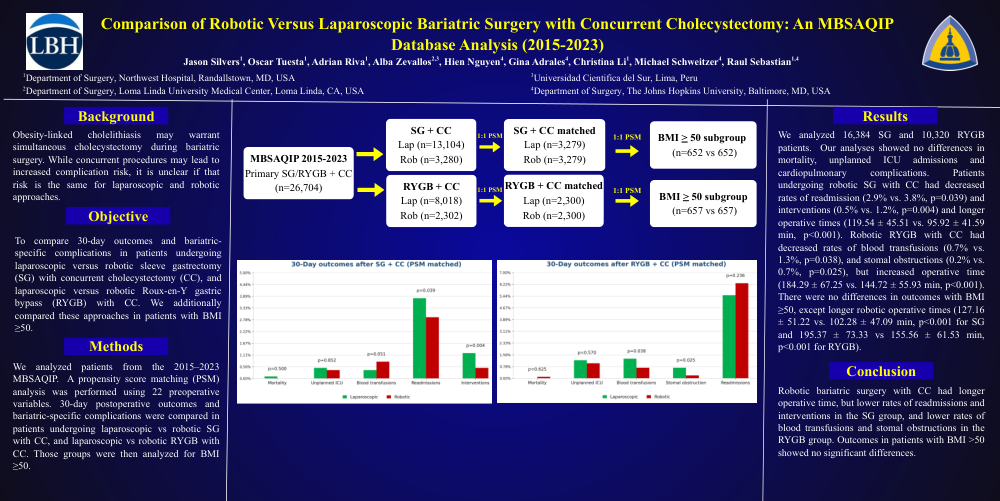
BACKGROUND: Obesity-linked cholelithiasis may warrant simultaneous cholecystectomy during bariatric surgery. While concurrent procedures may lead to increased complication risk, it is unclear if that risk is the same for laparoscopic and robotic approaches. We aimed to compare 30-day outcomes and bariatric-specific complications in patients undergoing laparoscopic versus robotic sleeve gastrectomy (SG) with concurrent cholecystectomy (CC), and laparoscopic versus robotic Roux-en-Y gastric bypass (RYGB) with CC. We additionally compared these approaches in patients with BMI ≥50.
METHODS: We analyzed patients who underwent primary SG or RYGB with CC using the 2015-2023 MBSAQIP database and performed a 1:1 Propensity Score Matching (PSM) analysis using 22 preoperative characteristics, comparing 30-day outcomes and bariatric-specific complications for patients undergoing laparoscopic versus robotic SG with CC (analysis 1) and patients undergoing laparoscopic versus robotic RYGB with CC (analysis 2). We then compared those outcomes for patients with BMI ≥50 undergoing laparoscopic versus robotic SG with CC (analysis 3) and laparoscopic versus robotic RYGB with CC (analysis 4).
RESULTS: We analyzed 16,384 SG and 10,320 RYGB patients. In all four analyses, there were no differences in mortality, unplanned ICU admissions and cardiopulmonary complications. In analysis 1 (n=3,279 matched cases) robotic SG with CC had decreased rates of readmission (2.9% vs. 3.8%, p=0.039) and interventions (0.5% vs. 1.2%, p=0.004) and longer operative times (119.54 ± 45.51 vs. 95.92 ± 41.59 min, p<0.001), but no difference in bariatric-specific outcomes. In analysis 2 (n=2,300) robotic RYGB with CC had decreased rates of blood transfusions (0.7% vs. 1.3%, p=0.038), and stomal obstructions (0.2% vs. 0.7%, p=0.025), but increased operative time (184.29 ± 67.25 vs. 144.72 ± 55.93 min, p<0.001). Analysis 3 (n=652) and analysis 4 (n=657) showed no differences in outcomes among higher BMI patients. Except longer robotic surgery longer operative times (127.16 ± 51.22 vs. 102.28 ± 47.09 min, p<0.001 for SG and 195.37 ± 73.33 vs 155.56 ± 61.53 min, p<0.001 for RYGB).
CONCLUSION: Laparoscopic and robotic bariatric surgeries with CC have similar 30-day outcomes. Despite the expected longer operative time, the robotic approach is associated with lower rates of readmissions and interventions in the SG group, and lower rates of blood transfusions and stomal obstructions in the RYGB group. Outcomes in patients with BMI >50 showed no significant differences; however, it must be considered that the total number of patients in these subgroups was low and may lack sufficient power.