875 posters, 25 topics, 3,440 authors, 1,061 institutions
ePostersLive by SciGen Technologies S.A. All rights reserved.
SAGES 2026 Annual Meeting Emerging Technology Session
March 25-28, 2026 | Tampa, FL, USA

P025
LAPAROSCOPIC MANAGEMENT OF PSEUDOSAC IN LAPAROSCOPIC INGUINAL HERNIA REPAIR
Poster Presenter
Authors
Affiliations
Part of Topic
Abdominal Wall Hernias
Laparoscopic management of pseudo sac in inguinal hernia
Background
Pseudosacs in hernia are a culprit for formation of seroma which is a common nuisance
encountered by surgeons in postoperative period of any hernia surgeries.
Although minimally invasive approaches have reduced the postoperative morbidity in hernia
patients, complications like seroma formation are unavoidable. We are presenting different
methods we have used for management of pseudo-sac and their outcomes.
Methods
Different methods we have used are as follows
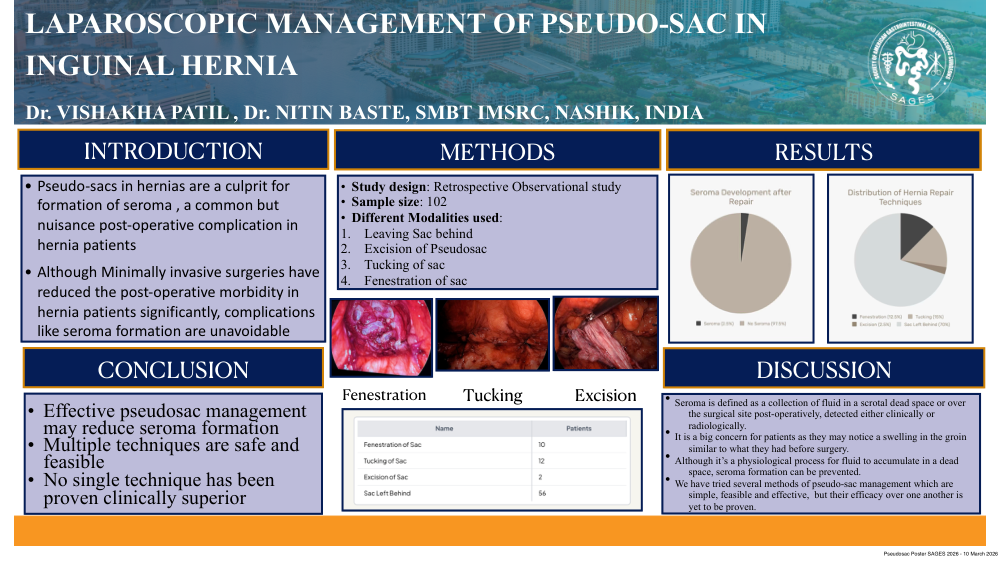
1) Tucking of sac, 2) Fenestration of sac, 3) Excision of sac, 4) leaving the sac behind All
these methods are simple, feasible and effective
Results
Out of 80 patients who underwent inguinal hernia repair at our institution, in around 10
patients fenestration of sac was performed, tucking of sac was done in 12 patients, 2
underwent excision of sac and in the rest sac was left behind.
After a long term follow up only 2 patients developed seroma
Conclusion
All these methods mentioned above are feasible and effective with more or less similar
results . Their efficacy over one another is yet to be proven
References
● Lodha M, Meena SP , Parihar YK, Badkur M, Puranik AK, Kompally PV . A newer method of seroma reduction by fenestration of pseudo-sac during
laparoscopic repair of direct inguinal hernia: A randomised, controlled pilot study. J Minim Access Surg. 2023 Jan-Mar;19(1):69-73. doi:
10.4103/jmas.jmas
391
21. PMID: 35915521; PMCID: PMC10034800.
_
_
● Li J, Gong W, Liu Q. Intraoperative adjunctive techniques to reduce seroma formation in laparoscopic inguinal hernioplasty:A systematic
review. Hernia. 2019;23:723–31.
● Reddy VM, Sutton CD, Bloxham L, Garcea G, Ubhi SS, Robertson GS. Laparoscopic repair of direct inguinal hernia:A new technique that
reduces the development of post-operative seroma. Hernia. 2007;11:393–6.
● Li J, Zhang W. Closure of a direct inguinal hernia defect in laparoscopic repair with barbed suture:A simple method to prevent seroma
formation?Surg Endosc. 2018;32:1082–6.
● Zhu Y , Liu M, Li J, Wang M. Closure of direct inguinal hernia defect in laparoscopic hernioplasty to prevent seroma formation:A prospective
double-blind randomized controlled trial. Surg Laparosc Endosc Percutan Tech. 2019;29:18–21.
● Ismail M, Garg M, Rajagopal M, Garg P . Impact of closed-suction drain in preperitoneal space on the incidence of seroma formation after
laparoscopic total extraperitoneal inguinal hernia repair. Surg Laparosc Endosc Percutan Tech. 2009;19:263–6.
● Fan JK, Liu J, Chen K, Y ang X, Xu X, Choi HK, et al. Preperitoneal closed-system suction drainage after totally extraperitoneal hernioplasty in
the prevention of early seroma formation:A prospective double-blind randomised controlled trial. Hernia. 2018;22:455–65.
● Daes J. Endoscopic repair of large inguinoscrotal hernias:Management of the distal sac to avoid seroma formation. Hernia. 2014;18:1