875 posters, 25 topics, 3,440 authors, 1,061 institutions
ePostersLive by SciGen Technologies S.A. All rights reserved.
SAGES 2026 Annual Meeting Emerging Technology Session
March 25-28, 2026 | Tampa, FL, USA

P250
IMPACT OF SEVERE DIABETES (HBA1C >9%) ON SHORT-TERM OUTCOMES FOLLOWING BARIATRIC SURGERY: AN ANALYSIS OF 379,034 MBSAQIP PATIENTS
Poster Presenter
Authors
Juan Aulestia, Melissa Wills, Anibal La Riva, Jerry Dang, Andrew Strong, Yung Lee, Juan Barajas Gamboa, Ricard Corcelles, Matthew Kroh, Salvador Navarrete, Valentin Mocanu
Affiliations
Cleveland Clinic, Digestive Disease & Surgery Institute, Department of General Surgery, Cleveland Clinic Abu Dhabi, Digestive Disease Institute
Part of Topic
Bariatric
IMPACT OF SEVERE DIABETES (HBA1C >9%) ON SHORT-TERM OUTCOMES FOLLOWING BARIATRIC SURGERY: AN ANALYSIS OF 379,034 MBSAQIP PATIENTS
Juan Aulestia MD1, Melissa Wills MD1, Anibal La Riva MD1, Jerry Dang MD, PhD1, Andrew Strong MD1, Yung Lee, MD1, Juan S Barajas-Gamboa MD2, Ricard Corcelles MD1, Matthew Kroh MD1, Salvador Navarrete MD1, Valentin Mocanu MD, PhD1.
1 Cleveland Clinic, Digestive Disease Institute, Department of General Surgery, Cleveland, OH, USA
2 Cleveland Clinic Abu Dhabi, Digestive Disease Institute, Abu Dhabi, United Arab Emirates
INTRODUCTION: Bariatric surgery is recognized as an effective treatment for type 2 diabetes, often leading to remission or significant glycemic improvement. However, poor preoperative glycemic control is common among bariatric surgery candidates, and patients with severe diabetes may face barriers to surgery due to concerns about perioperative risk. Despite these concerns, the independent effect of severe diabetes on short-term surgical outcomes remains uncertain. This study evaluated the association between HbA1c >9% and perioperative outcomes after sleeve gastrectomy and Roux-en-Y gastric bypass.
METHODS AND PROCEDURES: This retrospective analysis of MBSAQIP 2020–2023 included adults undergoing primary laparoscopic sleeve gastrectomy or Roux-en-Y gastric bypass with reported HbA1c values. Severe diabetes was defined as HbA1c >9%. Baseline demographics, comorbidities, and outcomes were compared between HbA1c ≤9% and >9% cohorts. Serious complications were defined according to MBSAQIP as a composite of major postoperative adverse events, including cardiopulmonary, infectious, thromboembolic, renal, and anastomotic complications. Statistical analyses included chi-square and t-tests for unadjusted comparisons, and multivariable logistic regression adjusted for demographic and clinical covariates to assess independent associations with serious complications, readmission, and mortality.
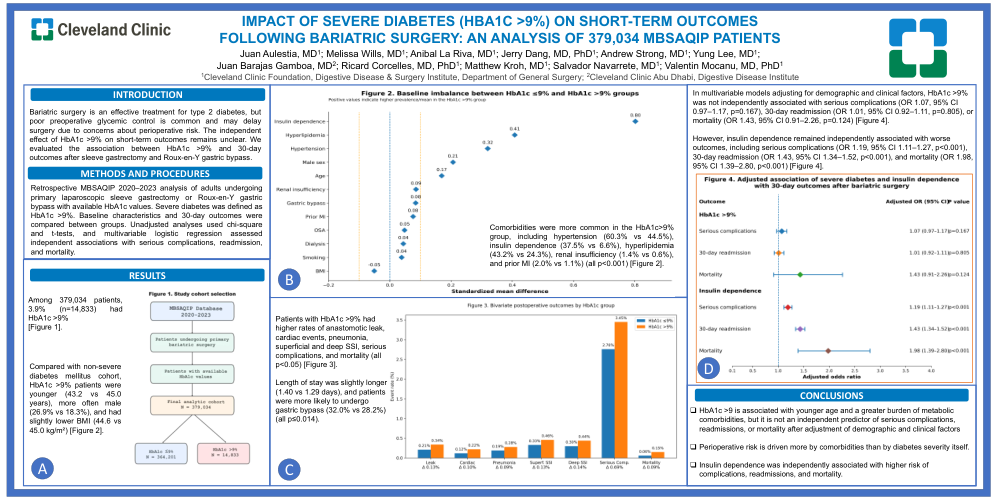
RESULTS: Among 379,034 patients, only 3.9% (n=14,833) had severe diabetes with an HbA1c >9%. They were younger (43.2 vs 45.0 years, p<0.001), more often male (26.9% vs 18.3%, p<0.001), and had slightly lower body mass index (44.6 vs 45.0 kg/m², p<0.001), though the difference was not clinically meaningful. Comorbidities more frequent with HbA1c >9% included hypertension (60.3% vs 44.5%, p<0.001), insulin dependence (37.5% vs 6.6%, p<0.001), hyperlipidemia (43.2% vs 24.3%, p<0.001), renal insufficiency (1.4% vs 0.6%, p<0.001), and prior MI (2.0% vs 1.1%, p<0.001).
On bivariate analysis, HbA1c >9% was associated with higher rates of anastomotic leak (0.34% vs 0.21%, p=<0.001), cardiac events (0.22% vs 0.12%, p=0.001), pneumonia (0.28% vs 0.19%, p=0.014), superficial and deep SSI (0.46% vs 0.33% and 0.44% vs 0.30%, respectively), serious complications overall (3.45% vs 2.76%, p<0.001), and mortality (0.15% vs 0.06%, p<0.001). Length of stay was longer (1.40 vs 1.29 days, p<0.001) and patients were more likely to receive gastric bypass (32.0 vs. 28.2%, p <0.001).
Insulin dependence was also independently associated with worse outcomes (serious complications [OR 1.19, 95% CI 1.11–1.27, p<0.001], 30-day readmission [OR 1.43, 95% CI 1.34–1.52, p<0.001], and Mortality [OR 1.98, 95% CI 1.39–2.80, p<0.001]).
In adjusted models, HbA1c >9% was not independently associated with serious complications (OR 1.07, 95% CI 0.97–1.17, p=0.167), 30-day readmission (OR 1.01, 95% CI 0.92–1.11, p=0.805), or mortality (OR 1.43, 95% CI 0.91–2.26, p=0.124).
CONCLUSIONS: Severe diabetes (HbA1c >9%) is associated with younger age and a greater burden of metabolic comorbidities, but it is not an independent predictor of serious complications, readmissions, or mortality after adjustment, suggesting that perioperative risk is driven more by comorbid conditions than by diabetes severity itself. Although HbA1c >9% was not an independent predictor, insulin dependence was independently associated with higher risk of complications, readmissions, and mortality.