875 posters, 25 topics, 3,440 authors, 1,061 institutions
ePostersLive by SciGen Technologies S.A. All rights reserved.
SAGES 2026 Annual Meeting Emerging Technology Session
March 25-28, 2026 | Tampa, FL, USA

P231
"The Paradox of Low BMI": Higher Complication Rates After SG to RYGB Conversion for GERD using 2020-2023 MBSAQIP Analysis
Poster Presenter
Part of Topic
Bariatric
BACKGROUND: Sleeve gastrectomy (SG) is strongly associated with new or worsening gastroesophageal reflux disease (GERD). While conversion from SG to Roux-en-Y gastric bypass (RYGB) is effective for reflux control, outcomes may differ depending on body mass index (BMI). Our study aimed to compare the 30-day outcomes and bariatric-specific complications between patients with BMI<35 versus BMI>35 who underwent conversion from SG to RYGB due to GERD.
METHODS: We analyzed patients from the 2020–2023 MBSAQIP database with PROCEDURE_TYPE coded as “conversion”. Only patients who underwent conversion from SG to RYGB for GERD were included. A propensity score matching (PSM) analysis was performed using 21 preoperative variables. Thirty-day postoperative outcomes and bariatric-specific complications were compared in patients with BMI <35 versus BMI ≥35.
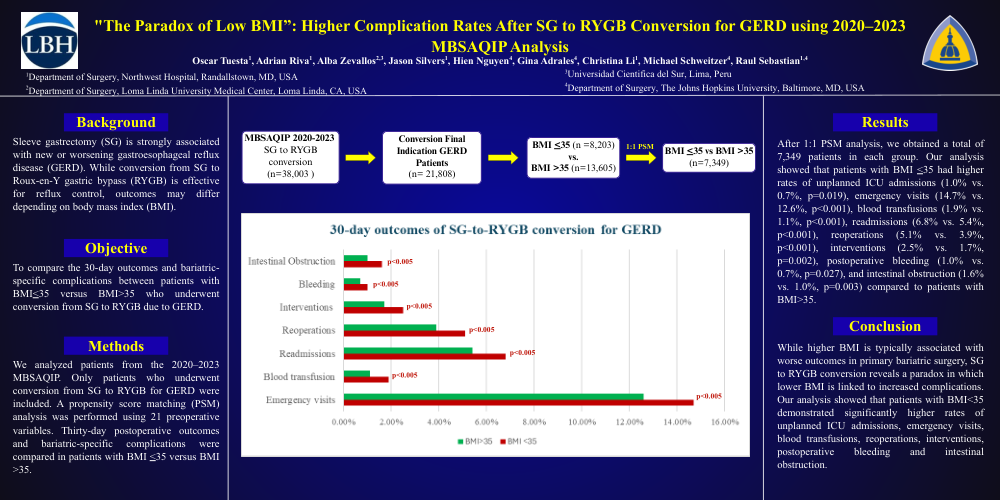
RESULTS: A total of 21,808 patients underwent SG to RYGB conversion for GERD. After 1:1 PSM analysis, we obtained a total of 7,349 patients in each group. Our analysis showed that patients with BMI <35 had higher rates of unplanned ICU admissions (1.0% vs. 0.7%, p=0.019), emergency visits (14.7% vs. 12.6%, p<0.001), blood transfusions (1.9% vs. 1.1%, p<0.001), readmissions (6.8% vs. 5.4%, p<0.001), reoperations (5.1% vs. 3.9%, p<0.001), interventions (2.5% vs. 1.7%, p=0.002), postoperative bleeding (1.0% vs. 0.7%, p=0.027), and intestinal obstruction (1.6% vs. 1.0%, p=0.003) compared to patients with BMI>35.
CONCLUSION: While higher BMI is typically associated with worse outcomes in primary bariatric surgery, SG to RYGB conversion reveals a paradox in which lower BMI is linked to increased complications. Our analysis showed that patients with BMI<35 demonstrated significantly higher rates of unplanned ICU admissions, emergency visits, blood transfusions, reoperations, interventions, postoperative bleeding and intestinal obstruction.