875 posters, 25 topics, 3,440 authors, 1,061 institutions
ePostersLive by SciGen Technologies S.A. All rights reserved.
SAGES 2026 Annual Meeting Emerging Technology Session
March 25-28, 2026 | Tampa, FL, USA

P222
ENDOSCOPIC SLEEVE GASTROPLASTY RESULTS IN EXCELLENT WEIGHT LOSS UP TO THREE YEARS, REGARDLESS OF PAYER
Poster Presenter
Authors
Julia R Amundson, Kristine Kuchta, Natalie Liu, H. Mason Hedberg, Michael B Ujiki
Affiliations
Part of Topic
Bariatric
Endoscopic Sleeve Gastroplasty (ESG) Results in Persistent Weight Loss Up to 5 Years, Regardless of Payer
Julia R. Amundson MD MPH, Kristine Kuchta MS, Natalie Liu MD, H. Mason Hedberg MD MS, Michael B. Ujiki MD FACS
Endeavor Health, Evanston, IL
Background ESG is an endoscopic procedure to treat obesity and associated metabolic comorbidities. Outcomes after bariatric surgery have previously been shown to vary by Payer.1-5 Minimal literature exists on outcomes of ESG by payer.6
Aim Review institutional outcomes of ESG stratified by payer (trial, private insurance, self-pay)
Hypothesis Self-pay patients experience greater weight loss and comorbidity resolution than insured patients
Methods Retrospective review of a single institutions prospective bariatric quality database; all ESG 6/2016–9/2025, stratified by payer (trial, private insurance, self-pay) excluding non-U-stitch suture patterns and postop GLP-1 users
Outcomes of interest % excess and total body weight loss (%EWL, %TBWL), comorbidity resolution, and complications
Results
N=78 ESG eligible for inclusion during the study period (15 trial, 25 private insurance, 38 self-pay); excluded 25
No significant demographic differences by payer
No differences in rates of hypertension, hyperlipidemia, obstructive sleep apnea, GERD, smoking or HbA1c
More diabetes mellitus in trial vs self-pay patients at baseline (31.3% vs 6.4%, p=0.037), 6 months postop (26.7% vs 0.0%, p<0.01), 1 year postop (23.3% vs 4.8%, p=0.011), and 3 years postop (80% vs 0%, p<0.01)
No significant intraoperative differences in EBL, OR time
Significant difference in number of endo-sutures used (Trial 6.6±1.6, Insured 5.0±1.2, Self-pay 5.9±1.4)
Significantly longer LOS for insured vs self-pay patients, though all averaged <1 day [0(0-0) vs 0(0-1), p<0.01]
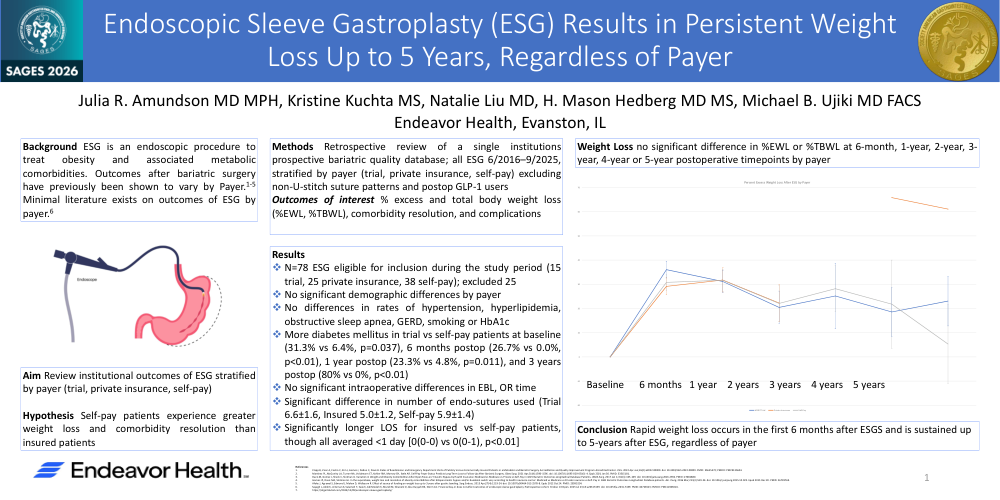
Weight Loss no significant difference in %EWL or %TBWL at 6-month, 1-year, 2-year, 3-year, 4-year or 5-year postoperative timepoints by payer
Conclusion Rapid weight loss occurs in the first 6 months after ESGS and is sustained up to 5-years after ESG, regardless of payer