875 posters, 25 topics, 3,440 authors, 1,061 institutions
ePostersLive by SciGen Technologies S.A. All rights reserved.
SAGES 2026 Annual Meeting Emerging Technology Session
March 25-28, 2026 | Tampa, FL, USA

P216
Intussusception following a deceased donor renal transplant in a patient with Roux-en-Y gastric bypass
Poster Presenter
Authors
Hannah J Sidoti, Michael Fruscione, Jean B Guerrier, Michael Goldstein
Affiliations
Part of Topic
Bariatric
Intussusception following a deceased donor renal transplant in a patient with Roux-en-Y gastric bypass
Background
Adult intussusception is a rare clinical entity and is generally secondary to a pathologic lead point. While malignant and benign neoplasms are frequently discovered lead points, intussusception has been described as a complication after Roux-en-Y gastric bypass (RYGB). We present a 73 year old male with a history of RYGB who presented 75 days after renal transplant with acute pancreatitis secondary to biliopancreatic limb obstruction, found during diagnostic laparoscopy to have obstruction secondary to intussusception. The patient’s intussusception was successfully reduced and his bowel was viable. The patient's clinical course was uncomplicated.
Case Description
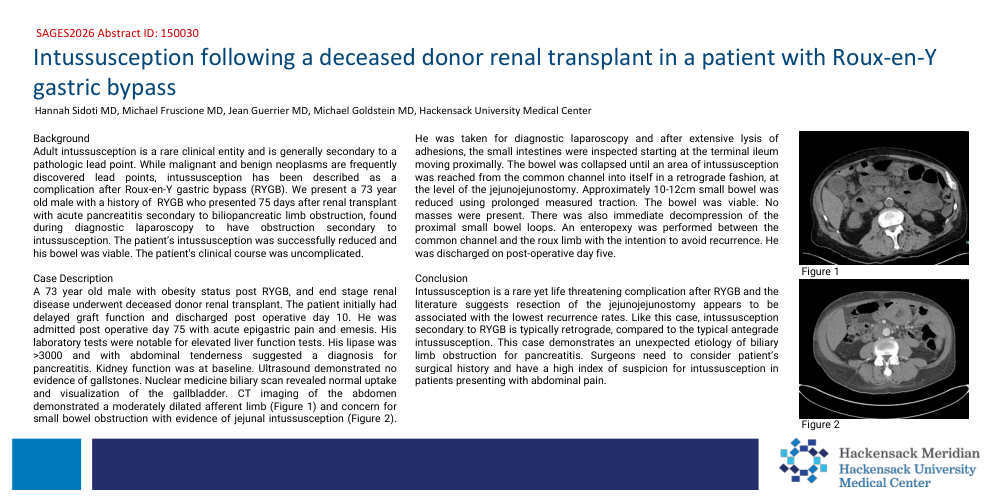
A 73 year old male with obesity status post RYGB, and end stage renal disease underwent deceased donor renal transplant. The patient initially had delayed graft function and discharged post operative day 10. He was admitted post operative day 75 with acute epigastric pain and emesis. His laboratory tests were notable for elevated liver function tests. His lipase was >3000 and with abdominal tenderness suggested a diagnosis for pancreatitis. Kidney function was at baseline. Ultrasound demonstrated no evidence of gallstones. Nuclear medicine biliary scan revealed normal uptake and visualization of the gallbladder. CT imaging of the abdomen demonstrated a moderately dilated afferent limb (Figure 1) and concern for small bowel obstruction with evidence of jejunal intussusception (Figure 2). He was taken for diagnostic laparoscopy and after extensive lysis of adhesions, the small intestines were inspected starting at the terminal ileum moving proximally. The bowel was collapsed until an area of intussusception was reached from the common channel into itself in a retrograde fashion, at the level of the jejunojejunostomy. Approximately 10-12cm small bowel was reduced using prolonged measured traction. The bowel was viable. No masses were present. There was also immediate decompression of the proximal small bowel loops. An enteropexy was performed between the common channel and the roux limb with the intention to avoid recurrence. He was discharged on post-operative day five.
Conclusion
Intussusception is a rare yet life threatening complication after RYGB and the literature suggests resection of the jejunojejunostomy appears to be associated with the lowest recurrence rates. Like this case, intussusception secondary to RYGB is typically retrograde, compared to the typical antegrade intussusception. This case demonstrates an unexpected etiology of biliary limb obstruction for pancreatitis. Surgeons need to consider patient’s surgical history and have a high index of suspicion for intussusception in patients presenting with abdominal pain.