875 posters, 25 topics, 3,440 authors, 1,061 institutions
ePostersLive by SciGen Technologies S.A. All rights reserved.
SAGES 2026 Annual Meeting Emerging Technology Session
March 25-28, 2026 | Tampa, FL, USA

P018
Surgical Treatment of Rectus Abdominis Diastasis with Robotic Surgery: Initial Experience with 23 Cases
Poster Presenter
Authors
Reinaldo M Oliveira Neto, Carlos R Puglia, Paulo R Corsi, Beny Castro
Affiliations
Part of Topic
Abdominal Wall Hernias
SURGICAL TREATMENT OF RECTUS ABDOMINIS DIASTASIS WITH ROBOTIC SURGERY: INITIAL EXPERIENCE WITH 23 CASES Reinaldo M Oliveira Neto, MD, FACS; Carlos R Puglia, MD; Paulo R Corsi, MD, FACS; Beny Castro, MD; Hospital Samaritano Higienopolis
Rectus abdominis diastasis is characterized by excessive separation of the linea alba, usually associated with pregnancy, obesity, and aging. Although it does not represent a true hernia, it can cause low back pain, abdominal wall weakness, and significant aesthetic concerns. Surgical treatment is indicated in symptomatic patients or those unresponsive to conservative management. Robotic surgery, by providing greater technical precision and improved ergonomics, emerges as an alternative to open and laparoscopic approaches.
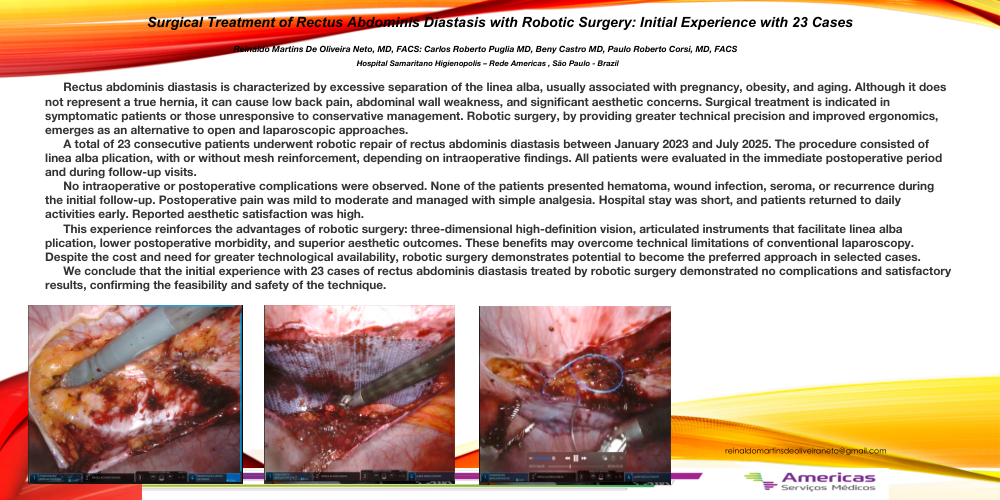
A total of 23 consecutive patients underwent robotic repair of rectus abdominis diastasis between January 2023 and July 2025. The procedure consisted of linea alba plication, with or without mesh reinforcement, depending on intraoperative findings. All patients were evaluated in the immediate postoperative period and during follow-up visits.
No intraoperative or postoperative complications were observed. None of the patients presented hematoma, wound infection, seroma, or recurrence during the initial follow-up. Postoperative pain was mild to moderate and managed with simple analgesia. Hospital stay was short, and patients returned to daily activities early. Reported aesthetic satisfaction was high.
This experience reinforces the advantages of robotic surgery: three-dimensional high-definition vision, articulated instruments that facilitate linea alba plication, lower postoperative morbidity, and superior aesthetic outcomes. These benefits may overcome technical limitations of conventional laparoscopy. Despite the cost and need for greater technological availability, robotic surgery demonstrates potential to become the preferred approach in selected cases.
We conclude that the initial experience with 23 cases of rectus abdominis diastasis treated by robotic surgery demonstrated no complications and satisfactory results, confirming the feasibility and safety of the technique.