875 posters, 25 topics, 3,440 authors, 1,061 institutions
ePostersLive by SciGen Technologies S.A. All rights reserved.
SAGES 2026 Annual Meeting Emerging Technology Session
March 25-28, 2026 | Tampa, FL, USA

P162
Artificial Intelligence-Enhanced Precision in Endoscopic Bariatric Surgery: Emerging Frontiers in Gastrointestinal Surgery and Computational Medicine
Poster Presenter
Authors
Rida Shakeel, Sohaib Aftab Ahmad Chaudhry, Abdul M Khuram, Rameesha Zubair, Hakim Wazir, Immad Muhammad Usman, Shahana Rehman
Affiliations
University Of Connecticut Health Department of Internal Medicine, Dow Medical College, ABWA Medical College, University of Connecticut Health, Lady Reading Hospital Peshawar, Pakistan
Part of Topic
Artificial Intelligence
Background:
Obesity has increased the demand for bariatric interventions. Artificial intelligence (AI) is emerging as a tool to enhance precision and decision-making in endoscopic bariatric surgery.
Objective of this study is to To review recent advances in AI applications in endoscopic bariatric surgery and evaluate their impact on procedural precision and clinical outcomes.
Methods:
Literature review of studies published between 2018–2025 using PubMed, IEEE Xplore, and Web of Science focusing on machine learning applications in bariatric endoscopy.
Results:
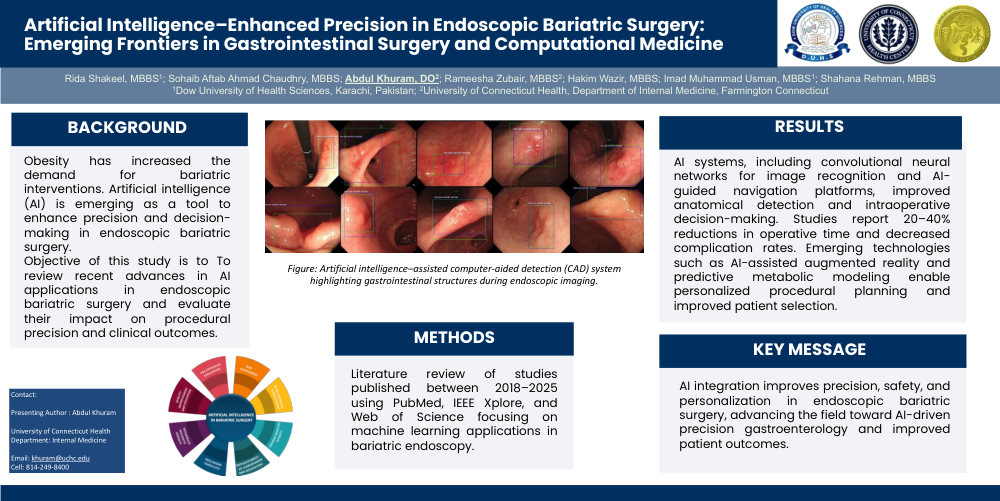
AI systems, including convolutional neural networks for image recognition and AI-guided navigation platforms, improved anatomical detection and intraoperative decision-making. Studies report 20–40% reductions in operative time and decreased complication rates. Emerging technologies such as AI-assisted augmented reality and predictive metabolic modeling enable personalized procedural planning and improved patient selection.
Conclusion:
AI integration improves precision, safety, and personalization in endoscopic bariatric surgery, advancing the field toward AI-driven precision gastroenterology and improved patient outcomes.