875 posters, 25 topics, 3,440 authors, 1,061 institutions
ePostersLive by SciGen Technologies S.A. All rights reserved.
SAGES 2026 Annual Meeting Emerging Technology Session
March 25-28, 2026 | Tampa, FL, USA

P131
Outcome Comparisons between Intraoperative Indocyanine Green Usage and no additional Intervention during Minimally Invasive Cholecystectomy
Poster Presenter
Authors
Fadlullah Ba'th, Michael Littau, Sayf Al-deen Said, Sofya Asfaw, Robert Simon, Benjamin Miller
Affiliations
Part of Topic
Acute Care
OUTCOME COMPARISONS BETWEEN INTRAOPERATIVE INDOCYANINE GREEN USAGE AND NO ADDITIONAL INTERVENTION DURING MINIMALLY INVASIVE CHOLECYSTECTOMY
Fadlullah Ba'th, MD; Michael Littau, MD; Sayf Al-deen Said, MD; Sofya Asfaw, MD; Robert Simon, MD; Benjamin Miller, MD
Intro: Minimally invasive cholecystectomy is one of the most commonly performed surgeries in the USA. Inadvertent injury to the biliary tree is one of the most feared complications and comes with significant morbidity and mortality during cholecystectomy. Multiple modalities exist to aid in intra-operative identification of biliary anatomy. Fluorescent cholangiography via administration of indocyanine green (ICG), can aid in real-time identification of biliary anatomy. However, data are lacking regarding outcomes for surgical cases in which ICG is utilized.
Methods: This retrospective study analyzed data from a large hospital system using CPT codes to identify patients undergoing laparoscopic or robotic cholecystectomy from 1/1/2024 – 7/31/2025. A hybrid natural language pipeline combining rule-based and supervised learning approaches identified patients from operative reports who underwent cholecystectomy with ICG versus cholecystectomy alone. Univariate analysis was used to identify differences in patient characteristics. A multivariable logistic regression model was used to evaluate the associations between ICG use and 30-day reoperations, readmission, and reintervention (endoscopy or percutaneous drain) rates, adjusting for comorbidities, age, race, ethnicity, gender, and elective versus non-elective cases.
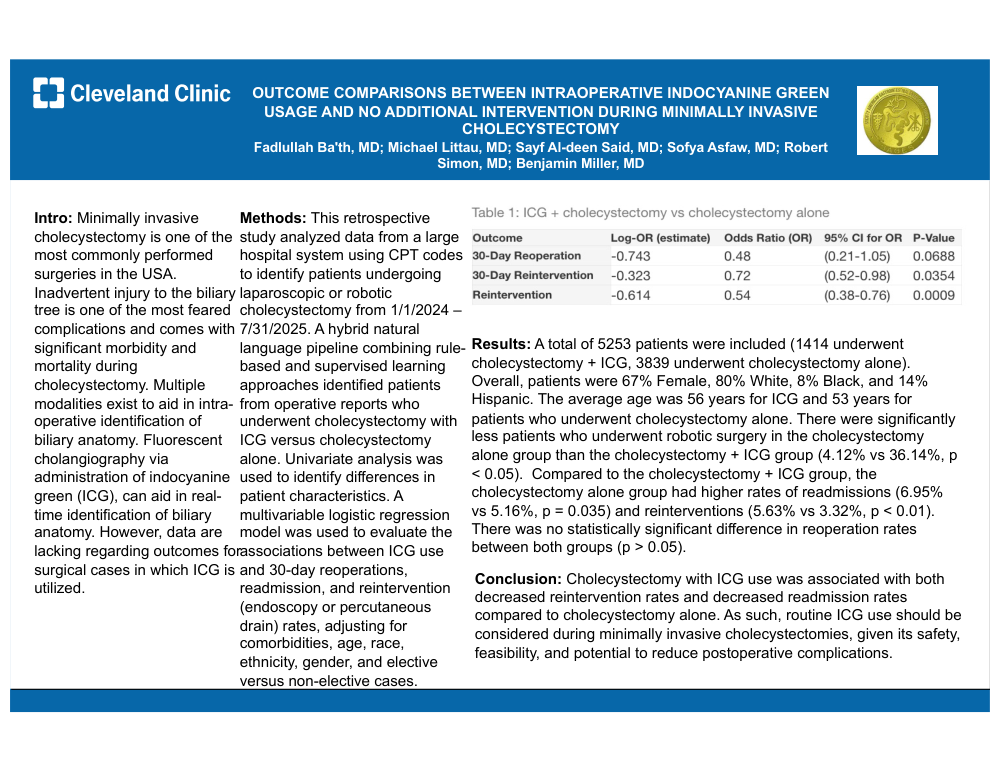
Results: A total of 5253 patients were included (1414 underwent cholecystectomy + ICG, 3839 underwent cholecystectomy alone). Overall, patients were 67% Female, 80% White, 8% Black, and 14% Hispanic. The average age was 56 years for ICG and 53 years for patients who underwent cholecystectomy alone. There were significantly less patients who underwent robotic surgery in the cholecystectomy alone group than the cholecystectomy + ICG group (4.12% vs 36.14%, p < 0.05). Compared to the cholecystectomy + ICG group, the cholecystectomy alone group had higher rates of readmissions (6.95% vs 5.16%, p = 0.035) and reinterventions (5.63% vs 3.32%, p < 0.01). There was no statistically significant difference in reoperation rates between both groups (p > 0.05).
Conclusion: Cholecystectomy with ICG use was associated with both decreased reintervention rates and decreased readmission rates compared to cholecystectomy alone. As such, routine ICG use should be considered during minimally invasive cholecystectomies, given its safety, feasibility, and potential to reduce postoperative complications.