119 posters, 6 topics, 524 authors, 243 institutions
ePostersLive by SciGen Technologies S.A. All rights reserved.
RCR Global AI Conference 2026
29-30 June, 2026 | QEII Centre, Westminster

38
<p>Who Waits Longer? A Systematic Review of Ethnic Disparities in AI-Driven Triage and Patient Prioritisation</p>
Poster Presenter
Authors
Affiliations
Part of Topic
Risk management and compliance: projects around governance, compliance and/or ethics and societal impact
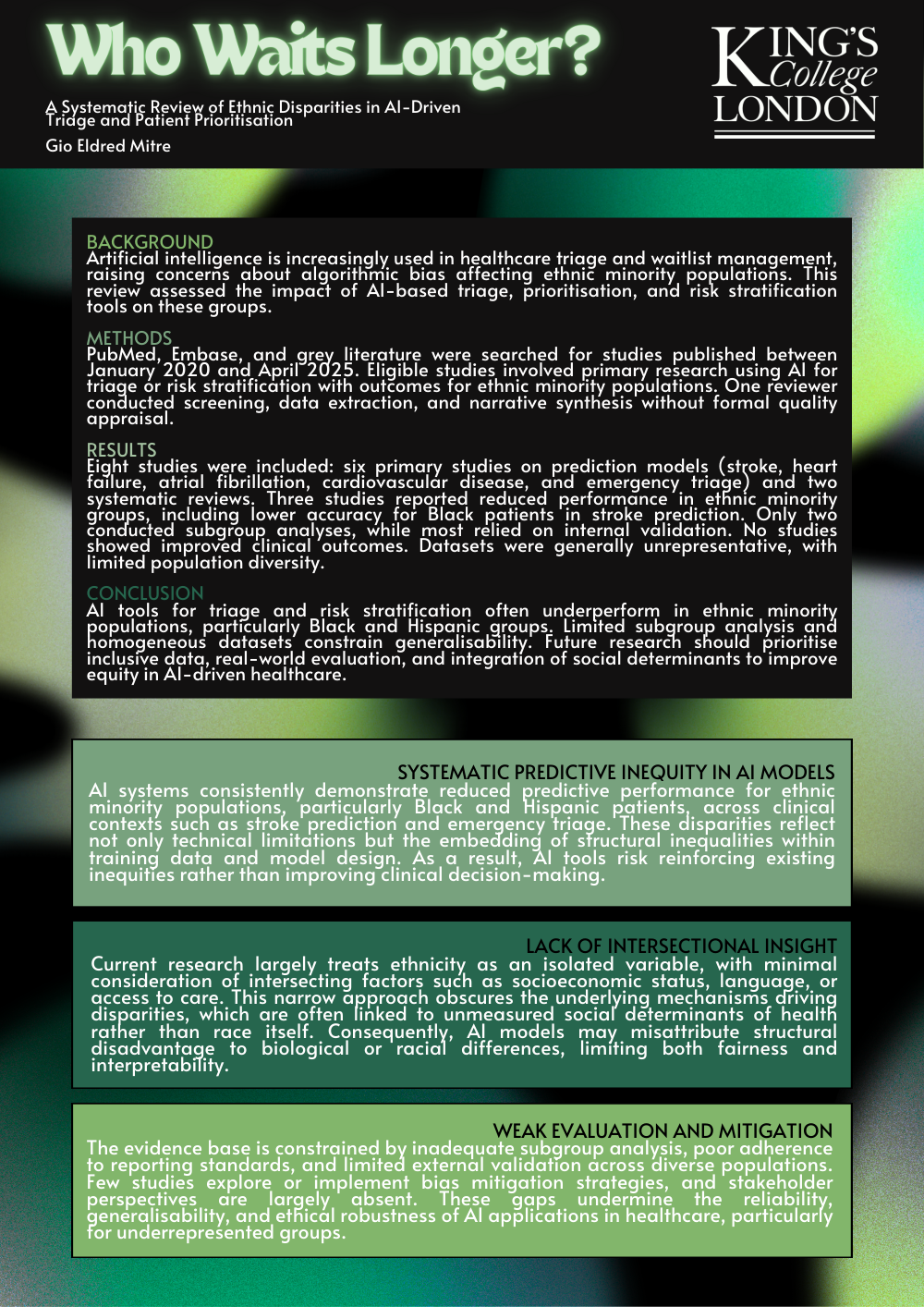
who waits longer?
a systematic review of ethnic disparities in ai-driven triage and patient prioritisation
gio eldred mitre
king’s college london
background
artificial intelligence is increasingly used in healthcare triage and waitlist management, raising concerns about algorithmic bias affecting ethnic minority populations. this review assessed the impact of ai-based triage, prioritisation, and risk stratification tools on these groups.
methods
pubmed, embase, and grey literature were searched for studies published between january 2020 and april 2025. eligible studies involved primary research using ai for triage or risk stratification with outcomes for ethnic minority populations. one reviewer conducted screening, data extraction, and narrative synthesis without formal quality appraisal.
results
eight studies were included: six primary studies on prediction models (stroke, heart failure, atrial fibrillation, cardiovascular disease, and emergency triage) and two systematic reviews. three studies reported reduced performance in ethnic minority groups, including lower accuracy for black patients in stroke prediction. only two conducted subgroup analyses, while most relied on internal validation. no studies showed improved clinical outcomes. datasets were generally unrepresentative, with limited population diversity.
conclusion
ai tools for triage and risk stratification often underperform in ethnic minority populations, particularly black and hispanic groups. limited subgroup analysis and homogeneous datasets constrain generalisability. future research should prioritise inclusive data, real-world evaluation, and integration of social determinants to improve equity in ai-driven healthcare.
systematic predictive inequity in ai models
ai systems consistently demonstrate reduced predictive performance for ethnic minority populations, particularly black and hispanic patients, across clinical contexts such as stroke prediction and emergency triage. these disparities reflect not only technical limitations but the embedding of structural inequalities within training data and model design. as a result, ai tools risk reinforcing existing inequities rather than improving clinical decision-making.
lack of intersectional insight
current research largely treats ethnicity as an isolated variable, with minimal consideration of intersecting factors such as socioeconomic status, language, or access to care. this narrow approach obscures the underlying mechanisms driving disparities, which are often linked to unmeasured social determinants of health rather than race itself. consequently, ai models may misattribute structural disadvantage to biological or racial differences, limiting both fairness and interpretability.
weak evaluation and mitigation
the evidence base is constrained by inadequate subgroup analysis, poor adherence to reporting standards, and limited external validation across diverse populations. few studies explore or implement bias mitigation strategies, and stakeholder perspectives are largely absent. these gaps undermine the reliability, generalisability, and ethical robustness of ai applications in healthcare, particularly for underrepresented groups.