119 posters, 6 topics, 524 authors, 243 institutions
ePostersLive by SciGen Technologies S.A. All rights reserved.
RCR Global AI Conference 2026
29-30 June, 2026 | QEII Centre, Westminster

183
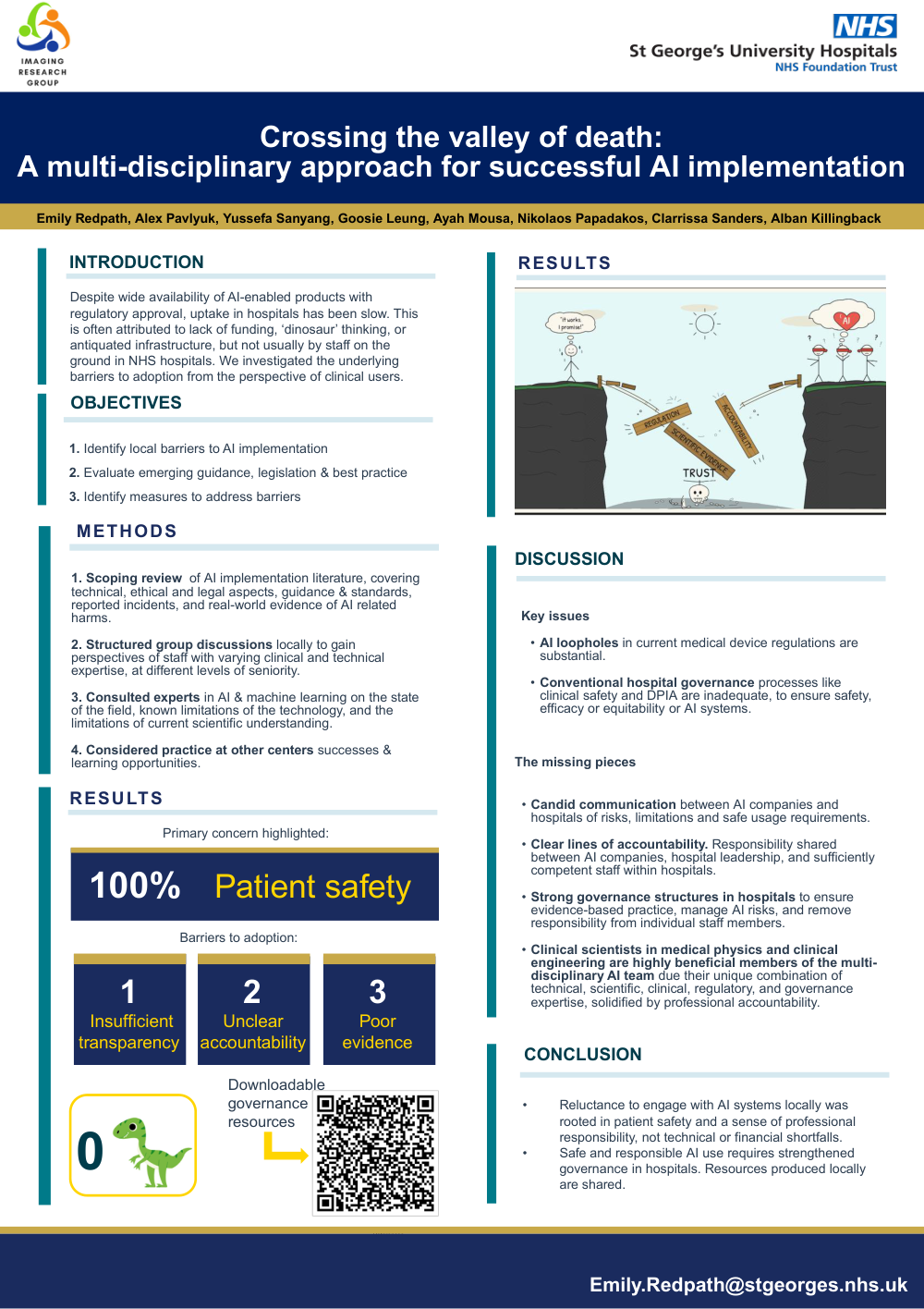
<p>Crossing the valley of death: A multi-disciplinary approach for successful AI implementation</p>
Poster Presenter
Part of Topic
Risk management and compliance: projects around governance, compliance and/or ethics and societal impact
Introduction
Despite wide availability of AI-enabled products with regulatory approval, uptake in hospitals has been slow. This is often attributed to lack of funding, ‘dinosaur’ thinking, or antiquated infrastructure, but not usually by staff on the ground in NHS hospitals. We investigated the underlying barriers to adoption from the perspective of clinical users.
Objectives
1. Identify local barriers to AI implementation
2. Evaluate emerging guidance, legislation & best practice
3. Identify measures to address barriers
Methods
1. Scoping review of AI implementation literature, covering technical, ethical and legal aspects, guidance & standards, reported incidents, and real-world evidence of AI related harms.
2. Structured group discussions locally to gain perspectives of staff with varying clinical and technical expertise, at different levels of seniority.
3. Consulted experts in AI & machine learning on the state of the field, known limitations of the technology, and the limitations of current scientific understanding.
4. Considered practice at other centers successes & learning opportunities.
Results:
Barriers are: Lack of regulation, unclear accountability and poor scientific evidence.
Downloadable governance resources are provided at QR code
Discussion:
AI loopholes in current medical device regulations are substantial.
Conventional hospital governance processes like clinical safety and DPIA are inadequate, to ensure safety, efficacy or equitability or AI systems.
The missing pieces:
- Candid communication between AI companies and hospitals of risks, limitations and safe usage requirements.
- Clear lines of accountability. Responsibility shared between AI companies, hospital leadership, and sufficiently competent staff within hospitals.
- Strong governance structures in hospitals to ensure evidence-based practice, manage AI risks, and remove responsibility from individual staff members.
- Clinical scientists in medical physics and clinical engineering are highly beneficial members of the multi-disciplinary AI team due their unique combination of technical, scientific, clinical, regulatory, and governance expertise, solidified by professional accountability.
Conclusion
Reluctance to engage with AI systems locally was rooted in patient safety and a sense of professional responsibility, not technical or financial shortfalls. Safe and responsible AI use requires strengthened governance in hospitals. Resources produced locally are shared.