119 posters, 6 topics, 524 authors, 243 institutions
ePostersLive by SciGen Technologies S.A. All rights reserved.
RCR Global AI Conference 2026
29-30 June, 2026 | QEII Centre, Westminster

235
<p>From Algorithm to Action: Evaluating the Integration of Brainiomix in Acute Clinical Workflows.</p>
Poster Presenter
Authors
Affiliations
Part of Topic
AI vigilance ??? Post-implementation monitoring, real world performance evaluation, health economic evaluation
Background
Brainomix e-ASPECTS is a decision support tool for the assessment of stroke on non-contrast CT head scans.1 It assesses scans for evidence of parenchymal hypodensity (ischaemic stroke) and automates the ASPECTs score, intracranial hyperdensity (haemorrhagic stroke) and vascular hyperdensity (large vessel occlusion).1
The generated results are in the form of a colour-coded output which is uploaded to PACs as a new series in an existing patient. 1
Locally (Morriston Hospital, Swansea Bay University Health Board, Wales), this output is available to both reporting radiologists and referring clinicians to review for all CT heads performed for acute stroke to aid clinical management of patients.
Aim
To evaluate how Brainomix e-ASPECTS outputs are utilised by reporting radiologists locally in real-world “shop floor” clinical practice.
Methods
A short online survey (via Google Forms) was distributed to a cohort of local radiologists (body radiology consultants, neuroradiology consultants and radiology residents) who are routinely responsible for acute stroke reporting.
The survey explored how Brainomix e-ASPECTS outputs are integrated into the acute clinical workflow and the degree of influence the outputs had on the final formal radiology reports and consequently, the clinical care of patients.
Results
A total of 20 responses were collected from local radiology residents (45%), body radiology consultants (40%) and neuroradiology consultants (15%).
When reporting CT heads for acute stroke, 65% of respondents reported always reviewing Brainomix e-ASPECTS outputs and a further 15% of respondents reported occasionally reviewing Brainomix e-ASPECTS outputs. Interestingly, 20% of respondents reported never reviewing Brainomix e-ASPECTs outputs.
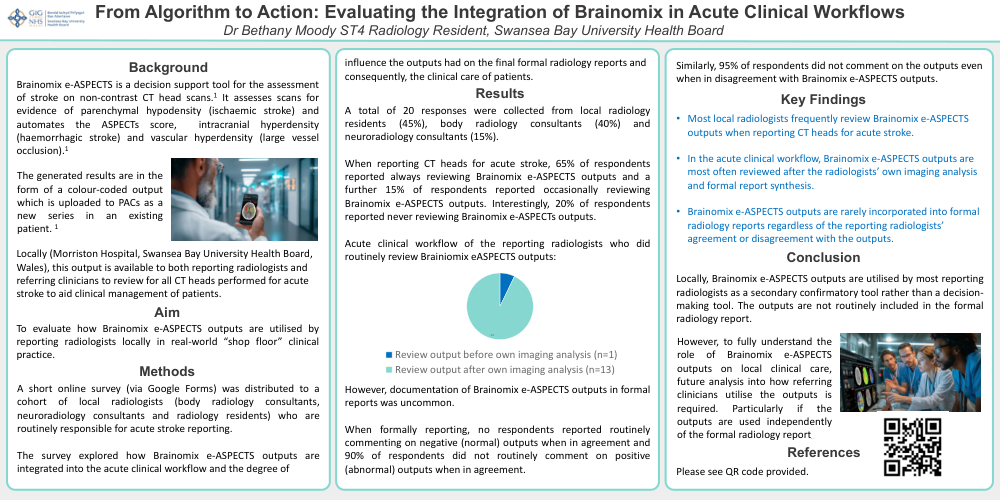
Acute clinical workflow of the reporting radiologists who did routinely review Brainiomix eASPECTS outputs.
However, documentation of Brainomix e-ASPECTS outputs in formal reports was uncommon.
When formally reporting, no respondents reported routinely commenting on negative (normal) outputs when in agreement and 90% of respondents did not routinely comment on positive (abnormal) outputs when in agreement.
Similarly, 95% of respondents did not comment on the outputs even when in disagreement with Brainomix e-ASPECTS outputs.
Key Findings
•Most local radiologists frequently review Brainomix e-ASPECTS outputs when reporting CT heads for acute stroke.
•In the acute clinical workflow, Brainomix e-ASPECTS outputs are most often reviewed after the radiologists’ own imaging analysis and formal report synthesis.
•Brainomix e-ASPECTS outputs are rarely incorporated into formal radiology reports regardless of the reporting radiologists’ agreement or disagreement with the outputs.
Conclusion
Locally, Brainomix e-ASPECTS outputs are utilised by most reporting radiologists as a secondary confirmatory tool rather than a decision-making tool. The outputs are not routinely included in the formal radiology report.
However, to fully understand the role of Brainomix e-ASPECTS outputs on local clinical care, future analysis into how referring clinicians utilise the outputs is required. Particularly if the outputs are used independently of the formal radiology report.