119 posters, 6 topics, 524 authors, 243 institutions
ePostersLive by SciGen Technologies S.A. All rights reserved.
RCR Global AI Conference 2026
29-30 June, 2026 | QEII Centre, Westminster

224
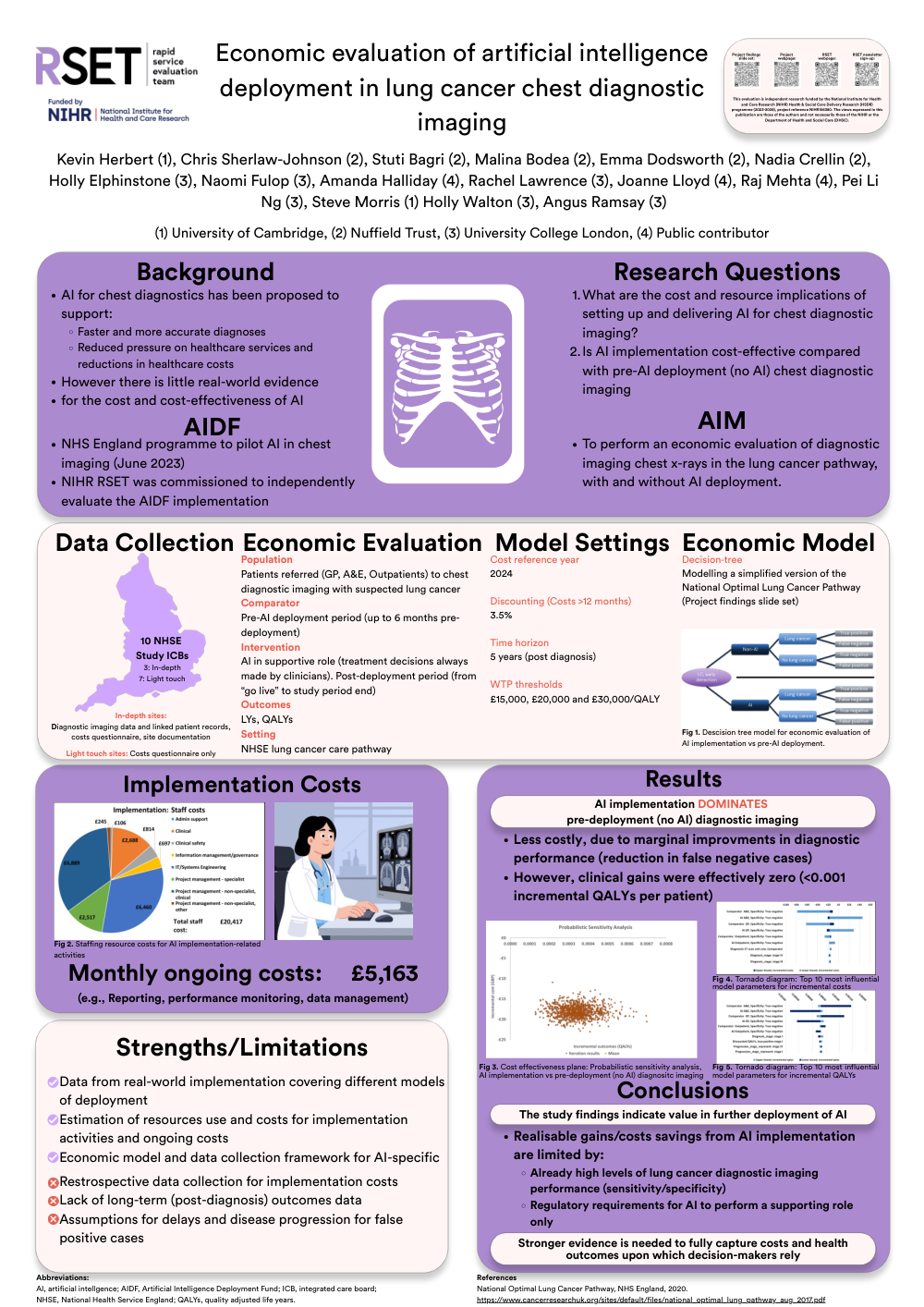
<p>ECONOMIC EVALUATION OF ARTIFICIAL INTELLIGENCE DEPLOYMENT IN LUNG CANCER CHEST DIAGNOSTIC IMAGING</p>
Poster Presenter
Part of Topic
AI vigilance ??? Post-implementation monitoring, real world performance evaluation, health economic evaluation
RSET: Rapid Servioce Evaluation Team
Funded by NIHR (National Institute for Health and Care Research)
Title: Economic evaluation of artificial intelligence deployment in lung cancer chest diagnostic imaging
Kevin Herbert (1), Chris Sherlaw-Johnson (2), Stuti Bagri (2), Malina Bodea (2), Emma Dodsworth (2), Nadia Crellin (2), Holly Elphinstone (3), Naomi Fulop (3), Amanda Halliday (4), Rachel Lawrence (3), Joanne Lloyd (4), Raj Mehta (4), Pei Li Ng (3), Steve Morris (1) Holly Walton (3), Angus Ramsay (3)
(1) University of Cambridge, (2) Nuffield Trust, (3) University College London, (4) Public contributor
INTRODUCTION
Background
- AI for chest diagnostics has been proposed to support:
- Faster and more accurate diagnoses
- Reduced pressure on healthcare services and reductions in healthcare costs
- However there is little real-world evidence
- for the cost and cost-effectiveness of AI
AIDF
- NHS England programme to pilot AI in chest imaging (June 2023)
- NIHR RSET was commissioned to independently evaluate the AIDF implementation
Research questions
- What are the cost and resource implications of setting up and delivering AI for chest diagnostic imaging?
- Is AI implementation cost-effective compared with pre-AI deployment (no AI) chest diagnostic imaging
AIM
To perform an economic evaluation of diagnostic imaging chest x-rays in the lung cancer pathway, with and without AI deployment.
METHODS
Data collection
10 NHSE Study ICBs; 3: In-depth; 7: Light touch
In-depth sites: Diagnostic imaging data and linked patient records, costs questionnaire, site documentation
Light touch sites:Costs questionnaire only
Economic Evaluation
Population: Patients referred (GP, A&E, Outpatients) to chest diagnostic imaging with suspected lung cancer
Comparator: Pre-AI deployment period (up to 6 months pre-deployment)
Intervention: AI in supportive role (treatment decisions always made by clinicians). Post-deployment period (from “go live” to study period end)
Outcomes: LYs, QALYs
Setting: NHSE lung cancer care pathway
Model Settings
Cost reference year: 2024
Discounting (Costs >12 months): 3.5%
Time horizon: 5 years (post diagnosis)
WTP thresholds: £15,000, £20,000 and £30,000/QALY
Economic Model
Decision‑tree: Modelling a simplified version of the National Optimal Lung Cancer Pathway (Project findings slide set)
RESULTS
AI implementation DOMINATES pre-deployment (no AI) diagnostic imaging
- Less costly, due to marginal improvments in diagnostic performance (reduction in false negative cases)
- However, clinical gains were effectively zero (<0.001 incremental QALYs per patient)
STRENGTHS
- Data from real-world implementation covering different models of deployment
- Estimation of resources use and costs for implementation activities and ongoing costs
- Economic model and data collection framework for AI-specific
LIMITATIONS
- Restrospective data collection for implementation costs
- Lack of long-term (post-diagnosis) outcomes data
- Assumptions for delays and disease progression for false positive cases
CONCLUSIONS
The study findings indicate value in further deployment of AI
- Realisable gains/costs savings from AI implementation are limited by:
- Already high levels of lung cancer diagnostic imaging performance (sensitivity/specificity)
- Regulatory requirements for AI to perform a supporting role only
Stronger evidence is needed to fully capture costs and health outcomes upon which decision-makers rely
Abbreviations: AI, artificial intellgence; AIDF, Artificial Intelligence Deployment Fund; ICB, integrated care board; NHSE, National Health Service England; QALYs, quality adjusted life years.
This evaluation is independent research funded by the National Institute for Health and Care Research (NIHR) Health & Social Care Delivery Research (HSDR) programme (2023-2028), project reference NIHR156380. The views expressed in this publication are those of the authors and not necessarily those of the NIHR or the Department of Health and Social Care (DHSC).