296 posters, 7 videos, 13 audios, 14 topics, 10 sessions, 1,019 authors, 260 institutions
ePostersLive by SciGen Technologies S.A. All rights reserved.
RCOphth Annual Congress 2026
18 - 21 May, 2026 | Manchester Central, Manchester

P070
Efficacy and Safety of implantable phakic contact lens versus implantable collamer lens in myopia correction: A Systematic Review and Meta-analysis
Poster Presenter
Authors
Erum Habib, Ayesha Saleem, Saad Arsalan Wasti, Hashem Abu Serhan
Affiliations
Part of Topic
Cataract and refractive surgery
Title: Efficacy and Safety of implantable phakic contact lens versus implantable collamer lens in myopia correction: A Systematic Review and Meta-analysis
Background: Implantable phakic contact lens (IPCL) and implantable collamer lens (ICL) are widely used posterior chamber phakic intraocular lenses for the correction of moderate to high myopia. While both devices offer favorable refractive outcomes, their comparative performance in terms of visual acuity, optical quality, and safety remains uncertain. Given the importance of postoperative visual function and long-term endothelial health, this study was conducted to evaluate and compare the efficacy and safety profiles of IPCL and ICL across key clinical parameters.
Objectives: To evaluate postoperative visual acuity, refractive accuracy, optical quality, and endothelial safety outcomes following IPCL versus ICL implantation in myopic patients.
Methods: A systematic search of PubMed, Embase, Cochrane Library, and Scopus was conducted from inception to November 2025. Pooled estimates were calculated using random-effects models, reporting mean differences (MD) with 95% confidence intervals (CI). Heterogeneity was assessed using I² and χ² statistics. All analyses were performed using RevMan 5.4. A p-value <0.05 was considered statistically significant.
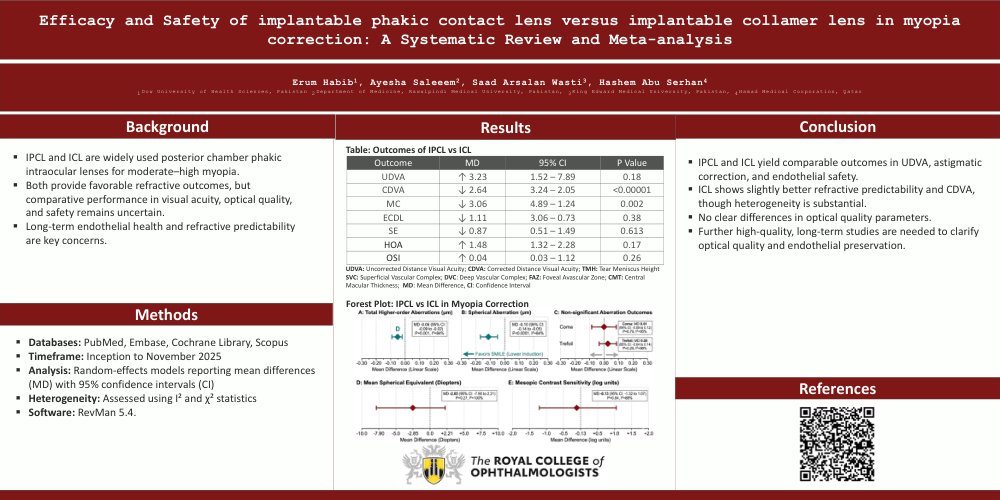
Results: This meta-analysis included seven studies comprising 672 eyes (IPCL = 280; ICL = 392). No significant differences were observed in postoperative uncorrected distance visual acuity (MD –0.01; 95% CI: –0.03 to 0.01; P=0.37; I²=0%), corrected distance visual acuity (MD 0.00; 95% CI: –0.01 to 0.01; P=0.84; I²=0%), manifest cylinder (MD 0.00; 95% CI: –0.11 to 0.12; P=0.94; I²=59%), or endothelial cell density loss (MD 47.23; 95% CI: –15.44 to 109.90; P=0.14; I²=55%). ICL was associated with significantly better postoperative spherical equivalent (MD –0.15; 95% CI: –0.26 to –0.04; P=0.009; I²=74%) and corrected distance visual acuity (MD 0.04; 95% CI: 0.01 to 0.08; P=0.02; I²=97%), although heterogeneity was substantial. No significant differences were found in higher-order aberrations (MD 0.28; 95% CI: –0.38 to 0.94; P=0.41; I²=78%) or objective scattering index (MD 0.33; 95% CI: –1.06 to 1.72; P=0.64; I²=89%).
Conclusion: IPCL and ICL provide comparable outcomes in terms of uncorrected visual acuity, astigmatic correction, and endothelial safety. However, ICL demonstrates slightly better refractive predictability and corrected distance visual acuity, supporting its continued use as a benchmark phakic lens. Further high-quality, long-term studies are warranted to clarify differences in optical quality and endothelial preservation.