296 posters, 7 videos, 13 audios, 14 topics, 10 sessions, 1,019 authors, 260 institutions
ePostersLive by SciGen Technologies S.A. All rights reserved.
RCOphth Annual Congress 2026
18 - 21 May, 2026 | Manchester Central, Manchester

P270
Visual outcomes following treatment of extramacular retinoblastoma and the effectiveness of occlusion therapy in amblyopia
Part of Topic
Paediatric ophthalmology
Visual outcomes following treatment of extramacular retinoblastoma and the effectiveness of occlusion therapy in amblyopia
K. Wu1, S. Waseem1,2, M. Kirk1,2, P. Caulthar1, J. Abbott1, S. Gurney1, H. Jenkinson1, G. Millen1, M. Parulekar1,2
1Birmingham Children's Hospital, Birmingham Women's and Children's NHS Foundation Trust
2Oxford University Hospitals NHS Foundation Trust
INTRODUCTION
- Epidemiology: Retinoblastoma is the most common primary paediatric intraocular malignancy, accounting for 3% of all childhood cancers [1]
- Evolution of Care: Management has progressed from life preservation to ocular salvage via systemic chemotherapy (SC) and intra-arterial chemotherapy (IAC), with a current focus on achieving optimal visual outcomes
- Clinical Presentation: Most cases typically present with leukocoria (white pupillary reflex) or strabismus
- Risk of Amblyopia: Visual deprivation or strabismus during the critical period of development can lead to amblyopia, necessitating prompt orthoptic intervention
- Prognostic Factors: Visual outcomes are heavily influenced by tumour location, with macular involvement being the primary limiting factor for visual potential
AIM
To examine changes in visual acuity following treatment for extramacular retinoblastoma and to determine whether occlusion therapy improves outcomes in amblyopic eyes
METHODS
- A 12-year retrospective, single-institution review of retinoblastoma patients referred to Birmingham Children's Hospital between 2010 and 2022
- 290 referrals were reviewed; 37 patients met the inclusion criteria – unilateral or bilateral extramacular retinoblastoma without enucleation
- Data points included patient diagnosis (unilateral vs. bilateral), chemotherapy modality (SC vs. IAC), and amblyopia therapy adherence
- Primary outcomes were measured using pre- and post-treatment logMAR visual acuity (VA)
- Statistical significance was determined using paired t-tests, with results expressed as mean change ± standard deviation (SD)
- VA Quantification: Qualitative vision (e.g., 'Fixing and Following') was converted to logMAR equivalents for statistical analysis
RESULTS
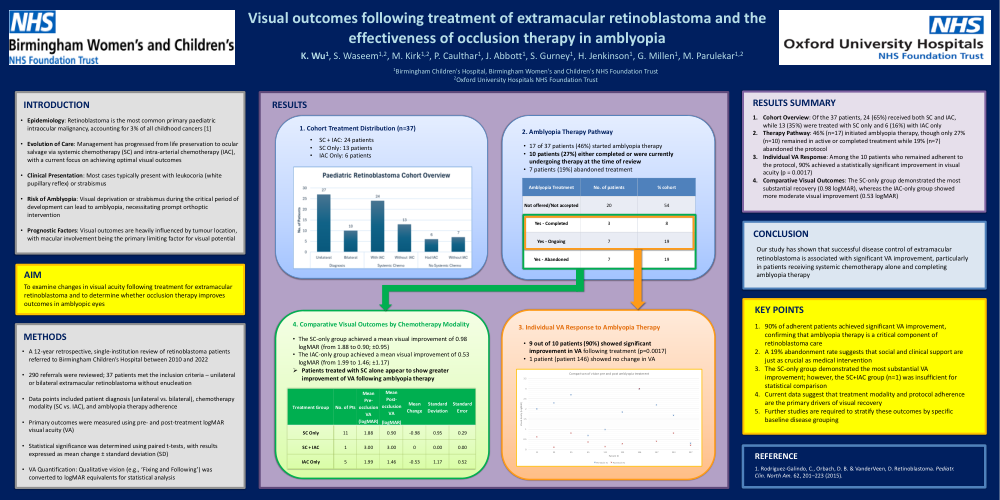
1. Cohort Treatment Distribution (n=37)
• SC + IAC: 24 patients
• SC Only: 13 patients
• IAC Only: 6 patients
2. Amblyopia Therapy Pathway
• 17 of 37 patients (46%) started amblyopia therapy
• 10 patients (27%) either completed or were currently undergoing therapy at the time of review
• 7 patients (19%) abandoned treatment
3. Individual VA Response to Amblyopia Therapy
• 9 out of 10 patients (90%) showed significant improvement in VA following treatment (p=0.0017)
• 1 patient (patient 146) showed no change in VA
4. Comparative Visual Outcomes by Chemotherapy Modality
• The SC-only group achieved a mean visual improvement of 0.98 logMAR (from 1.88 to 0.90; ±0.95)
• The IAC-only group achieved a mean visual improvement of 0.53 logMAR (from 1.99 to 1.46; ±1.17)
➡Patients treated with SC alone appear to show greater improvement of VA following amblyopia therapy
RESULTS SUMMARY
1. Cohort Overview: Of the 37 patients, 24 (65%) received both SC and IAC, while 13 (35%) were treated with SC only and 6 (16%) with IAC only
2. Therapy Pathway: 46% (n=17) initiated amblyopia therapy, though only 27% (n=10) remained in active or completed treatment while 19% (n=7) abandoned the protocol
3. Individual VA Response: Among the 10 patients who remained adherent to the protocol, 90% achieved a statistically significant improvement in visual acuity (p = 0.0017)
4. Comparative Visual Outcomes: The SC-only group demonstrated the most substantial recovery (0.98 logMAR), whereas the IAC-only group showed more moderate visual improvement (0.53 logMAR)
CONCLUSION
Our study has shown that successful disease control of extramacular retinoblastoma is associated with significant VA improvement, particularly in patients receiving systemic chemotherapy alone and completing amblyopia therapy.
KEY POINTS
1. 90% of adherent patients achieved significant VA improvement, confirming that amblyopia therapy is a critical component of retinoblastoma care
2. A 19% abandonment rate suggests that social and clinical support are just as crucial as medical intervention
3. The SC-only group demonstrated the most substantial VA improvement; however, the SC+IAC group (n=1) was insufficient for statistical comparison
4. Current data suggest that treatment modality and protocol adherence are the primary drivers of visual recovery
5. Further studies are required to stratify these outcomes by specific baseline disease grouping
REFERENCE
1. Rodriguez-Galindo, C., Orbach, D. B. & VanderVeen, D. Retinoblastoma. Pediatr. Clin. North Am. 62, 201–223 (2015).