296 posters, 7 videos, 13 audios, 14 topics, 10 sessions, 1,019 authors, 260 institutions
ePostersLive by SciGen Technologies S.A. All rights reserved.
RCOphth Annual Congress 2026
18 - 21 May, 2026 | Manchester Central, Manchester

P237
Effectiveness of Prism Therapy versus Botulinum Toxin Injection in the Management of Sixth Cranial Nerve Palsy: A Systematic Review and Meta-Analysis
Poster Presenter
Authors
Erum Habib, Omar Abdullah Gill, Syeda Noor Us Saba, Hashem Abu Serhan
Affiliations
Part of Topic
Neuro ophthalmology
Title: Effectiveness of Prism Therapy versus Botulinum Toxin Injection in the Management of Sixth Cranial Nerve Palsy: A Systematic Review and Meta-Analysis
Background: Sixth cranial nerve palsy is a neuro-ophthalmic disorder characterized by impaired lateral rectus function, leading to horizontal diplopia and restricted abduction. Prism therapy and botulinum toxin injection are established treatment modalities that aim to alleviate diplopia and improve ocular alignment; however, their comparative effectiveness across different severities of palsy remains uncertain. While prism therapy offers a non-invasive optical correction, botulinum toxin injection targets the antagonist medial rectus muscle to restore balance in ocular motility. Given the variability in reported outcomes and the clinical importance of tailoring treatment to the severity of abduction deficit, this study was conducted to systematically evaluate and compare the efficacy of prism therapy versus botulinum toxin injection in the management of sixth cranial nerve palsy.
Objective: To compare the effectiveness of prism therapy versus botulinum toxin injections in improving ocular alignment and reducing diplopia in sixth cranial nerve palsy.
Methods: A literature search of PubMed, Embase, Scopus, and Cochrane databases was performed from their inception until September 31, 2025. Pooled estimates were calculated using random-effects models, reporting risk ratio RR with 95% confidence intervals (CI). Heterogeneity was evaluated using I² and X² statistics. All calculations were performed using Meta packages 4.4.3. A p-value of <0.05 was considered statistically significant.
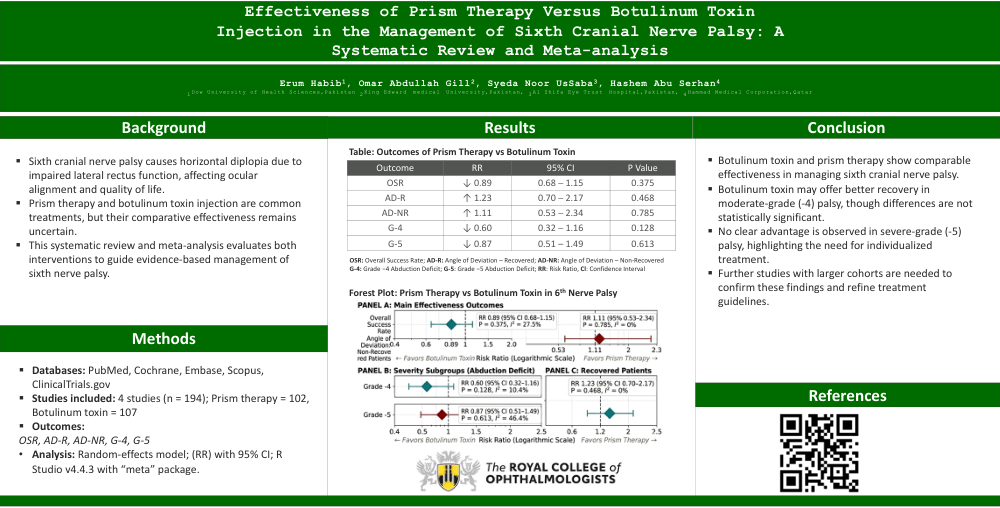
Results: This meta-analysis included four studies with 194 patients (Prism therapy=102; Botulinum toxin injection=107) with sixth cranial nerve palsy. Prism therapy was not significantly different from botulinum toxin injection in improving overall success rates in sixth nerve palsy (RR 0.89, 95% CI 0.68–1.15, p = 0.375, I² = 27.5%). No significant differences were observed in the angle of deviation among recovered patients (RR 1.23, 95% CI 0.70–2.17, p = 0.468, I² = 0%) or non-recovered patients (RR 1.11, 95% CI 0.53–2.34, p = 0.785, I² = 0%). Severity of the palsy showed that in grade –4 abduction deficit, botulinum toxin was associated with a higher recovery rate (RR 0.60, 95% CI 0.32–1.16, p = 0.128, I² = 10.4%) though the difference was not statistically significant, whereas in grade –5 palsy, no significant difference was found between interventions (RR 0.87, 95% CI 0.51–1.49, p = 0.613, I² = 46.4%).
Conclusion: Botulinum toxin and prism therapy show similar effectiveness in sixth nerve palsy. Botulinum toxin may offer better recovery in moderate cases, but no clear advantage is seen in severe palsy. Further studies are needed to confirm these findings.