296 posters, 7 videos, 13 audios, 14 topics, 10 sessions, 1,019 authors, 260 institutions
ePostersLive by SciGen Technologies S.A. All rights reserved.
RCOphth Annual Congress 2026
18 - 21 May, 2026 | Manchester Central, Manchester

P021
Real World Patient Experience with Autonomous Clinical Consultations: A 3-Year Analysis of over 145,000 Interactions Across NHS Cataract Pathways
Poster Presenter
Part of Topic
Audit and clinical governance
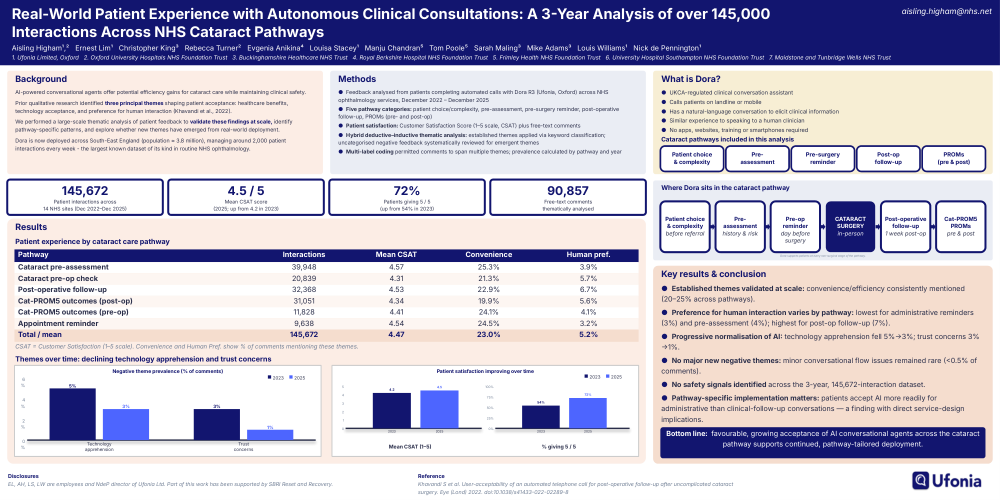
Introduction: Artificial intelligence (AI)-powered conversational agents offer potential efficiency gains for cataract care pathway management while maintaining clinical safety. Prior qualitative research from a research study identified three principal themes shaping patient acceptance: recognition of healthcare benefits, technology acceptance, and preference for human interaction (Khavandi et al., 2022). We conducted a large-scale thematic analysis of patient feedback to validate these findings at scale, identify pathway-specific patterns, and explore whether new themes have emerged from wide-sread real-world deployment.
Methods: We analysed feedback from patients completing automated interactions via an AI conversational agent (Dora R3, Ufonia Ltd, Oxford) deployed across NHS ophthalmology services from December 2022 to December 2025. Conversations were categorised into five pathways: patient choice of provider and complexity assessment, pre-assessment, pre-surgery reminder, post-operative follow-up, patient reported outcomes collection (pre- and post-operative).
Patient satisfaction was assessed with a Customer Satisfaction score on a 1 to 5 scale (CSAT), with supporting free-text comments towards the end of a call. A hybrid deductive-inductive thematic analysis was performed. The established themes from the prior research study were applied using keyword-based automated classification, while systematic review of uncategorised negative feedback was conducted to identify emergent themes. Multi-label coding permitted comments to be assigned to multiple themes. Theme prevalence was calculated as percentage of comments containing relevant keywords, stratified by pathway and year.
Results: A total of 145,672 ophthalmology interactions generated 99,117 (68% response rate) with CSAT scores and 90,857 analysable free-text comments (62%) across 14 NHS sites. Mean CSAT improved from 4.2 (2023) to 4.5 (2025), with the percentage of patients giving 5/5 increasing from 54% to 72%.
Previously established themes were validated at scale: convenience/efficiency was consistently mentioned across pathways (20–25%), while human interaction preference varied significantly by pathway type, lowest in the slightly more administrative appointment reminders (3%) and pre-assessment (4%), but highest in post-operative follow-up (7%).
Technology apprehension and trust concerns both showed declining trends over the study period (5%→3% and 3%→1% respectively), suggesting progressive normalisation of AI use. No major new negative themes emerged; minor conversational flow issues were identified but remained rare (<0.5% of comments). Pathway-specific analysis revealed highest satisfaction for cataract pre-assessment (CSAT 4.6, n=39,948) and appointment reminders (CSAT 4.5, n=9,638), with slightly lower scores for outcomes collection pathways (4.3). No safety signals were identified.
Discussion: This analysis validates prior qualitative research at unprecedented scale while revealing clinically relevant pathway-specific trends. The thematic framework from foundational research remains robust, with no major new negative themes emerging despite substantially increased deployment. The variation in human preference themes suggests patients accept AI assistance more readily for administrative interactions than for clinical follow-up conversations, a finding with direct implications for service design. The declining prevalence of technology apprehension and trust concerns over time suggests that patient acceptance improves with familiarity, an encouraging finding for future AI deployment in ophthalmology. These patterns demonstrate favourable patient acceptance of AI conversational agents across the cataract care pathway and support continued deployment with pathway-appropriate implementation strategies.