296 posters, 7 videos, 13 audios, 14 topics, 10 sessions, 1,019 authors, 260 institutions
ePostersLive by SciGen Technologies S.A. All rights reserved.
RCOphth Annual Congress 2026
18 - 21 May, 2026 | Manchester Central, Manchester

P002
A study on the relationship between the Visual Function Index score and visual acuity of patients with Wet AMD before and after anti-VEGF treatment.
Poster Presenter
Authors
Part of Topic
Audit and clinical governance
Introduction
This audit explored the relationship between changes in visual acuity and patient-reported visual function in individuals receiving anti-VEGF therapy for age-related macular degeneration (AMD). Visual acuity alone may not fully reflect the functional impact of vision loss. Patient-reported outcome measures such as the VF-14 questionnaire offer a more holistic view, better aligning with the WHO’s definition of health.
Methods
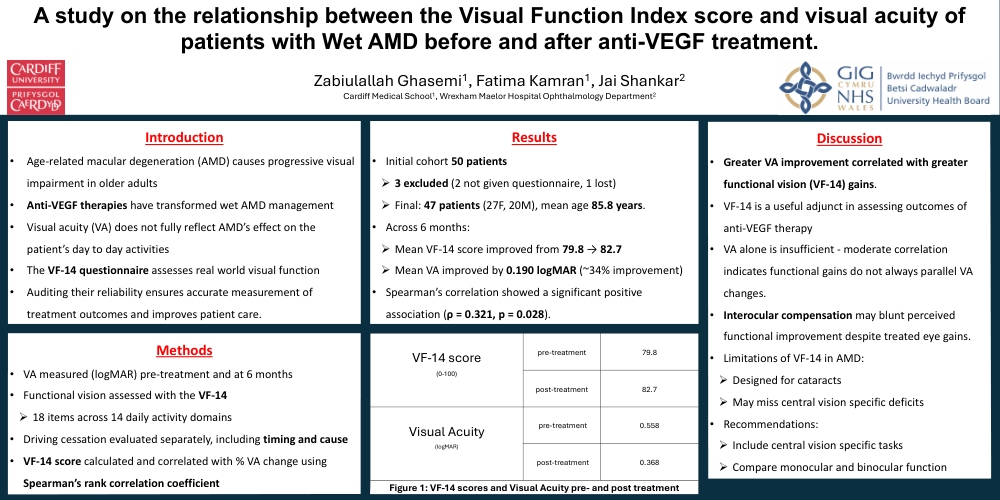
Forty-seven patients undergoing treatment for AMD completed the VF-14 questionnaire before and six months after anti-VEGF therapy. Visual acuity was measured using a Snellen chart and converted to logMAR. The VF-14 scores were calculated based on responses to 18 functional vision tasks. Spearman’s rank correlation coefficient was used to evaluate the relationship between percentage improvements in visual acuity and VF-14 scores.
Results
A statistically significant moderate positive correlation was found between percentage improvement in visual acuity and VF-14 scores (Spearman’s ρ = 0.321, p = 0.028), indicating that patients with greater clinical improvements tended to report better functional outcomes.
Discussion
Although a positive association was observed, the modest strength of the correlation suggests that visual acuity does not always equate to perceived improvements in daily functioning. This may be due to factors like interocular compensation. Given that the VF-14 was developed for cataract patients, its relevance to AMD could be improved by including tasks specific to central vision loss and considering monocular versus binocular performance.