296 posters, 7 videos, 13 audios, 14 topics, 10 sessions, 1,019 authors, 260 institutions
ePostersLive by SciGen Technologies S.A. All rights reserved.
RCOphth Annual Congress 2026
18 - 21 May, 2026 | Manchester Central, Manchester

P191
Safety of Intravitreal Injections in Patients with Thrombocytopenia: A mini-review
Poster Presenter
Authors
Miranda Buckle, Emily Fletcher, Kate Hellier, Quresh Mohamed
Affiliations
Part of Topic
Medical retina
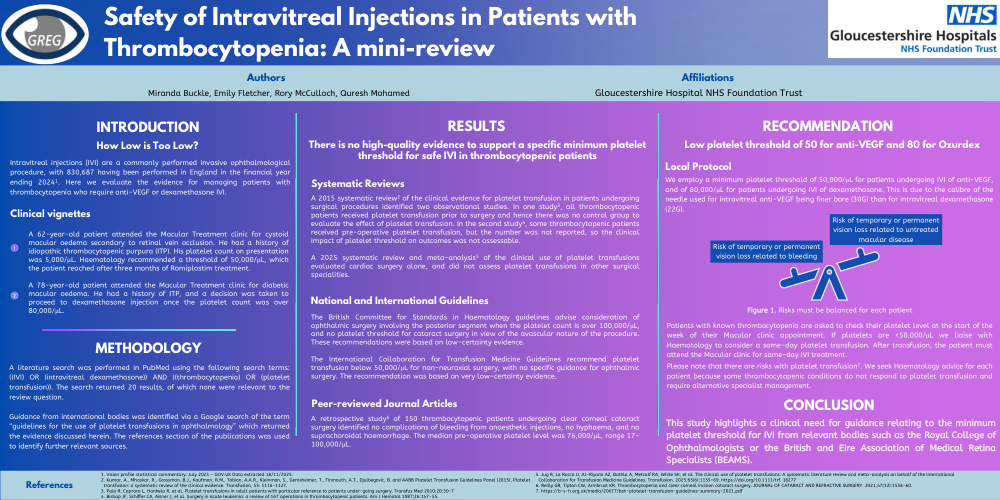
Intravitreal injections [IVI] are a commonly performed invasive ophthalmological procedure, with 830,687 having been performed in England in the financial year ending 2024. Here we evaluate the evidence for managing patients with thrombocytopenia who require anti-VEGF or dexamethasone IVI.
We employ a minimum platelet threshold of 50,000/μL for patients undergoing IVI of anti-VEGF, and of 80,000/μL for patients undergoing IVI of dexamethasone. This is due to the calibre of the needle used for intravitreal anti-VEGF being finer bore (30G) than for intravitreal dexamethasone (22G).
Patients with known thrombocytopenia are asked to check their platelet level at the start of the week of their Macular clinic appointment. If platelets are <50,000/μL we liaise with Haematology to consider a same-day platelet transfusion. After transfusion, the patient must attend the Macular clinic for same-day IVI treatment.
Please note that there are risks with platelet transfusion. We seek Haematology advice for each patient because some thrombocytopenic conditions do not respond to platelet transfusion and require alternative specialist management.
This study highlights a clinical need for guidance relating to the minimum platelet threshold for IVI from relevant bodies such as the Royal College of Ophthalmologists or the British and Eire Association of Medical Retina Specialists (BEAMS).