296 posters, 7 videos, 13 audios, 14 topics, 10 sessions, 1,019 authors, 260 institutions
ePostersLive by SciGen Technologies S.A. All rights reserved.
RCOphth Annual Congress 2026
18 - 21 May, 2026 | Manchester Central, Manchester

P177
Predictive factors for Activation in Quiescent Macular Neovascularization:�A Real-World OCTA-Based Cohort Analysis�
Poster Presenter
Authors
Part of Topic
Medical retina
PREDICTIVE FACTORS FOR ACTIVATION IN QUIESCENT MACULAR NEOVASCULARIZATION: A REAL-WORLD OCTA-BASED COHORT ANALYSIS
PURPOSE:
•To evaluate the activation rate of quiescent type 1 macular neovascularization (MNV)
•To identify OCTA–derived predictors of conversion to exudative disease.
METHODS:
•A retrospective longitudinal cohort study
•Inclusion Criteria: Eyes with treatment-naïve quiescent MNV associated with AMD or polypoidal choroidal vasculopathy.
•Structural OCT and OCTA parameters were analysed at baseline and during follow-up.
•Activation Definition: Development of intraretinal or subretinal fluid or haemorrhage requiring anti-VEGF therapy.
RESULTS:
•Follow up period: 35.9 months
•17 out of 50 eyes progressed to exudative disease
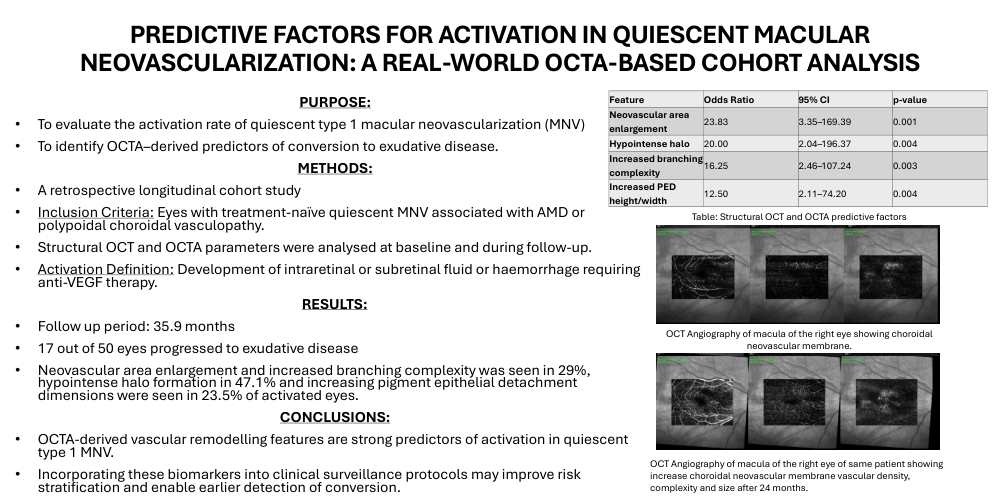
•Neovascular area enlargement and increased branching complexity was seen in 29%, hypointense halo formation in 47.1% and increasing pigment epithelial detachment dimensions were seen in 23.5% of activated eyes.
CONCLUSIONS:
•OCTA-derived vascular remodelling features are strong predictors of activation in quiescent type 1 MNV.
•Incorporating these biomarkers into clinical surveillance protocols may improve risk stratification and enable earlier detection of conversion.