296 posters, 7 videos, 13 audios, 14 topics, 10 sessions, 1,019 authors, 260 institutions
ePostersLive by SciGen Technologies S.A. All rights reserved.
RCOphth Annual Congress 2026
18 - 21 May, 2026 | Manchester Central, Manchester

P168
Impact of E-Cigarette Vaping on Ocular Symptoms and Retinal Microvasculature in Adolescents and Young Adults: A Systematic Review and Meta-Analysis
Poster Presenter
Authors
Erum Habib, Muhammad Ali Bin Jabir, Muhammad Imaz Bhatti, Sahla Waqas, Hashem Abu Serhan
Affiliations
Part of Topic
Medical retina
Title: Impact of E-Cigarette Vaping on Ocular Symptoms and Retinal Microvasculature in Adolescents and Young Adults: A Systematic Review and Meta-Analysis
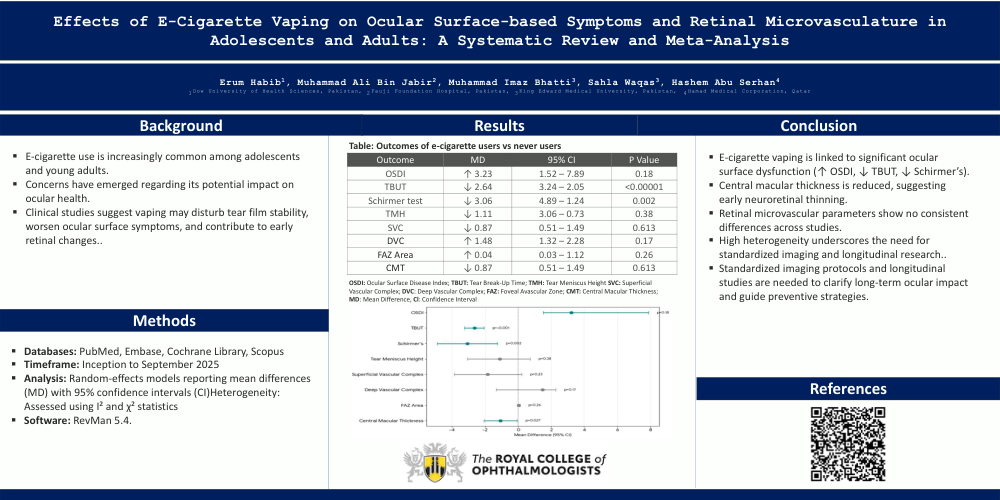
Background: E‑cigarette use has become increasingly common among adolescents and young adults, raising concerns about its impact on eye health. Clinical studies suggest that vaping may disturb tear film stability, worsen ocular surface symptoms, and contribute to early retinal changes. However, the overall evidence remains limited and fragmented. This meta‑analysis was conducted to assess the effects of e‑cigarette use on ocular surface parameters and retinal microvasculature compared with never users.
Objectives: To evaluate the impact of e-cigarette vaping on ocular surface parameters and retinal microvasculature compared with never users.
Methods: A systematic search of PubMed, Embase, Cochrane Library, and Scopus was conducted from inception to September 2025. Pooled estimates were calculated using random-effects models, reporting mean differences (MD) with 95% confidence intervals (CI). Heterogeneity was assessed using I² and χ² statistics. All analyses were performed using RevMan 5.4. A p-value <0.05 was considered statistically significant.
Results: This meta-analysis included six studies with 586 participants (e-cigarette users = 296; never users = 290). E-cigarette users showed significantly higher OSDI scores (MD 3.23, 95% CI: 1.52 to 7.89; P=0.18; I²=85%), shorter TBUT (MD –2.64, 95% CI: –3.24 to –2.05; P<0.00001; I²=37%), and lower Schirmer’s scores (MD –3.06, 95% CI: –4.89 to –1.24; P=0.002; I²=59%), indicating greater ocular surface dysfunction. No significant differences were observed in tear meniscus height (MD –1.11, 95% CI: –3.06 to 0.73; P=0.38; I²=86%), superficial vascular complex (MD –1.83, 95% CI: –3.86 to 0.21; P=0.23; I²=75%), deep vascular complex (MD 1.48, 95% CI: –1.32 to 2.28; P=0.17; I²=86%), or FAZ area (MD 0.04, 95% CI: –0.03 to 0.12; P=0.26; I²=0%). Central macular thickness was significantly reduced in e-cigarette users (MD –1.06, 95% CI: –2.05 to –0.07; P=0.027; I²=83%), suggesting early neuroretinal thinning.
Conclusion: E-cigarette vaping is associated with significant ocular surface impairment and reduced central macular thickness, suggesting early compromise of both tear film stability and neuroretinal integrity in young adults. Although no significant differences were observed in retinal microvascular parameters, the substantial heterogeneity across studies limits the strength of pooled estimates. These findings underscore the need for standardized imaging protocols and longitudinal studies to better characterize the ocular impact of vaping and guide preventive strategies.