296 posters, 7 videos, 13 audios, 14 topics, 10 sessions, 1,019 authors, 260 institutions
ePostersLive by SciGen Technologies S.A. All rights reserved.
RCOphth Annual Congress 2026
18 - 21 May, 2026 | Manchester Central, Manchester

P163
Faricimab Treatment in Bilateral Neovascular AMD: Real-World Outcomes and Fellow Eye Response
Poster Presenter
Authors
Christopher Stewart, Jaskaran Singh Bhangu, Parinita Swarnkar, Ahmed Al-Janabi, Mahmoud Awad, Gwyn Williams
Affiliations
Faculty of Medicine, Health, and Life Science, Swansea University, Swansea, Wales, UK, Ophthalmology department, Singleton Hospital, Swansea Bay University Health Board, Swansea, Wales, UK
Part of Topic
Medical retina
In neovascular age-related macular degeneration (nAMD), approximately 20% of patients with unilateral disease develop fellow eye involvement.(1) When this occurs in treatment-experienced patients already on anti-VEGF therapy, a clinical dilemma emerges: whether to switch both eyes to a new agent for standardised treatment. This study evaluated outcomes when patients on prior anti-VEGF monotherapy switched to Faricimab dual-pathway inhibition following fellow eye activation, with both eyes treated according to the worse-performing eye's requirements after loading. Primary objectives assessed anatomical efficacy (CMT reduction, dry macula achievement) in both eyes over five injections. Secondary objectives included functional outcomes (BCVA change), treatment interval extension capacity, and safety profile.
Single-centre retrospective study of 86 eyes from 43 patients with nAMD switched to Faricimab(November 2022 December 2024). Inclusion criteria: prior anti-VEGF therapy in the first eye, fellow eye activation requiring treatment initiation, and a minimum of five Faricimab injections. Treatment protocol: three monthly loading doses at 4 weekly intervals followed by a treat-and-extend regimen with injection intervals of both eyes dictated by the worse-performing eye. Intervals extended by 4 weeks if both eyes are dry, reduced by 2 weeks if active disease is present (minimum 4-week interval). Outcomes measured at baseline and after each injection: central macular thickness (CMT), best-corrected visual acuity (logMAR), fluid status (IRF, SRF, PED, haemorrhage). Thirty-seven eyes were pseudophakic (20 treatment-exposed, 17 naïve); none underwent surgery during the study period. Statistical analysis: paired t-tests for continuous variables, proportions test for categorical outcomes, significance p<0.05.
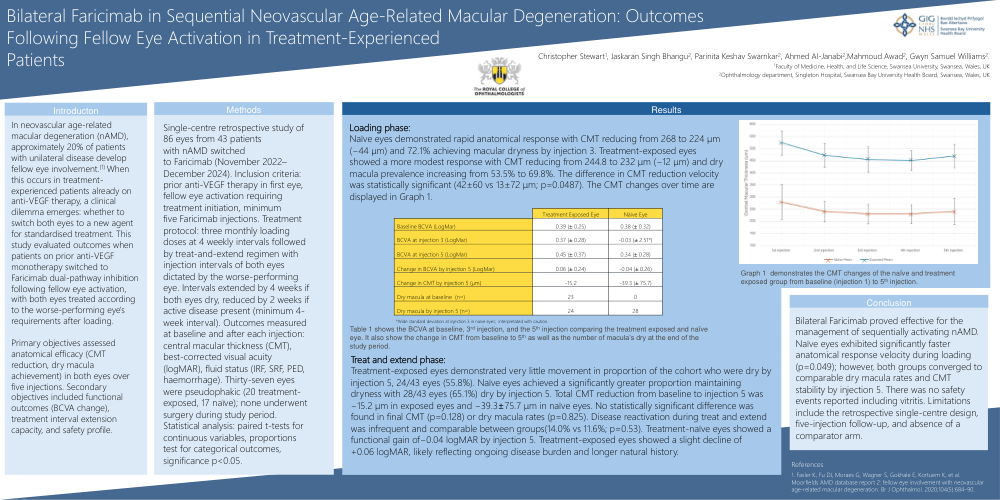
Loading phase: Naïve eyes demonstrated a rapid anatomical response with CMT reducing from 268 to 224 μm (−44 μm) and 72.1% achieving macular dryness by injection 3. Treatment-exposed eyes showed a more modest response with CMT reducing from 244.8 to 232 μm(−12 μm) and dry macula prevalence increasing from 53.5% to 69.8%. The difference in CMT reduction velocity was statistically significant (42±60 vs 13±72 μm; p=0.0487). The CMT changes over time are displayed in Graph 1.
Treat and extend phase: Treatment-exposed eyes demonstrated very little movement in proportion of the cohort who were dry by injection 5, 24/43 eyes (55.8%). Naïve eyes achieved a significantly greater proportion maintaining dryness with 28/43 eyes (65.1%) dry by injection 5. Total CMT reduction from baseline to injection 5 was −15.2μmin exposed eyes and −39.3±75.7μmin naïve eyes. No statistically significant difference was found in final CMT (p=0.128) or dry macula rates (p=0.825). Disease reactivation during treat and extend was infrequent and comparable between groups(14.0% vs 11.6%; p=0.53). Treatment-naïve eyes showed a functional gain of−0.04logMARby injection 5. Treatment-exposed eyes showed a slight decline of +0.06logMAR, likely reflecting ongoing disease burden and longer natural history.
Bilateral Faricimab improved effectiveness for the management of sequentially activating nAMD. Naïve eyes exhibited significantly faster anatomical response velocity during loading (p=0.049); however, both groups converged to comparable dry macula rates and CMT stability by injection 5. There were no safety events reported, including vitritis. Limitations include the retrospective single-centre design, five-injection follow-up, and absence of a comparator arm.