296 posters, 7 videos, 13 audios, 14 topics, 10 sessions, 1,019 authors, 260 institutions
ePostersLive by SciGen Technologies S.A. All rights reserved.
RCOphth Annual Congress 2026
18 - 21 May, 2026 | Manchester Central, Manchester

P146
Challenging the Treatment Threshold: Early Faricimab Prevents Vision Loss in nAMD - A Real-World Welsh Experience
Poster Presenter
Part of Topic
Medical retina
Audio
Abstract
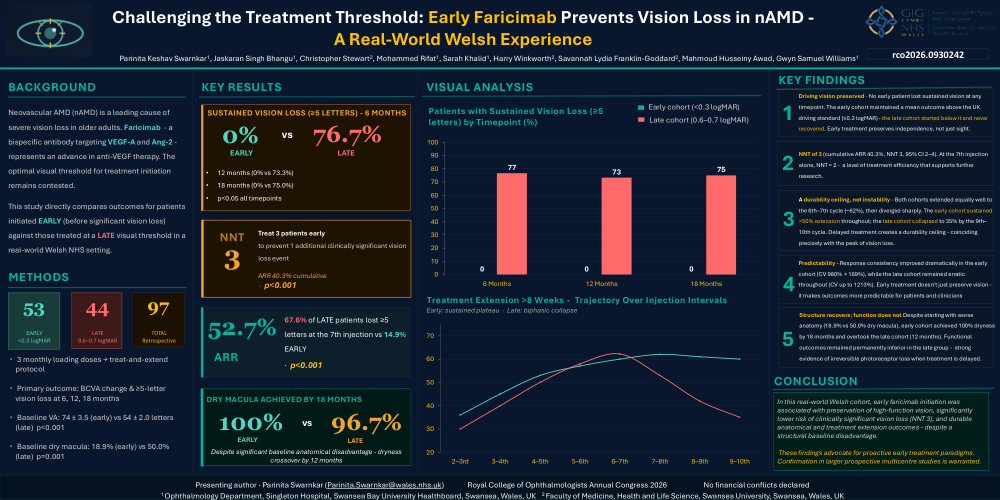
Purpose: To compare real-world outcomes in treatment-naïve neovascular age-related macular degeneration (nAMD) patients initiated on Faricimab at early (<0.3 logMAR) versus late (0.6–0.7 logMAR) visual thresholds.
Methods: Retrospective, single-centre cohort study of 97 patients (53 early, 44 late) treated at a UK centre, with three monthly loading doses followed by treat-and-extend. Outcomes: BCVA change, vision loss (≥5 letters), stable vision at 6/12/18 months, injection intervals, extension >8 weeks, dry macula.
Results: Baseline VA was 74 ± 3.5 letters (early) vs 54 ± 2.0 letters (late), p<0.001. No early patient experienced sustained vision loss at 6, 12, or 18 months compared with 76.7%, 73.3%, and 75.0% of late patients, respectively (p<0.05 for all). At the 7th injection, 67.6% of late patients lost ≥5 letters vs 14.9% of early patients (ARR 52.7%, p<0.001). Cumulatively, 81.8% of late patients experienced ≥5-letter loss vs 41.5% of early patients (ARR 40.3%, NNT 3, p<0.001). Mean injection intervals were similar, but the early cohort sustained extension beyond 8 weeks in >50% of eyes from the 4th–5th interval onward. In contrast, the late cohort exhibited a biphasic collapse, with extension rates declining from 62.2% at 6th–7th to only 35.0% by 9th–10th. Despite a significant baseline anatomical disadvantage (18.9% vs 50.0% dry macula, p=0.001), the early cohort achieved 100% dryness by 18 months compared with 96.7% in the late cohort, with crossover occurring by 12 months (95.8% vs 89.7%, p=0.269).
Conclusion: In this retrospective, single-centre study, early faricimab initiation was associated with preservation of high-function vision, a lower risk of clinically significant vision loss, and high rates of anatomical quiescence and durable treatment extension. These findings suggest that proactive early intervention may offer advantages over reactive treatment paradigms, although confirmation in larger, prospective, and multi-centre studies is needed.