296 posters, 7 videos, 13 audios, 14 topics, 10 sessions, 1,019 authors, 260 institutions
ePostersLive by SciGen Technologies S.A. All rights reserved.
RCOphth Annual Congress 2026
18 - 21 May, 2026 | Manchester Central, Manchester

P145
Centre-Involving Diabetic Macular Oedema Treatment Strategies: A Validated NHS England Wide Delphi Approach Supporting NHSE Commissioning Treatment Priorities
Poster Presenter
Authors
Richard Gale, Louise Downey, Christiana Dinah, Arijit Mitra, Helen Devonport, Michael Grinton, Clare Bailey, Christina Rennie, Luke Nicholson, Maged Habib
Affiliations
HYMS, University of York, York and Scarborough NHS Teaching Hospital NHS Foundation Trust, United Kingdom, Leeds Teaching hospitals NHS Trust and Hull and East Yorkshire NHS Trust, United Kingdom, London Northwest University Healthcare NHS Trust, United Kingdom, Birmingham and Midland Eye Centre, United Kingdom,
Part of Topic
Medical retina
Introduction
Eye care is the NHS’s highest-volume outpatient specialty, and treatments for retinal vascular conditions represent some of the costliest and most frequently used in secondary care. The NHSE commissioning priorities for DMO aim to reduce variation in care and improve cost-effectiveness while maintaining clinician choice and ensuring timely intervention to prevent vision loss.
Purpose
The treatment landscape for centre-involved diabetic macular oedema (CI-DMO) is evolving rapidly, with longer-acting anti-VEGF agents, biosimilars, and updated NICE recommendations supporting the use of corticosteroids in phakic patients. NHSE commissioning prioritises high-quality, cost-effective care that ensures patients receive the most appropriate therapy at the right time. Against this backdrop, establishing a validated consensus to define the optimal use of anti-VEGFs and corticosteroids in CI-DMO. Updating current care pathways accordingly aims to provide clear, evidence-based direction for clinicians and supports implementation of NHSE treatment guidance, align with national and ICB priorities, and promotes consistent, patient-centred care.
Methods
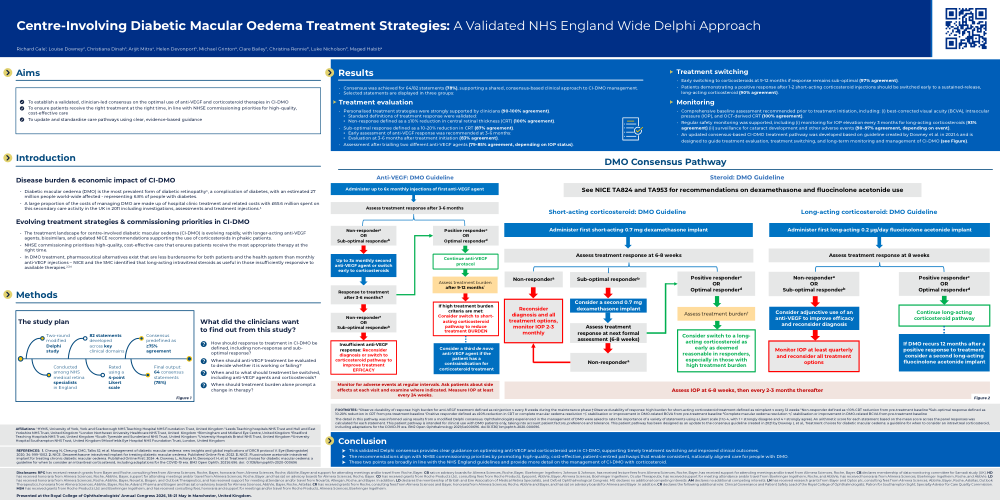
A modified Delphi process was undertaken with 10 medical retina specialists across NHS England. Individual and anonymous opinions were collected by completing an 82-item questionnaire across seven topics (approach to care and patient outcomes, baseline assessments and monitoring, key definitions, anti-VEGF switching and stopping criteria, corticosteroids as first-line treatment, corticosteroid stopping and switching criteria, and corticosteroid benefits, risks, and mitigation strategies). Two iterative online survey rounds were conducted. Statements were rated using a 4-point Likert scale with a predefined consensus threshold of ≥ 75% agreement. Statements not reaching this threshold were revised and retested in a second round.
Results
Consensus was achieved in 64/82 statements (78%). Key outcomes included: consensus on the value of personalised treatment strategies, consensus to validate a definition of non-response to intravitreal treatment for DMO as a reduction in Central Retinal Thickness (CRT) by ≤10%, and a suboptimal response as a reduction in CRT by 10-20%. Early evaluation of anti-VEGF treatment response was recommended at 3-6 months and after trying two different anti-VEGF agents. Switching early (after 9-12 months) to corticosteroids if response remains sub-optimal. Patients who achieved a positive response after 1-2 injections of short-acting corticosteroid should then be switched early to a sustained-release, long-acting corticosteroid.
Conclusions
This validated Delphi consensus provides clear guidance on optimising anti-VEGF and corticosteroid use in CI-DMO, supporting timely treatment switching and improved clinical outcomes. The recommendations align with NHSE commissioning priorities by promoting high-quality, cost-effective, patient-centred pathways that enable consistent, nationally aligned care for people with DMO.