226 posters, 5 topics, 20 sessions, 598 authors, 292 institutions
ePostersLive by SciGen Technologies S.A. All rights reserved.
Obstetric Anaesthesia Annual Scientific Meeting 2026
14-15 May 2026 | Liverpool Convention Centre

7163817
A quality improvement project to create an epidural troubleshooting guideline for midwives
Poster Presenter
Authors
Affiliations
Part of Topic
Quality Improvement
Background
The on-call anaesthetist is frequently contacted by midwives to troubleshoot epidurals. The resulting interventions required are usually simple, such as turning the patient laterally for topping up a one-sided block.
In busy maternity units, delays in anaesthetic review may lead to prolonged maternal discomfort and a worse maternal experience.
An epidural guideline to assist midwives in epidural troubleshooting existed on the hospital intranet. However, it was necessary to search through the trust-wide clinical guidelines to access it.
It is also lengthy and text-heavy, limiting its accessibility and use.
Method
16 Midwives at Queen Charlotte's and Chelsea Hospital were surveyed using a 3 question yes/no questionnaire to assess awareness and usability of the existing
epidural guideline.
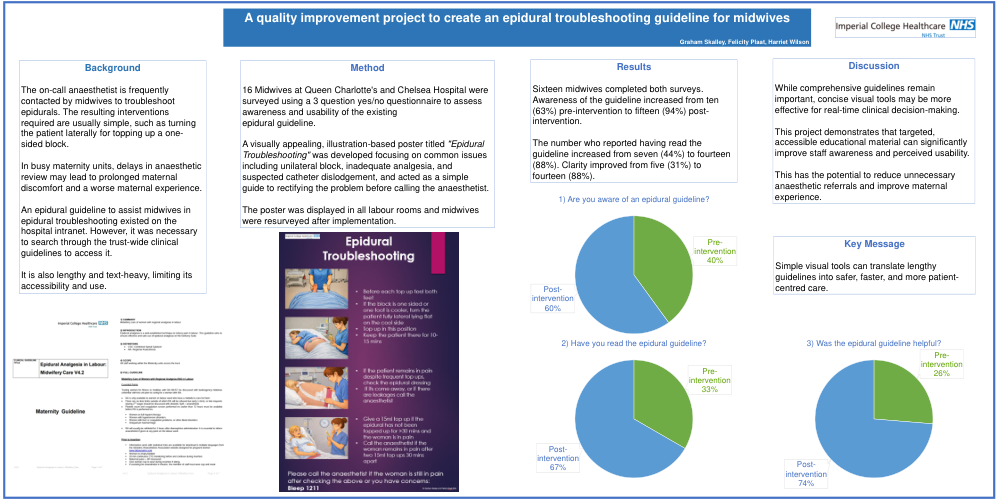
A visually appealing, illustration-based poster titled "Epidural Troubleshooting" was developed focusing on common issues including unilateral block, inadequate analgesia, and suspected catheter dislodgement, and acted as a simple guide to rectifying the problem before calling the anaesthetist.
The poster was displayed in all labour rooms and midwives were resurveyed after implementation.
Results
Sixteen midwives completed both surveys. Awareness of the guideline increased from ten (63%) pre-intervention to fifteen (94%) post-intervention.
The number who reported having read the guideline increased from seven (44%) to fourteen (88%). Clarity improved from five (31%) to fourteen (88%).
Discussion
While comprehensive guidelines remain important, concise visual tools may be more effective for real-time clinical decision-making.
This project demonstrates that targeted, accessible educational material can significantly improve staff awareness and perceived usability.
This has the potential to reduce unnecessary anaesthetic referrals and improve maternal experience.
Key Message
Simple visual tools can translate lengthy guidelines into safer, faster, and more patient-centred care.