226 posters, 5 topics, 20 sessions, 598 authors, 292 institutions
ePostersLive by SciGen Technologies S.A. All rights reserved.
Obstetric Anaesthesia Annual Scientific Meeting 2026
14-15 May 2026 | Liverpool Convention Centre

7149399
Improving communication during a Major Obstetric Haemorrhage: a second cycle Quality Improvement Project
Poster Presenter
Authors
Affiliations
Part of Topic
Quality Improvement
Introduction
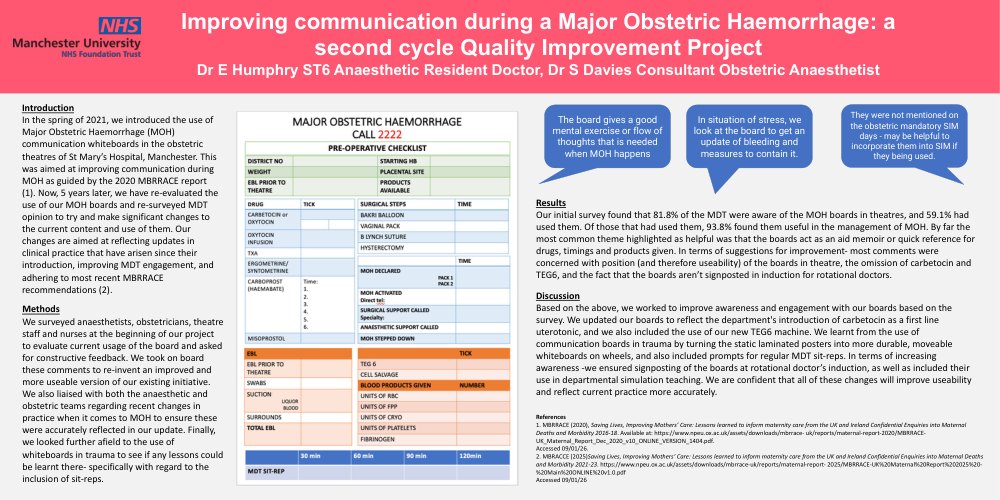
In the spring of 2021, we introduced the use of Major Obstetric Haemorrhage (MOH) communication whiteboards in the obstetric theatres of St Mary’s Hospital, Manchester. This was aimed at improving communication during MOH as guided by the 2020 MBRRACE report (1). Now, 5 years later, we have re-evaluated the use of our MOH boards and re-surveyed MDT opinion to try and make significant changes to the current content and use of them. Our changes are aimed at reflecting updates in clinical practice that have arisen since their introduction, improving MDT engagement, and adhering to most recent MBRRACE recommendations (2).
Methods
We surveyed anaesthetists, obstetricians, theatre staff and nurses at the beginning of our project to evaluate current usage of the board and asked for constructive feedback. We took on board these comments to re-invent an improved and more useable version of our existing initiative. We also liaised with both the anaesthetic and obstetric teams regarding recent changes in practice when it comes to MOH to ensure these were accurately reflected in our update. Finally, we looked further afield to the use of whiteboards in trauma to see if any lessons could be learnt there- specifically with regard to the inclusion of sit-reps.
Results
Our initial survey found that 81.8% of the MDT were aware of the MOH boards in theatres, and 59.1% had used them. Of those that had used them, 93.8% found them useful in the management of MOH. By far the most common theme highlighted as helpful was that the boards act as an aid memoir or quick reference for drugs, timings and products given. In terms of suggestions for improvement- most comments were concerned with position (and therefore useability) of the boards in theatre, the omission of carbetocin and TEG6, and the fact that the boards aren’t signposted in induction for rotational doctors.
Discussion
Based on the above, we worked to improve awareness and engagement with our boards based on the survey. We updated our boards to reflect the department's introduction of carbetocin as a first line uterotonic, and we also included the use of our new TEG6 machine. We learnt from the use of communication boards in trauma by turning the static laminated posters into more durable, moveable whiteboards on wheels, and also included prompts for regular MDT sit-reps. In terms of increasing awareness -we ensured signposting of the boards at rotational doctor’s induction, as well as included their use in departmental simulation teaching. We are confident that all of these changes will improve useability and reflect current practice more accurately.