226 posters, 5 topics, 20 sessions, 598 authors, 292 institutions
ePostersLive by SciGen Technologies S.A. All rights reserved.
Obstetric Anaesthesia Annual Scientific Meeting 2026
14-15 May 2026 | Liverpool Convention Centre

7162643
Early initiation of skin to skin contact during caesarean birth: a quality improvement project
Poster Presenter
Authors
Affiliations
Part of Topic
Quality Improvement
Early initiation of skin to skin contact during caesarean birth: a quality improvement project
Introduction
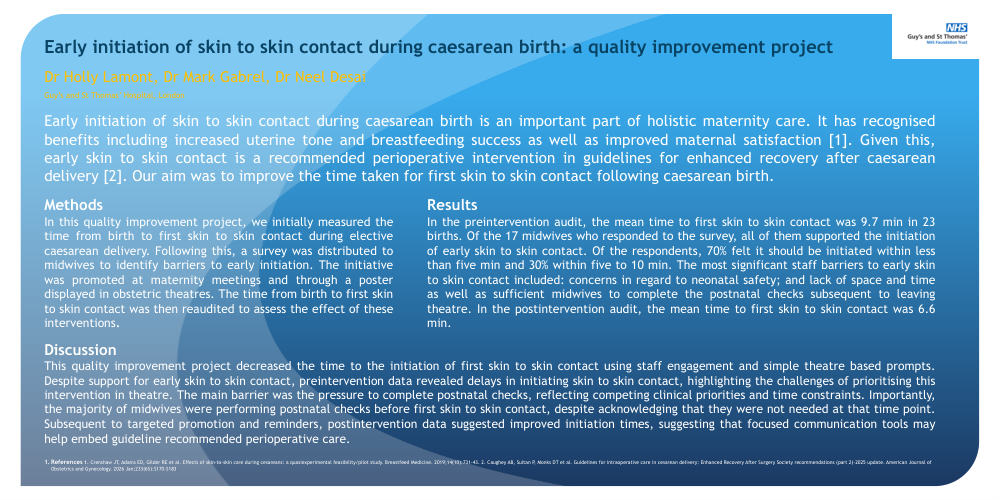
Early initiation of skin to skin contact during caesarean birth is an important part of holistic maternity care. It has recognised benefits including increased uterine tone and breastfeeding success as well as improved maternal satisfaction [1]. Given this, early skin to skin contact is a recommended perioperative intervention in guidelines for enhanced recovery after caesarean delivery [2]. Our aim was to improve the time taken for first skin to skin contact following caesarean birth.
Methods
In this quality improvement project, we initially measured the time from birth to first skin to skin contact during elective caesarean delivery. Following this, a survey was distributed to midwives to identify barriers to early initiation. The initiative was promoted at maternity meetings and through a poster displayed in obstetric theatres. The time from birth to first skin to skin contact was then reaudited to assess the effect of these interventions.
Results
In the preintervention audit, the mean time to first skin to skin contact was 9.7 min in 23 births. Of the 17 midwives who responded to the survey, all of them supported the initiation of early skin to skin contact. Of the respondents, 70% felt it should be initiated within less than five min and 30% within five to 10 min. The most significant staff barriers to early skin to skin contact included: concerns in regard to neonatal safety; and lack of space and time as well as sufficient midwives to complete the postnatal checks subsequent to leaving theatre. In the postintervention audit, the mean time to first skin to skin contact was 6.6 min.
Discussion
This quality improvement project decreased the time to the initiation of first skin to skin contact using staff engagement and simple theatre based prompts. Despite support for early skin to skin contact, preintervention data revealed delays in initiating skin to skin contact, highlighting the challenges of prioritising this intervention in theatre. The main barrier was the pressure to complete postnatal checks, reflecting competing clinical priorities and time constraints. Importantly, the majority of midwives were performing postnatal checks before first skin to skin contact, despite acknowledging that they were not needed at that time point. Subsequent to targeted promotion and reminders, postintervention data suggested improved initiation times, suggesting that focused communication tools may help embed guideline recommended perioperative care.
References
- Crenshaw JT, Adams ED, Gilder RE et al. Effects of skin-to-skin care during cesareans: a quasiexperimental feasibility/pilot study. Breastfeed Medicine. 2019;14(10):731-43.
- Caughey AB, Sultan P, Monks DT et al. Guidelines for intraoperative care in cesarean delivery: Enhanced Recovery After Surgery Society recommendations (part 2)-2025 update. American Journal of Obstetrics and Gynecology. 2026 Jan;233(6S):S170-S183.