226 posters, 5 topics, 20 sessions, 598 authors, 292 institutions
ePostersLive by SciGen Technologies S.A. All rights reserved.
Obstetric Anaesthesia Annual Scientific Meeting 2026
14-15 May 2026 | Liverpool Convention Centre

7162468
Improving equity and efficiency in labour epidural consent using QR codes: a quality improvement project
Poster Presenter
Part of Topic
Quality Improvement
Improving Equity and Efficiency on Labour Epidural Consent using QR Codes: A Quality Improvement Project
Background
Informed consent for labour epidural analgesia requires understanding of the risks, benefits and alternatives. For patients whose first language is not English, barriers such as limited access to translated information, time pressures and reliance on interpreters contribute to care inequalities [1].
In our tertiary obstetric centre, provision of translated epidural information was inconsistent, highlighting the need for a more accessible and sustainable approach to support equitable consent.
Our aims:
- To improve equitable access to information about labour epidural analgesia and support informed consent.
- To improve the efficiency and experience of the anaesthetic consent process.
Initial Survey
Baseline surveys were completed by 15 postnatal patients and 18 anaesthetists.
Patient survey assessed:
- First language
- Receipt of epidural information
- Self-rated understanding (0–10)
- Willingness to use QR-code resources
Anaesthetist survey explored:
- Provision of written information for non-English speaking patients
- Interpreter use
- Perceived impact of language barriers on consent time
Summary of Results:
Post-natal Patients:
- All English-speaking patients (6) reported receiving written or digital epidural information antenatally or intrapartum, compared with 1/9 non-English-speaking patients.
- 66% (6/9) of non-English-speaking patients stated they would use a QR-code resource if available.
Anaesthetists:
- Written information was provided variably when obtaining consent from non-English-speaking patients.
- Professional interpreters were used by 14/18 anaesthetists.
- Consent commonly took an additional 20+ minutes in these patients
Positive Change
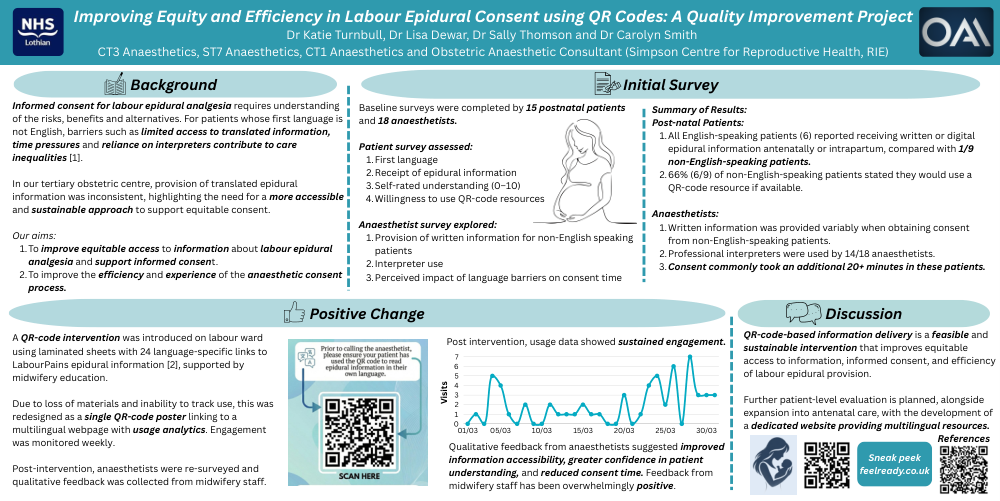
A QR-code intervention was introduced on labour ward using laminated sheets with 24 language-specific links to LabourPains epidural information [2], supported by midwifery education.
Due to loss of materials and inability to track use, this was redesigned as a single QR-code poster linking to a multilingual webpage with usage analytics. Engagement was monitored weekly.
Post-intervention, anaesthetists were re-surveyed and qualitative feedback was collected from midwifery staff.
Post intervention, usage data showed sustained engagement.
Qualitative feedback from anaesthetists suggested improved information accessibility, greater confidence in patient understanding, and reduced consent time. Feedback from midwifery staff has been overwhelmingly positive.
Discussion
QR-code-based information delivery is a feasible and sustainable intervention that improves equitable access to information, informed consent, and efficiency of labour epidural provision.
Further patient-level evaluation is planned, alongside expansion into antenatal care, with the development of a dedicated website providing multilingual resources.
References
1. Calabrese F, Mele P, Stella M et al. Enhancing epidural analgesia access during labor: a pilot study on the use of translated informational materials. Journal of Anesthesia, Analgesia and Critical Care. 2025; 5: 48.
2. Obstetric Anaesthetists’ Association, Labour Pains: information on pain relief and anaesthesia for labour and birth. http://www.labourpains.org, 2026 (accessed 17 January 2026).