226 posters, 5 topics, 20 sessions, 598 authors, 292 institutions
ePostersLive by SciGen Technologies S.A. All rights reserved.
Obstetric Anaesthesia Annual Scientific Meeting 2026
14-15 May 2026 | Liverpool Convention Centre

7158432
Standardising NSAID prescribing practices at the Princess Royal Maternity Unit
Poster Presenter
Authors
Affiliations
Part of Topic
Quality Improvement
The National Institute for Clinical Excellence (NICE) recommend that all women receive a regular non-steroidal anti-inflammatory (NSAID) after caesarean birth1. At the Princess Royal Maternity (PRM) unit, Glasgow, we have historically administered rectal diclofenac at the end of a caesarean birth followed by regular diclofenac. Since the introduction of electronic prescribing, we saw a shift away from this practice. We conducted an audit of our NSAID prescribing practices for women undergoing a caesarean birth at our unit to identify variation and inform future standardisation.
Methods
All caesarean births at the PRM between 01/09/25-14/09/25 (N=103) were included. A review of electronic clinical records was conducted to establish the type of caesarean birth (emergency vs elective), timing of NSAID prescription relative to anaesthetic commencement and the route of administration of NSAIDs. Data analysis was performed using Microsoft Excel. Following analysis, a survey was then sent to all anaesthetic doctors who worked within our unit to assess their view on the best method of NSAID administration and agreement with the statement 'for an uncomplicated caesarean birth under spinal, the NSAID should be administered within 4 hours'. To allow for cost analysis of different prescribing practices, we consulted our hospital pharmacy department. Caldicott approval was obtained for this project.
Results
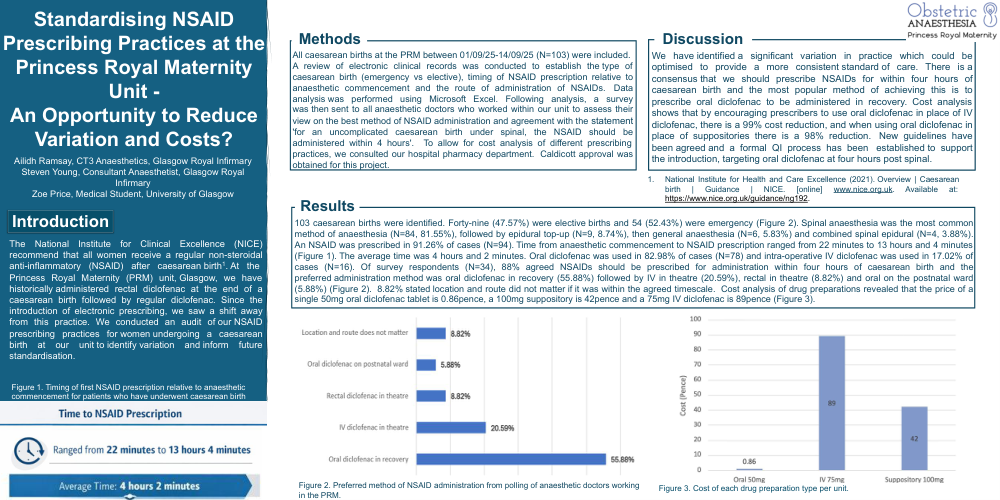
103 caesarean births were identified. Forty-nine (47.57%) were elective births and 54 (52.43%) were emergency (Figure 2). Spinal anaesthesia was the most common method of anaesthesia (N=84, 81.55%), followed by epidural top-up (N=9, 8.74%), then general anaesthesia (N=6, 5.83%) and combined spinal epidural (N=4, 3.88%). An NSAID was prescribed in 91.26% of cases (N=94). Time from anaesthetic commencement to NSAID prescription ranged from 22 minutes to 13 hours and 4 minutes (Figure 1). The average time was 4 hours and 2 minutes. Oral diclofenac was used in 82.98% of cases (N=78) and intra-operative IV diclofenac was used in 17.02% of cases (N=16). Of survey respondents (N=34), 88% agreed NSAIDs should be prescribed for administration within four hours of caesarean birth and the preferred administration method was oral diclofenac in recovery (55.88%) followed by IV in theatre (20.59%), rectal in theatre (8.82%) and oral on the postnatal ward (5.88%) (Figure 2). 8.82% stated location and route did not matter if it was within the agreed timescale. Cost analysis of drug preparations revealed that the price of a single 50mg oral diclofenac tablet is 0.86pence, a 100mg suppository is 42pence and a 75mg IV diclofenac is 89pence (Figure 3).
Discussion
We have identified a significant variation in practice which could be optimised to provide a more consistent standard of care. There is a consensus that we should prescribe NSAIDs for within four hours of caesarean birth and the most popular method of achieving this is to prescribe oral diclofenac to be administered in recovery. Cost analysis shows that by encouraging prescribers to use oral diclofenac in place of IV diclofenac, there is a 99% cost reduction, and when using oral diclofenac in place of suppositories there is a 98% reduction. New guidelines have been agreed and a formal QI process has been established to support the introduction, targeting oral diclofenac at four hours post spinal.
National Institute for Health and Care Excellence (2021). Overview | Caesarean birth | Guidance | NICE. [online] www.nice.org.uk. Available at: https://www.nice.org.uk/guidance/ng192.