226 posters, 5 topics, 20 sessions, 598 authors, 292 institutions
ePostersLive by SciGen Technologies S.A. All rights reserved.
Obstetric Anaesthesia Annual Scientific Meeting 2026
14-15 May 2026 | Liverpool Convention Centre

7158044
Shake It Off: a quality improvement project to reduce intraoperative shivering in obstetric patients under neuraxial anaesthesia
Poster Presenter
Authors
Affiliations
Part of Topic
Quality Improvement
Introduction
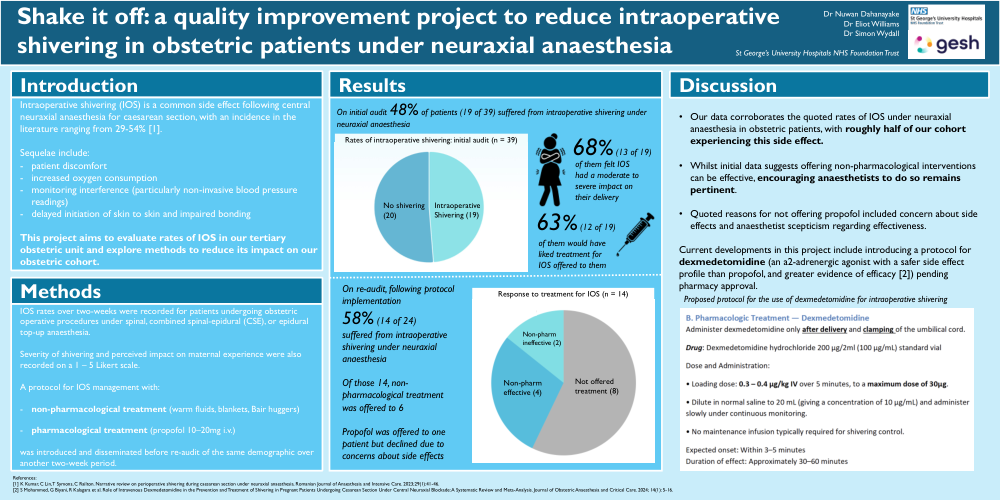
Intraoperative shivering (IOS) is a common side effect following central neuraxial anaesthesia for caesarean section, with an incidence in the literature ranging from 29-54% [1]. Sequelae include patient discomfort, increased oxygen consumption, and monitoring interference – particularly noninvasive blood pressure readings. The unpleasant effects of IOS on the mother may lead to delayed initiation of skin to skin and impaired bonding with their newborn baby. This project aims to evaluate rates of IOS in our tertiary obstetric unit and explore methods to reduce its impact on our obstetric cohort.
Methods
Initial rates of IOS over two-weeks were recorded from standard anaesthetic follow up of patients undergoing obstetric operative procedures under spinal, combined spinal-epidural, or epidural top-up anaesthesia. Severity of shivering and perceived impact on maternal experience were also recorded on a 1 – 5 Likert scale. A protocol for IOS management with non-pharmacological (warm fluids, blankets, Bair huggers) and pharmacological (propofol 10–20mg i.v.) treatment was introduced and disseminated before re-audit of the same demographic over another two-week period.
Results
The initial audit observed 39 theatre cases under neuraxial anaesthesia. Nineteen patients (48%) suffered from IOS: 13 considered its impact on their delivery ‘moderate to severe’, with 12 patients indicating they would’ve liked treatment for it if available. Following protocol introduction, our reaudit observed 24 theatre cases with 14 patients (54%) suffering from IOS. Six of these patients were offered non-pharmacological treatment, which in four cases was reported as ‘significantly effective’ by patients at follow up. Only one patient was offered propofol for IOS and declined at the time.
Discussion
Our data corroborates the quoted rates of IOS under neuraxial anaesthesia in obstetric patients, with roughly half of our cohort experiencing this side effect. Whilst initial data suggests offering non-pharmacological interventions can be effective, encouraging anaesthetists to do so remains pertinent. Quoted reasons for not offering propofol included concern about side effects and anaesthetist scepticism regarding effectiveness. Current developments in this project include introducing a protocol for the use of dexmedetomidine (an a2-adrenergic agonist with a safer side effect profile than propofol, and greater evidence of efficacy [2]) to improve treatment of IOS in our unit.
[1] K Kumar, C Lin, T Symons, C Railton. Narrative review on perioperative shivering during caesarean section under neuraxial anaesthesia. Romanian Journal of Anaesthesia and Intensive Care. 2023;29(1):41-46.
[2] S Mohammed, G Biyani, R Kalagara et al. Role of Intravenous Dexmedetomidine in the Prevention and Treatment of Shivering in Pregnant Patients Undergoing Cesarean Section Under Central Neuraxial Blockade: A Systematic Review and Meta-Analysis. Journal of Obstetric Anaesthesia and Critical Care. 2024; 14(1): 5-16.