226 posters, 5 topics, 20 sessions, 598 authors, 292 institutions
ePostersLive by SciGen Technologies S.A. All rights reserved.
Obstetric Anaesthesia Annual Scientific Meeting 2026
14-15 May 2026 | Liverpool Convention Centre

7157983
Total intravenous anaesthesia for lower-segment Caesarean section: a scoping review
Poster Presenter
Part of Topic
Original Research
Title
Total intravenous anaesthesia for lower-segment Caesarean section: a scoping review
Introduction
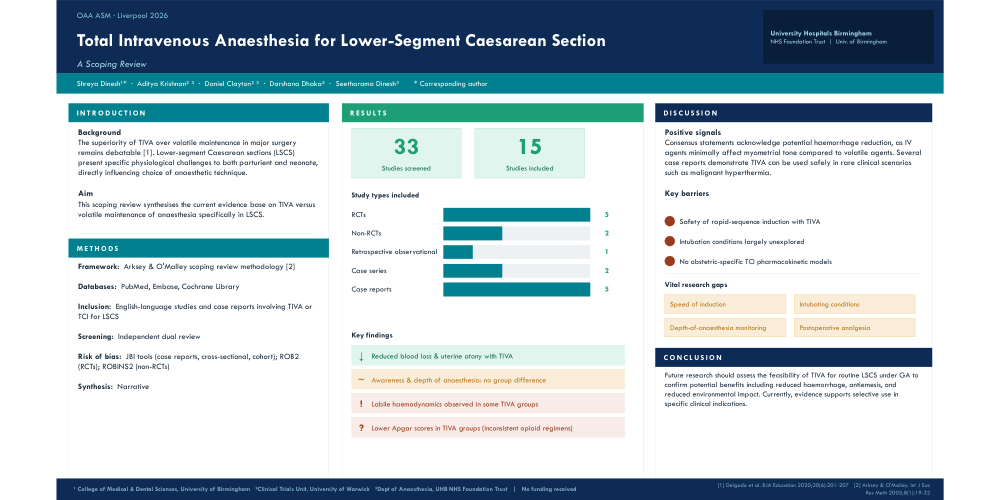
The superiority of maintaining anaesthesia by total intravenous anaesthesia (TIVA) compared to volatiles in major surgery remains debatable. Lower-segment Caesarean sections (LSCS) pose specific physiological challenges to parturient and baby, influencing method of anaesthesia [1]. This scoping review aims to synthesise the current evidence base on TIVA versus volatile maintenance of anaesthesia in LSCS.
Methods
The scoping review conducted using the Arksey and O’Malley framework, aimed to understand the state of literature on TIVA use for LSCS, including indications, TIVA protocols and commonly studied outcomes [2]. PubMed, Embase, and Cochrane Library were searched for English-language studies and case reports involving TIVA or target-controlled infusion (TCI) for LSCS. Two reviewers independently screened studies. Risk of bias (ROB) analysis was performed: JBI tools for case report, cross sectional and cohort studies; ROB2 tool for randomised controlled trials (RCTs); ROBINS2 for non-RCT to describe study limitations. Evidence was narratively synthesised.
Results
Of the 33 initially screened studies, 15 were included: five case reports, two case series, one retrospective observational, two prospective and five RCTs. ROB was low for most studies, particularly RCTs. Overall, studies demonstrated reduced blood loss and uterine atony with TIVA. Haemodynamics appeared labile in some TIVA groups. Some studies showed lower Apgar scores in TIVA groups, although opioid regimens were inconsistent. Awareness incidence and depth of anaesthesia were no different across groups though to power such studies would require a considerably larger population.
Discussion
We found several case reports, local guidance and few low-bias RCTs on TIVA use in obstetrics. Consensus statements acknowledged potential haemorrhage reduction, as IV agents minimally affect myometrial tone versus volatiles. Key barriers to TIVA in parturients include safety of rapid‑sequence induction; unexplored intubation safety; and no obstetric-specific TCI models. Vital research gaps are speed of induction, intubating conditions, use of depth-of-anaesthesia monitoring, and postoperative analgesia. While case reports show TIVA can be used safely in rare scenarios (e.g. malignant hyperthermia), future research should assess its feasibility for routine LSCS under GA to confirm benefits such as reduced haemorrhage, antiemesis, and environmental impact.
No funding was received.