226 posters, 5 topics, 20 sessions, 598 authors, 292 institutions
ePostersLive by SciGen Technologies S.A. All rights reserved.
Obstetric Anaesthesia Annual Scientific Meeting 2026
14-15 May 2026 | Liverpool Convention Centre

7148996
ROTEM to the rescue: optimising haemorrhage management in placenta accreta spectrum
Poster Presenter
Authors
Rachel Murali-Krishnan, Tim Hughes, Louise Murray, Melanie Woolnough
Affiliations
Part of Topic
Original Research
ROTEM to the rescue: optimising haemorrhage management in placenta accreta spectrum
Introduction
Placenta accreta spectrum (PAS) is a disorder of the placenta ranging from abnormally adherent to deeply invasive placental tissue. There is high maternal morbidity associated with PAS related to postpartum haemorrhage (PPH)1. Fibrinogen has been shown to fall earlier than other coagulation factors in moderate PPH. There has been increasing use of point-of-care viscoelastometric haemostatic assays including rotational thromboelastometry (ROTEM) to guide management of coagulopathy in PPH2.
Methods
After audit department approval, women with PAS were consented for inclusion in a database at Sheffield Teaching Hospitals (STH), a tertiary referral centre for PAS. Data was analysed, retrospectively, for patients delivered between 16/11/2010 and 28/04/2025. Mann-Whitney U tests were used to compare estimated blood loss (EBL), administration of blood products and fibrinogen for patients where ROTEM was, and was not, used.
Results
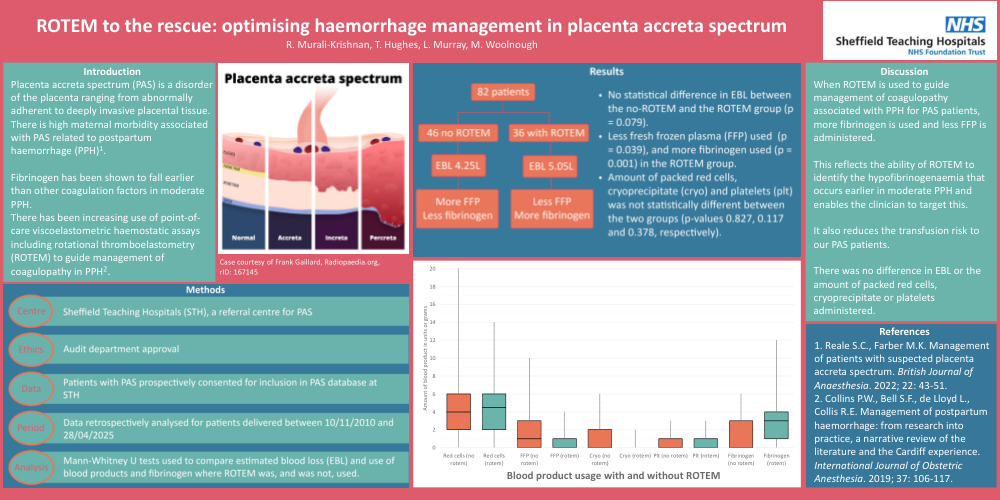
A total of 82 patients with PAS were delivered at STH during this period, 46 had no ROTEM use and 36 did. The median EBL was 4.25L in the no-ROTEM group compared to 5.05L in the ROTEM group, this was not statistically significant (p = 0.079). There was less fresh frozen plasma (FFP) used (p = 0.039), and more fibrinogen used (p = 0.001) in the ROTEM group. The amount of packed red cells, cryoprecipitate (cryo) and platelets (plt) was not statistically different between the two groups (p values 0.827, 0.117 and 0.378, respectively).
Discussion
When ROTEM is used to guide management of coagulopathy associated with PPH for PAS patients, more fibrinogen is used and less FFP is administered. This reflects the ability of ROTEM to identify the hypofibrinogenaemia that occurs earlier in moderate PPH and enables the clinician to target this. It also reduces the transfusion risk to our PAS patients. There was no difference in EBL or the amount of packed red cells, cryoprecipitate or platelets administered.
References
1. Reale S.C., Farber M.K. Management of patients with suspected placenta accreta spectrum. British Journal of Anaesthesia. 2022; 22: 43-51.
2. Collins P.W., Bell S.F., de Lloyd L., Collis R.E. Management of postpartum haemorrhage: from research into practice, a narrative review of the literature and the Cardiff experience. International Journal of Obstetric Anesthesia. 2019; 37: 106-117.