226 posters, 5 topics, 20 sessions, 598 authors, 292 institutions
ePostersLive by SciGen Technologies S.A. All rights reserved.
Obstetric Anaesthesia Annual Scientific Meeting 2026
14-15 May 2026 | Liverpool Convention Centre

7149105
First breaths after a high-risk caesarean: neonatal outcomes in placenta accreta spectrum and the impact of general anaesthesia
Poster Presenter
Authors
Rachel Murali-Krishnan, Tim Hughes, Louise Murray, Melanie Woolnough
Affiliations
Part of Topic
Original Research
First Breaths After a High-Risk Caesarean: Neonatal Outcomes in Placenta Accreta Spectrum and the Impact of General Anaesthesia
Introduction
Placenta accreta spectrum (PAS) occurs when the placenta becomes abnormally adherent or invasive. It presents many anaesthetic challenges and has related maternal and foetal morbidity. The anaesthetic technique varies considerably with no consensus on the optimum approach.1 General anaesthesia has been shown to be associated with lower APGAR scores and increased requirement of neonatal resuscitation compared to neuraxial anaesthesia for Caesarean delivery.2
Methods
After audit department approval, women with PAS were consented for inclusion in a database at Sheffield Teaching Hospitals (STH), a tertiary referral centre for PAS. Data was analysed, retrospectively, for patients delivered between 16/11/2010 and 28/04/2025. Outcomes included method of anaesthesia, neonatal resuscitation and APGAR scores at one and five minutes. Fisher’s exact test was used to compare neonatal intubation requirements.
Results
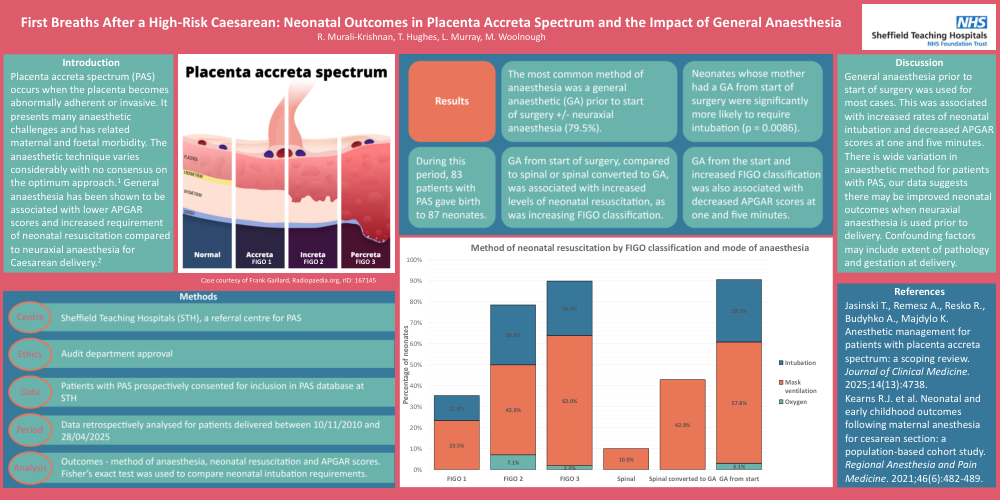
During this period, 83 patients with PAS gave birth to 87 neonates. The most common method of anaesthesia was a general anaesthetic (GA) prior to start of surgery +/- neuraxial anaesthesia (79.5%). GA from start of surgery, compared to spinal or spinal converted to GA, was associated with increased levels of neonatal resuscitation, as was increasing FIGO classification. Neonates whose mother had a GA from start of surgery were significantly more likely to require intubation (p = 0.0086). GA from the start and increased FIGO classification was also associated with decreased APGAR scores at one and five minutes.
Discussion
General anaesthesia prior to start of surgery was used for most cases. This was associated with increased rates of neonatal intubation and decreased APGAR scores at one and five minutes. There is wide variation in anaesthetic method for patients with PAS, our data suggests there may be improved neonatal outcomes when neuraxial anaesthesia is used prior to delivery. Confounding factors may include extent of pathology and gestation at delivery.
References
- Jasinski T., Remesz A., Resko R., Budyhko A., Majdylo K. Anesthetic management for patients with placenta accreta spectrum: a scoping review. Journal of Clinical Medicine. 2025;14(13):4738.
- Kearns R.J. et al. Neonatal and early childhood outcomes following maternal anesthesia for cesarean section: a population-based cohort study. Regional Anesthesia and Pain Medicine. 2021;46(6):482-489.