301 posters, 50 videos, 13 topics, 13 sessions, 734 authors, 193 institutions
ePostersLive by SciGen Technologies S.A. All rights reserved.
ISMICS 2026 Annual Meeting
10 - 13 June, 2026 | Miami, Florida

P50
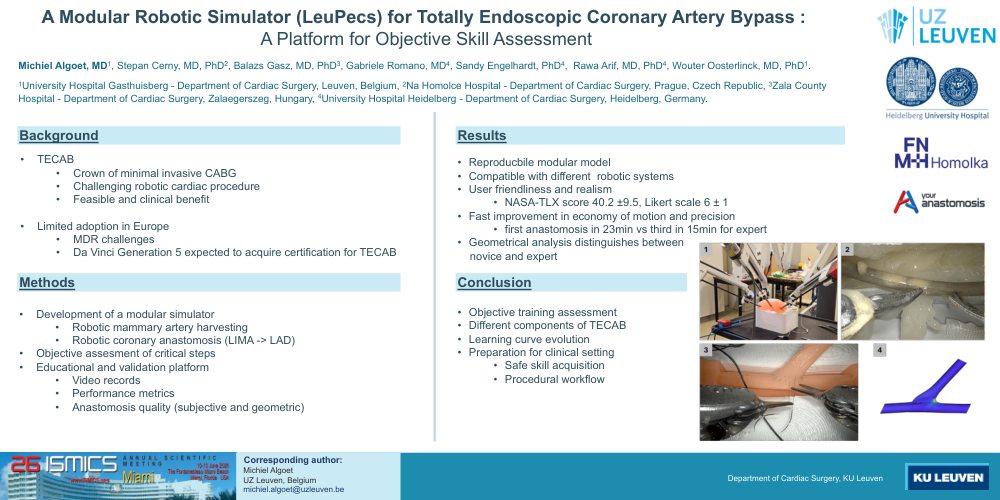
A Modular Robotic Simulator (leupecs) For Totally Endoscopic Coronary Artery Bypass: A Platform For Objective Skill Assessment
Part of Topic
Education, Imaging and Facilitating Technologies
Background
Totally endoscopic coronary artery bypass (TECAB) is the most technically demanding application of robotic cardiac surgery. Despite proven feasibility and clinical benefit, its practice in Europe has been halted due to Medical Device Regulation (MDR) restrictions, as currently approved robotic systems are not certified for intracardiac procedures. Next-generation robotic systems are expected to apply for higher MDR levels, reopening the path toward clinical TECAB.
We developed a novel, modulatable robotic simulator designed to train and objectively assess all critical components of TECAB, providing a robust educational and validation platform in anticipation of the regulatory renewal.
Methods
A dedicated simulation environment was constructed for use on a clinical robotic platform. The system includes two primary modules: (1) mammary artery harvesting on a realistic thoracic model and (2) left anterior descending (LAD) artery anastomosis on an exchangeable coronary module.
Procedures were video-recorded and analyzed to quantify performance metrics and learning curves using standardized technical scores. Anastomotic quality was assessed both subjectively (scoring) and objectively geometrical analysis), allowing reproducible and quantitative evaluation of performance.
Results
The simulator demonstrated excellent reproducibility, modularity, and compatibility with existing robotic systems. User-friendliness and realism was assessed using standardized questionnaires and resulted in excellent scores (NASA-TLX score 40.2 ±9.5, Likert scale 6 ± 1). Users rapidly improved in economy of motion and precision (first anastomosis in 23min vs third in 15min for expert). Geometrical analysis scored each anastomosis, distinguishing between novice and expert performance (score 3.6 vs 5.4 on geometrical analysis respectively).
Conclusion
This modular robotic simulation platform enables objective training and assessment of all key components of totally endoscopic coronary artery bypass surgery. By providing reproducible performance metrics and measurable learning curves, it effectively prepares surgeons for TECAB. The simulator represents a crucial step toward safe skill acquisition and procedural readiness ahead of renewed clinical implementation.