301 posters, 50 videos, 13 topics, 13 sessions, 734 authors, 193 institutions
ePostersLive by SciGen Technologies S.A. All rights reserved.
ISMICS 2026 Annual Meeting
10 - 13 June, 2026 | Miami, Florida

P34
Isolated Minimally Invasive Coronary Bypass Surgery In Obese Patients Early And 5 Year Results
Poster Presenter
Authors
Affiliations
Part of Topic
Coronary Revascularization
Video
Background
Obesity is traditionallyconsidered a risk factorforcoronaryartery bypass surgeryduetoincreasedperioperativeandpostoperativemorbidity. Data regardingthefeasibilityandmid-termoutcomes of isolatedminimallyinvasivecoronaryartery bypass (MiCAB) surgery in obesepatientsremainlimited. Weaimedtoevaluateearlyandfive-yearoutcomes of obesepatientsundergoingisolatedMiCAB in a high-volumecenter.
Methods
Allconsecutiveobesepatients (body massindex ≥30 kg/m²) whounderwentisolatedmulti-vesselminimallyinvasivecoronaryartery bypass surgerybetween 2020 and 2025 wereretrospectivelyanalyzed. Thesurgicalapproachconsisted of MICS-CABG usingarterialand/orvenousgraftingstrategies. Primaryendpointsincludedearlypostoperativeoutcomesandfive-yearmajor adverse cardiacandcerebrovascularevents (MACCE). Secondaryendpointswereoperativemortality, conversiontosternotomy, length of intensivecareunitandhospitalstay, andtheneedforrepeatrevascularization.
Results
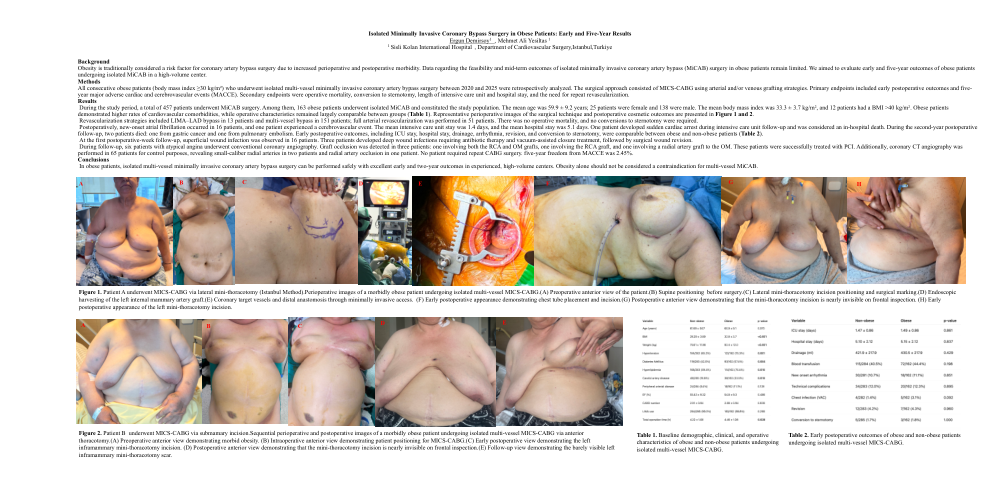
Duringthestudyperiod, a total of 457 patientsunderwentMiCABsurgery. Amongthem, 163 obesepatientsunderwentisolatedMiCABandconstitutedthestudypopulation. Themeanagewas 59.9 ± 9.2 years; 25 patientswerefemaleand 138 weremale. Themean body massindexwas 33.3 ± 3.7 kg/m², and 12 patients had a BMI >40 kg/m². Obesepatientsdemonstratedhigherrates of cardiovascularcomorbidities, whileoperativecharacteristicsremainedlargelycomparablebetweengroups (Table 1). Representativeperioperativeimages of thesurgicaltechniqueandpostoperativecosmeticoutcomesarepresented in Figure 1 and 2.
Revascularizationstrategiesincluded LIMA–LAD bypass in 13 patientsandmulti-vessel bypass in 151 patients; fullarterialrevascularizationwasperformed in 51 patients. Therewasnooperativemortality, andnoconversionstosternotomywererequired.
Postoperatively, new-onsetatrialfibrillationoccurred in 16 patients, andonepatientexperienced a cerebrovascularevent. Themeanintensivecareunitstaywas 1.4 days, andthemeanhospitalstaywas 5.1 days. Onepatientdevelopedsuddencardiacarrestduringintensivecareunitfollow-upandwasconsidered an in-hospitaldeath. Duringthesecond-yearpostoperativefollow-up, two patientsdied: onefromgastriccancerandonefrompulmonaryembolism. Earlypostoperativeoutcomes, including ICU stay, hospitalstay, drainage, arrhythmia, revision, andconversiontosternotomy, werecomparablebetweenobeseandnon-obesepatients (Table 2).
At thefirstpostoperative-weekfollow-up, superficialwoundinfectionwasobserved in 16 patients. Three patientsdevelopeddeepwoundinfectionsrequiringantibiotictherapyandvacuum-assistedclosuretreatment, followedbysurgicalwoundrevision.
Duringfollow-up, sixpatientswithatypicalanginaunderwentconventionalcoronaryangiography. Graft occlusionwasdetected in threepatients: oneinvolvingboththe RCA and OM grafts, oneinvolvingthe RCA graft, andoneinvolving a radialartery graft tothe OM. Thesepatientsweresuccessfullytreatedwith PCI. Additionally, coronary CT angiographywasperformed in 65 patientsforcontrolpurposes, revealingsmall-caliberradialarteries in two patientsandradialarteryocclusion in onepatient. No patientrequiredrepeat CABG surgery. five-yearfreedomfrom MACCE was 2.45%.
Conclusions
Inobesepatients, isolatedmulti-vesselminimallyinvasivecoronaryartery bypass surgery can be performedsafelywithexcellentearlyand two-yearoutcomes in experienced, high-volumecenters. Obesityaloneshould not be considered a contraindicationformulti-vesselMiCAB.